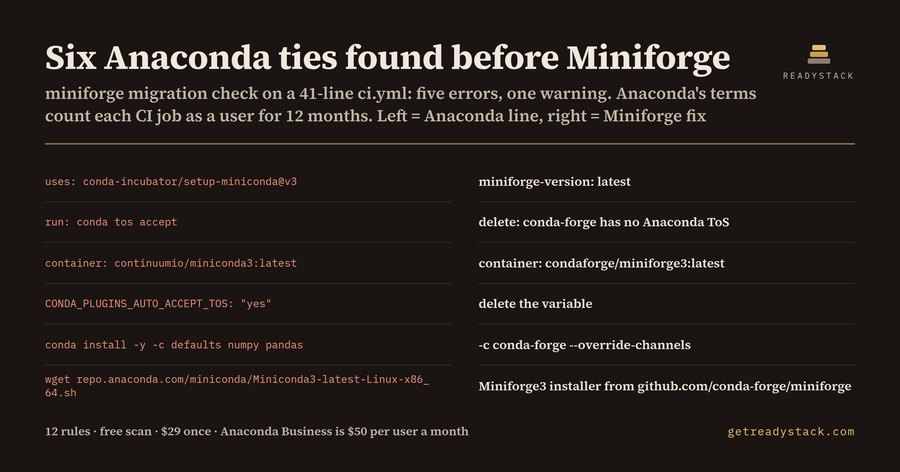
Miniforge Migration Check: Anaconda in Docker, CIFinds continuumio/miniconda3 images, repo.anaconda.com installers, setup-miniconda without miniforge-version and conda tos accept in Dockerfiles and CI YAML, with the Miniforge line for each. Installation Launch VS Code Quick Open ( Ctrl+P), paste the following command, and press enter.Copied to clipboard |

Miniforge Migration Check: Anaconda in Docker, CI
Finds every line in a Dockerfile or CI YAML that still pulls Miniconda, Anaconda images or Anaconda's terms, and prints the Miniforge line that replaces it. On the sample 41-line GitHub Actions Hub page: https://getreadystack.com/tools/miniforge-migration-check What it finds (12 rules)
Comment lines ( Why these lines matterAnaconda's Terms of Service (anaconda.com/legal/terms/terms-of-service, read 2026-10-10) say a for-profit organization with more than 200 total employees or contractors, including all affiliates, must pay for a Business Plan to use the Platform. The same terms define a "User" as human or non-human, and name CI/CD jobs, service accounts, serverless processes and AI agents as non-human users. A User counts as active for 12 months after it accesses packages on repo.anaconda.com. So a single Yardstick: anaconda.com/pricing lists the Business plan at $50 per user per month (read 2026-10-10). How to use it
The free web page runs the same engine: paste a file and read the same findings. Free and paidFree, no key: check the open file. You get every finding with its file line and its Miniforge replacement. With a licence key: scan every Dockerfile and CI file in the workspace in one pass and export a dated Markdown migration plan that maps each Anaconda pull to its Miniforge line. Get the workspace migration plan LimitsIt reads text. It cannot tell how many employees your company has, and it cannot tell whether you already hold an Anaconda licence. It does not read |