Manuscript Disclosure LintChecks a manuscript before submission for the statements journals and funders now require: AI-use disclosure, data availability, funding and grant IDs, CRediT, competing interests, ethics, ORCID. Installation Launch VS Code Quick Open ( Ctrl+P), paste the following command, and press enter.Copied to clipboard |

Manuscript Disclosure Lint (LaTeX & Markdown)
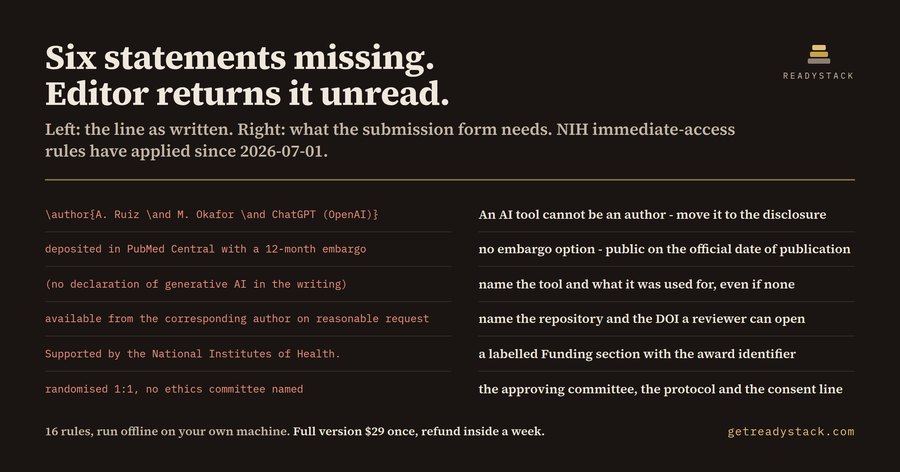
A manuscript is rejected before peer review more often for a missing paragraph than for a weak result. Editorial office staff work through a submission form that asks, one field at a time, for the statements that are supposed to already be in the file: data availability, funding with the award ID, competing interests, author contributions, ethics approval, consent, trial registration, ORCID, an open-access licence, and — since the ICMJE Recommendations were updated for generative AI — a declaration of whether an AI tool was used in the writing and for what. If one of them is absent the paper comes back unread, and the clock on the next issue starts again. This extension reads the What it checks16 rules, every one of them pointed at a line in your file:
That last rule is the one a chatbot gets wrong. Models trained before mid-2026 still describe the old 12-month window, and text written from that advice contradicts the policy the paper will actually be held to. Using it
A reference pointA manuscript formatting and compliance service quotes roughly $150-$400 per paper for the same read-through; a journal's own editorial office returns the file instead. The rule set here is the checklist, not the service. Free online versionThe same engine, byte for byte, runs in the browser at https://getreadystack.com/tools/manuscript-disclosure-lint — paste a manuscript, get the same findings, nothing uploaded. NotesResults are advisory. Journals differ, and a target journal's author guidelines always win over a general rule set. The 16 rules follow the ICMJE Recommendations, the CRediT standard (ANSI/NISO Z39.104-2022), and the open-access conditions attached by NIH, UKRI, Plan S and Horizon Europe. Licence: see |