Livewire Client Surface Audit
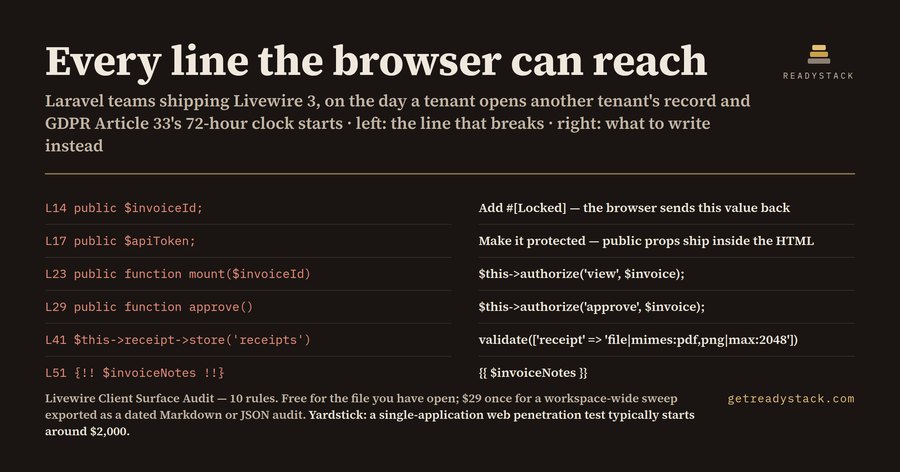
AI assistants write Livewire components the way they write plain PHP classes: public for everything, no #[Locked], no authorize(). Livewire does not treat those two keywords the way PHP does. Every public property on a Livewire component is round-tripped through the browser, and every public method on it can be called from the browser as $wire.methodName(). So public function deleteInvoice() is an endpoint, and public $amountDue is a form field, whether or not you put them in the template.
This extension reads the file you have open and marks each line the browser can reach, with the fix on that line.
What it checks — 10 rules
| Rule |
What it catches |
client_callable_method |
A public action method (delete…, approve…, save…, export…, 30 verbs) in a class with no authorize(), Gate::, can() or abort_unless() anywhere |
unlocked_state_property |
A public property named for identity, money or state (…Id, price, amount, status, role, quota…) with no #[Locked] above it |
secret_in_public_property |
A public property holding a token, key, password, signature or OTP — those are serialized into the page HTML |
mount_without_authorization |
mount() looks a record up, but the class never authorizes it |
mass_assign_from_state |
->update($this->…), ->fill($this->…), ::create($this->…) — browser-held state written straight to a row |
unvalidated_upload |
WithFileUploads plus ->store() with no validate() or #[Validate] in the class |
url_bound_property |
#[Url] on an identity or state property, so the address bar sets it |
unescaped_blade_echo |
{!! … !!} with no sanitizer on the line |
dynamic_template_include |
@include($var) / @component($var) — the template name comes from a variable |
debug_output_in_component |
dd(), dump(), var_dump(), ray(), print_r() left in a rendered component |
Run on the sample component shipped with this repo (_fixtures/dirty.php, 58 lines): 14 findings, 11 of them high. The fixed twin (_fixtures/clean.php, 65 lines) returns 0.
The clock
The moment an unguarded public method hands one tenant another tenant's record, that is a personal-data breach, and GDPR Article 33 gives the controller 72 hours from awareness to notify the supervisory authority. The scan you did not run is the one that starts that 72-hour clock without telling you.
Free and full
Free, with no key: open any .php or .blade.php file, run Livewire Client Surface Audit: Check this file, and you get every finding in that file — all 10 rules, the line, and the fix. Nothing is hidden, watermarked, timed out or counted down. One file is a finished job.
The full version scans every PHP and Blade file in the workspace in one run and writes a dated Markdown or JSON audit — the artefact you hand to a client, attach to a pull request, or fail a CI build on. $29 once, one licence key per person or team seat, 7-day full refund.
Why not a general PHP linter
PHPStan, Psalm and Larastan check types and call graphs. They model public as PHP defines it: reachable from other PHP. Livewire redefines public as reachable from the visitor's browser, and that redefinition is what this extension checks. A general linter reports zero on _fixtures/dirty.php.
Yardstick: a single-application web penetration test typically starts around $2,000.
Free web version and the rest of the toolkit: https://getreadystack.com/tools/livewire-client-surface-audit
Commands
- Livewire Client Surface Audit: Check this file — free, every rule, every line.
- Livewire Client Surface Audit: Sweep workspace and write report — full version.
- Livewire Client Surface Audit: Enter licence key
MIT for the free tier. See LICENSE.

