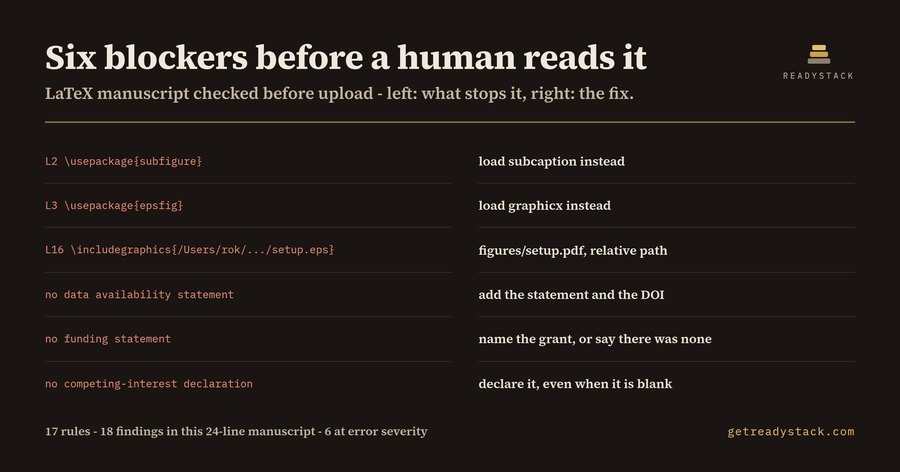
LaTeX Submission Lint: Desk-Reject CheckLints your .tex manuscript for what desk-rejects papers: missing data availability, funding, competing-interest and generative-AI statements, obsolete packages, absolute figure paths. Installation Launch VS Code Quick Open ( Ctrl+P), paste the following command, and press enter.Copied to clipboard |

LaTeX Submission Lint
A manuscript that compiles is not a manuscript that is accepted for review. Before an editor
ever opens your paper, an editorial assistant at Elsevier, Springer Nature, IEEE or PLOS runs
a checklist against the file you uploaded: is there a data availability statement, a funding
statement, a competing-interest declaration, CRediT roles, a line about generative-AI use, an
ORCID for the corresponding author, keywords, line numbers for the reviewers. If one of those
is absent, the submission is returned to you with a form letter and the clock restarts. None
of that is a compilation error, so This extension reads a Statements the editorial office looks for and cannot find — data availability, funding, competing interest, CRediT author contributions, generative-AI use, ORCID, keywords, continuous line numbering. Things in the source that break the publisher's build or the review — What it reportsRun LaTeX Submission Lint: Check this file on an open Free and licensedFree: the file you have open, all seventeen rules, the full line-numbered report. Nothing is watermarked, time-limited or locked after N runs. Licensed ($29 once): the same seventeen rules across every YardstickManuscript editing services price per word, from about $0.05, so a 6,000-word paper runs to roughly $300 and a revision cycle takes days. Web versionThe same engine, the same seventeen rules, in one page with nothing to install: https://getreadystack.com/tools/latex-submission-lint ScopeIt reads LaTeX source as text. It does not compile your document, does not contact a server, and does not replace your target journal's own author guidelines — journals differ, and the guidelines page for your journal is the authority. The rules here are the requirements that are common to the large publishers' submission checklists. |