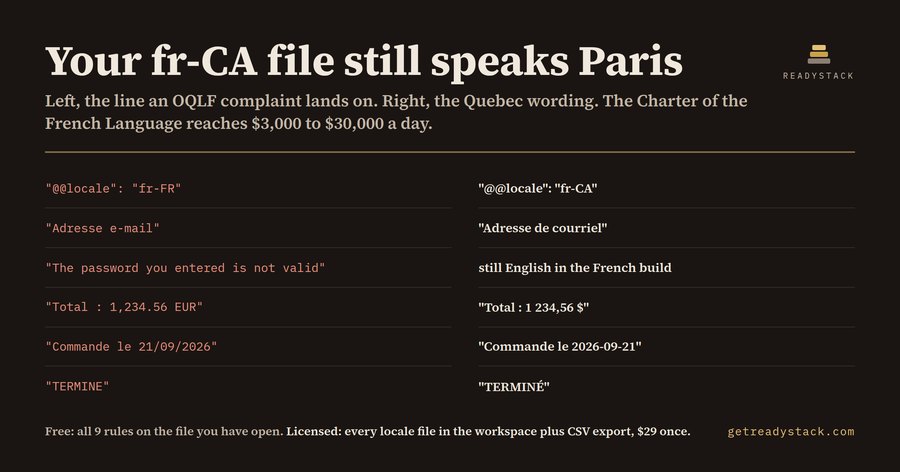
i18n fr-CA Lint — Quebec Bill 96Lints a French-Canadian locale file (fr-CA.json, .arb) for Quebec Bill 96 / OQLF problems: France-French terms, untranslated English, euro currency, slashed dates, fr-FR locale tags. Installation Launch VS Code Quick Open ( Ctrl+P), paste the following command, and press enter.Copied to clipboard |

i18n fr-CA Lint — Quebec Bill 96
Your This extension lints a French-Canadian locale resource — It is a linter, not a translator. It reads the file you already have and tells you which line an inspector or a complaint would land on, and what the Quebec wording is. The 9 rules
What it reportsThe sample file shipped in A random JSON file is left alone: the engine only lints a resource that declares a French locale tag or that already carries French accented text. Why not a chatbotAsk a general assistant for a French UI string and it answers in France French — What it costs to have a person do itA Canadian language-service provider bills fr-CA revision at $0.10 to $0.15 a word, so a 12,000-word UI string set is $1,200 to $1,800 per pass — and you pay it again on the next release. Free and licensedEvery one of the 9 rules runs on the file you have open, with no licence key, in the editor and on the free web page. A licence key adds a different job: one sweep across every locale file in the workspace, a Markdown report, a CSV or JSON export you keep, and a CI exit code. $29 once, one licence key per person or CI seat, 7-day full refund. Licence The web versionThe same engine, byte for byte, runs in the browser at https://getreadystack.com/tools/i18n-fr-ca-bill96-lint — paste a locale file, nothing is uploaded. The exposure this is pointed atUnder the Charter of the French Language a company faces $3,000 to $30,000 a day for a French-language violation, and the francization certificate threshold dropped to firms with 25 employees or more on June 1, 2025. Commands
MIT for the extension code. The rule data cites public OQLF terminology and the Charter of the French Language; it is not legal advice. |