Immobilienanzeige GEG 87 LintLints German property-ad HTML for the energy-certificate fields GEG Section 87 demands, and flags an efficiency class that contradicts the kWh value. Installation Launch VS Code Quick Open ( Ctrl+P), paste the following command, and press enter.Copied to clipboard |

Immobilienanzeige GEG 87 Lint
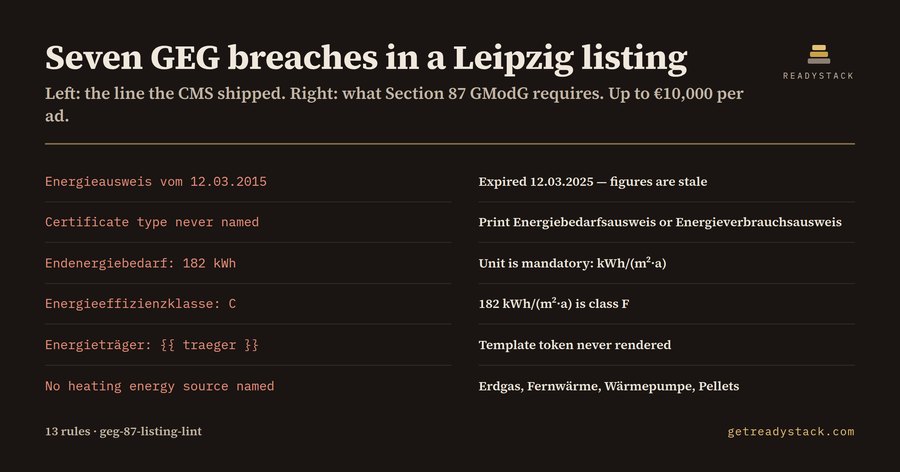
Lints German property-ad HTML for the certificate fields that § 87 GModG (the Gebäudemodernisierungsgesetz, still cited by most portals as GEG) makes mandatory in every commercial listing, and — the part a human proof-reader misses — checks that the efficiency class you print actually matches the kWh figure you print next to it. Hub: https://getreadystack.com/tools/geg-87-listing-lint What § 87 actually demandsWhen an Energieausweis exists at the moment the ad is placed, the ad must contain:
For a Nichtwohngebäude, § 87 (2) requires the figure split into Wärme and Strom separately. A missing or wrong mandatory field is an Ordnungswidrigkeit under § 108 (1) no. 16 GModG and can be fined up to 10,000 euro per ad. The check no proof-reader runsAnlage 10 fixes the class bands: A+ under 30, A under 50, B under 75, C under 100, D under 130,
E under 160, F under 200, G under 250, H from 250 kWh/(m²·a) upward. When a CMS renders the class
from one database column and the kWh value from another, the two drift apart and the ad states
two contradictory facts about the same building. The bundled dirty fixture prints
The linter also flags a certificate whose issue date is more than ten years old (§ 79 (4)),
a kWh figure shipped without the unit Rules13 rules, all listed in Running it
Diagnostics are advisory. A Bedarfsausweis drawn up by an Energieberater with an on-site visit runs about 300 to 500 euro in 2026; this linter does not replace it, it checks that what the certificate says arrives intact in the ad. Free and fullFree: lint the property ad you have open and see every § 87 field that is missing, expired or contradicted by the kWh value. Full version: scan every listing template in the workspace or CI feed at once and write a dated audit record you keep as proof of what the ad said on the day it ran — https://buy.polar.sh/polar_cl_sOwHAKyyi7buuu6frpXCErjfL8UmizPvqNmPz0ptuox Fixtures
|