FedRAMP OSCAL SSP Lint
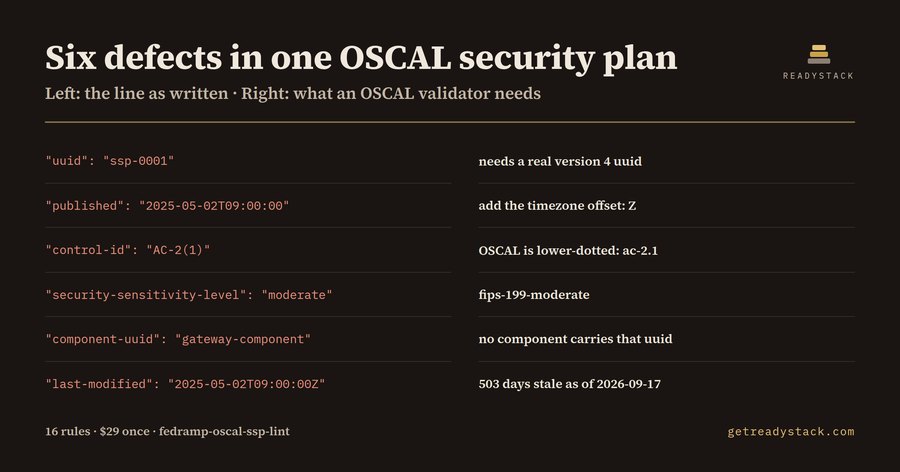
An OSCAL system security plan is machine-read before a human ever opens it. If the JSON breaks the
OSCAL datatypes or drops a required assembly, the package comes back to you instead of going
forward — and the note you get back is a schema path, not a sentence.
This extension reads a system-security-plan JSON file in your editor and tells you, line by line,
what a validator will object to and what to write instead. It runs entirely on your machine: the
document never leaves the workspace.
What it checks — 16 rules
Shape of the document
- the root key is
system-security-plan
- the five required assemblies are present:
metadata, import-profile, system-characteristics,
system-implementation, control-implementation
metadata carries title, last-modified, version and oscal-version- the file parses as JSON at all
Datatypes an SSP generator gets wrong
last-modified and published must be dateTime with a timezone offset — 2026-09-17T09:00:00
is rejected, 2026-09-17T09:00:00-04:00 is accepted- every
uuid must be an RFC 4122 version 4 or 5 UUID; hand-written ids such as ssp-0001 or
info-type-1 are not UUIDs, and a sequential id with a 1 in the version nibble is not one either
- every
component-uuid and every entry in party-uuids must resolve to a uuid defined somewhere
in the same document — dangling references are the quietest defect in a package
control-id is OSCAL lower-dotted: ac-2.1, never AC-2(1) copied out of the control catalogue
FIPS 199 and the control narratives
security-sensitivity-level is one of fips-199-low / fips-199-moderate / fips-199-highsecurity-impact-level carries all three objectives — confidentiality, integrity, availability —
each from the same vocabulary- each
implemented-requirement carries an implementation-status prop with one of the five
permitted values
- a control marked
planned carries a planned-completion-date, and that date has not already passed
TBD, TODO, Lorem ipsum, XXX and <insert do not survive in a description or remarks
a reviewer reads
The clock
metadata.last-modified more than 365 days before the date you are checking as. Continuous
monitoring expects the plan to be re-stamped every year, and the file tells you how many days late
it already is.
Measured on the bundled fixtures
_fixtures/clean.json is a clean FedRAMP Moderate SSP skeleton: 0 findings.
_fixtures/dirty.json is the same plan after a generator touched it: 19 findings across 14 of the
16 checks — 12 high, 6 medium, 1 low. Among them: last-modified 503 days stale as of
2026-09-17, and cp-9 still marked planned with a completion date that passed 79 days earlier.
Change the "as of" date and those two numbers change with it.
Free and paid
Free, no key: one OSCAL system security plan JSON, all 16 checks, every defect with its JSON path
and the fix. That job finishes — you can ship the file.
The licensed part is a different axis, scope and hand-off: it sweeps every OSCAL file in the
workspace (SSP, component definitions, profiles), resolves uuid references across files instead of
within one, and writes a dated report you can hand to your 3PAO.
Full version: https://buy.polar.sh/polar_cl_SxOM1H5OfW5QyRWyTfWSQebO53c3qNWtk5YfG04i69q — $29 once, one licence key per person or CI seat,
7-day full refund. Hand-review by a FedRAMP advisory consultant runs $150 to $300 an hour.
Also in the browser
The same engine, same rule file, runs as a single page with nothing to install:
https://getreadystack.com/tools/fedramp-oscal-ssp-lint
Commands
- FedRAMP OSCAL SSP: Check this file — lints the active editor
- FedRAMP OSCAL SSP: Check the workspace — the licensed sweep
Not affiliated with FedRAMP, GSA or NIST. OSCAL is a NIST project; this tool reads the format, it
does not speak for the programme.