EU Health Claim Lint — Food & Supplement PagesFlags unauthorised nutrition and health claims in food and supplement product pages (HTML/Markdown) against EU Reg 1924/2006, FIC 1169/2011 and the 14 June 2026 juice-honey-jam rules. Installation Launch VS Code Quick Open ( Ctrl+P), paste the following command, and press enter.Copied to clipboard |

EU Health Claim Lint — Food & Supplement Pages
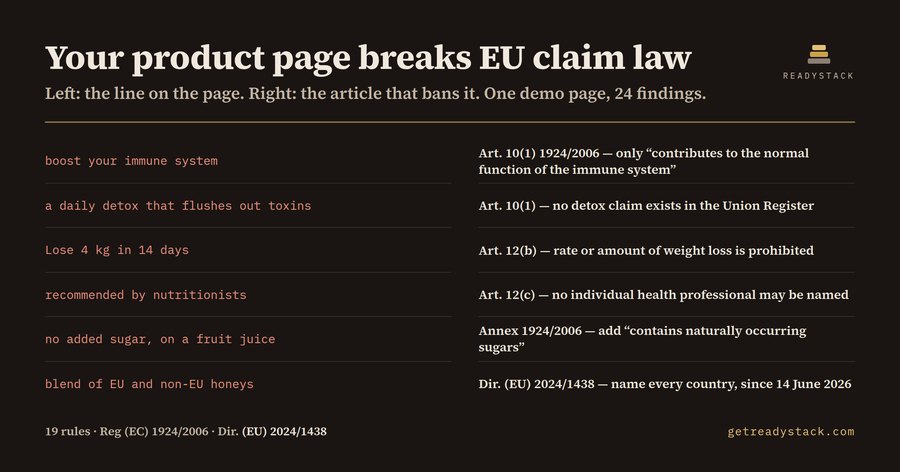
Scans the product page you have open — HTML, Markdown or MDX — for nutrition and health claims that EU food law does not allow, and names the article that stops each one. An AI writing assistant is a bad place to ask about this. It has read a great deal of food marketing and very little of the Union Register, so it will happily write boosts immunity, detox, clinically proven and blend of EU and non-EU honeys into a product page. Every one of those is a finding here. What it checks19 rules, drawn from four instruments:
The Annex thresholds are printed in the message, so you can fix the copy without opening the Official Journal: low fat 3 g/100 g · fat-free 0.5 g/100 g · low sugars 5 g/100 g · sugars-free 0.5 g/100 g · source of protein 12 % of energy · high protein 20 % of energy · source of fibre 3 g/100 g · high fibre 6 g/100 g · low sodium 0.12 g/100 g · source of a vitamin 15 % NRV · high in a vitamin 30 % NRV · light and reduced need a 30 % difference plus a statement of what was reduced. How it behavesOpen a product page and run EU Health Claim Lint: Check this file. Findings appear in the Problems panel on the line that carries the claim, each with the article and the wording that would be lawful instead. Rules tied to a date carry a The measureRunning the two fixtures shipped with this extension: Free and paidChecking the file you have open is the whole job and it is free: every rule, every finding, every article, no key, no limit. The paid layer moves on a different axis — scope and ownership. EU Health Claim Lint: Export compliance dossier walks every product page in the workspace and writes one dated Markdown and CSV dossier, per SKU, with the article citations, that you keep and hand to a lawyer, a client or an authority. $29 once. Hubhttps://getreadystack.com/tools/eu-health-claim-lint Limits worth knowingThis is a linter, not legal advice. It reads the text on the page; it cannot see your specification sheet, so a nutrition claim it flags for a missing figure may be perfectly true — it is telling you the figure is not on the page where a reader or an inspector would look for it. National rules differ, particularly for botanicals and for the word probiotic, and the tool says so rather than deciding for you. |