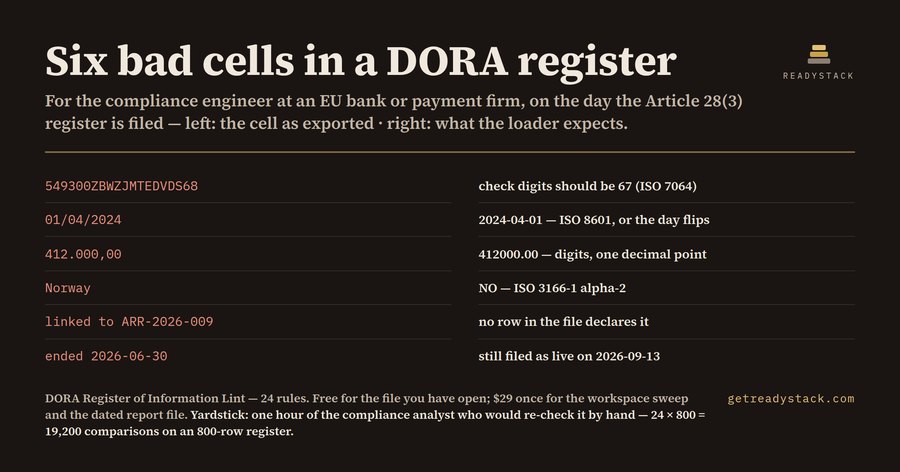
DORA Register of Information LintLints the DORA Register of Information CSV before it reaches the supervisor: LEI check digits, ISO 8601 dates, country and currency codes, duplicate or unresolved references, expired rows. Installation Launch VS Code Quick Open ( Ctrl+P), paste the following command, and press enter.Copied to clipboard |

DORA Register of Information Lint
Open the register CSV your team exports for DORA (Regulation (EU) 2022/2554, Article 28(3)) and press DORA Register Lint: Check this file. Every row is read where it sits — nothing is uploaded, nothing is sent to a model, nothing leaves the machine. The register lists who holds your data and which functions would stop if they did; it is not a file you can paste into a chat window. AI-written export code is now the normal way these files get produced, and the questions this extension answers are exactly the ones a generator cannot answer about itself: are these twenty characters a real LEI, does this link resolve to a row that exists, is this contract still live on the date you are filing. What it checks — 24 checks, all computed from the fileIdentifiers
References between rows
Dates
Codes and amounts
File shape
The column names are matched loosely ( Free and paidFree, no key, no account: check the register CSV open in your editor — every row, all 24 checks, with findings in the Problems panel and a written summary in the output channel. That is a finished job. Paid ($29 once, one licence key per person or CI seat, 7-day full refund): sweep every register CSV in
the workspace and write one dated report file — Numbers from the sampleThe 11-row sample register shipped with this repository ( Where else it runsThe same engine file, byte for byte, runs in the browser at https://getreadystack.com/tools/dora-register-lint — paste a register, get the same 24 checks, still without uploading anything. Findings are format, arithmetic and consistency facts about your file. They are not legal advice and they do not tell you whether your register is complete. |