CRAN Policy Submission Lint
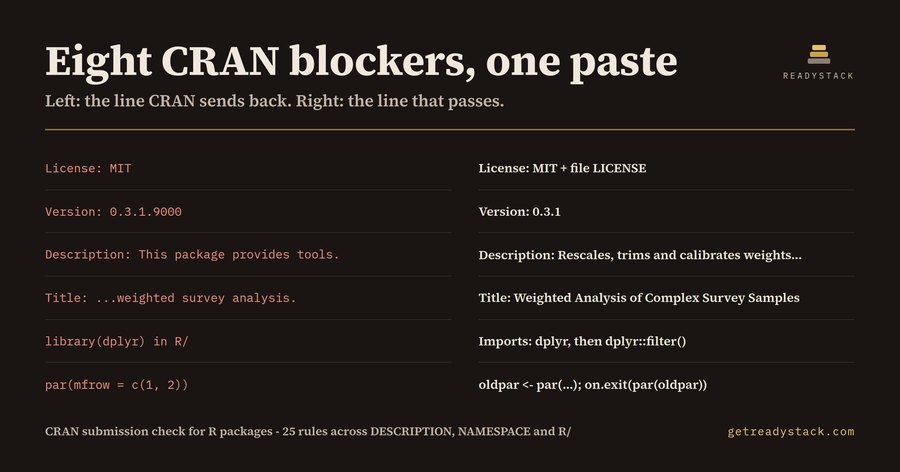
Reads an R package the way a CRAN volunteer reads it: not "does it compute", but "does it obey the
CRAN Repository Policy". R CMD check --as-cran already tells you about undocumented arguments and
missing imports. It says nothing about a Description: field that opens with the package name, a
License: MIT string with no + file LICENSE, a library(dplyr) call sitting in R/, or a
function that calls setwd() on the user's session. Those are prose rules, applied by a person, and
they are where first submissions get sent back.
This extension encodes 25 of those rules and reports them with a line number and the fix.
What it checks
DESCRIPTION (10 rules) — Title in title case with no trailing period; Description that does not
open with "This package" or the package name and is a real sentence; a License: string CRAN
actually accepts (bare MIT, BSD, Apache-2.0 and other SPDX ids are refused); exactly one
person() carrying role = "cre"; no four-component or .9000 development version; no
example.com placeholder maintainer address; a Date: field that is neither in the future nor over
a month old; packages listed in Imports: rather than Depends:.
NAMESPACE (1 rule) — exportPattern(), which exports your internals along with your API.
R sources (14 rules) — library()/require() in package code; install.packages();
setwd(); options(), par() or Sys.setenv() changed with no on.exit() to put them back;
writes to ~/, /tmp/ or Sys.getenv("HOME") instead of tempdir(); T and F for TRUE and
FALSE; print()/cat() where message() belongs; \dontrun{} in examples; non-ASCII source
characters; <<- and assign(..., envir = .GlobalEnv); installed.packages(); set.seed() inside
a function; ::: into another package; source() at package level.
Free and paid
Free, forever, uncapped: check the file you have open — an R/*.R file, DESCRIPTION or
NAMESPACE — against all 25 rules, in the editor or in the browser tool. That finishes one job:
this file is clean.
The licence covers a different axis — scope and a file you keep: sweep every file in the
package in one command and write a dated cran-policy-lint-report.md you can commit next to the
tarball or paste into your submission comments. $29 once, one key per person or CI seat, 7-day full
refund — get a licence key.
Yardstick: a freelance R developer in North America bills $50–$100 an hour (Upwork, 2026); one
rejected submission is a round trip of rework plus another wait in the queue.
Why this exists now
Package sources drafted with an AI assistant arrive with library() calls, T/F and setwd() in
them, because that is what the R the model learned from looks like — it learned from scripts, and a
script is allowed to do all three. A package is not.
Commands
CRAN Policy Lint: Check this fileCRAN Policy Lint: Sweep workspace and write report (licence)CRAN Policy Lint: Enter licence key
Multi-file paste: separate files with a #### FILE: R/foo.R #### line and the engine scopes each
block on its own. The browser tool at
https://getreadystack.com/tools/cran-policy-submission-lint runs the identical engine, byte for
byte, with nothing uploaded.
Findings are advisory. CRAN's own policy page is the authority.

