CBPR+ Structured Address LintLint ISO 20022 pacs.008, pacs.009 and pain.001 XML for postal addresses CBPR+ will not accept: unstructured blocks, missing Ctry or TwnNm, and values duplicated between a structured field and AdrLine. Installation Launch VS Code Quick Open ( Ctrl+P), paste the following command, and press enter.Copied to clipboard |

CBPR+ Structured Address Lint
Your AI assistant will happily generate a Point it at Where the dates actually stand
So the cliff moved, but the hybrid rules have been live since November 2025 and a malformed hybrid is rejected rather than repaired today. That gap is exactly where a model trained before August 2026 gives you a confident, wrong answer in either direction. The 9 checks
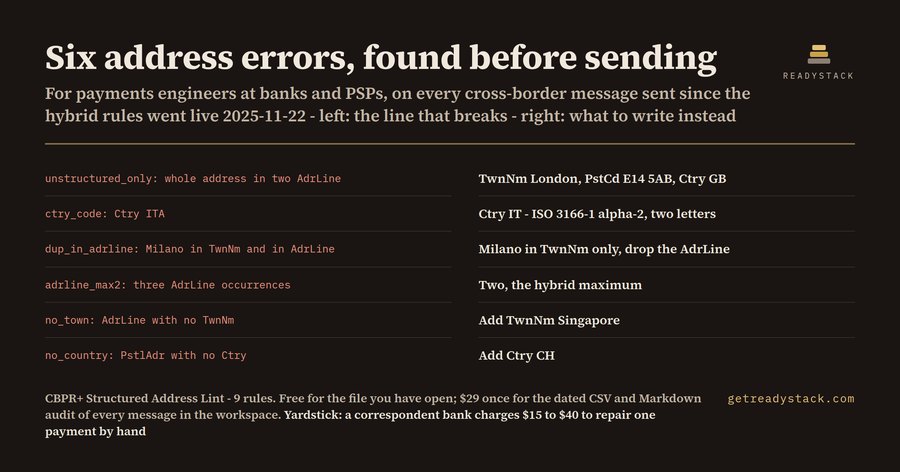
6 of the 9 rules are errors - the shapes that get a payment repaired by hand or returned. The other 3 are warnings. What it found in the sample files shipped with this repo
Free, and what asks for a keyFree, with no key: open any ISO 20022 XML and get every failing address block named, with the line number and the rule. That is the whole job for one file, and it finishes. The paid layer sits on a different axis — ownership: a dated CBPR+ address audit file (CSV and Markdown) covering every message in the workspace, with the rule citation per finding, written to disk so you can hand it to your correspondent bank, your migration programme or your auditor. $29 once, one licence key per person or CI seat. Yardstick: a correspondent bank charges $15 to $40 to repair one payment by hand, and an average rejected or repaired payment is reported at around $12. This reads the message before you send it.
Commands
Running it in a browserThe same engine file runs the free web page, unmodified. Nothing is uploaded; the check happens in the page. Not a substitute forSchema validation and your bank's own CBPR+ readiness testing. This reads address shape, not the whole message. LicenceSee |