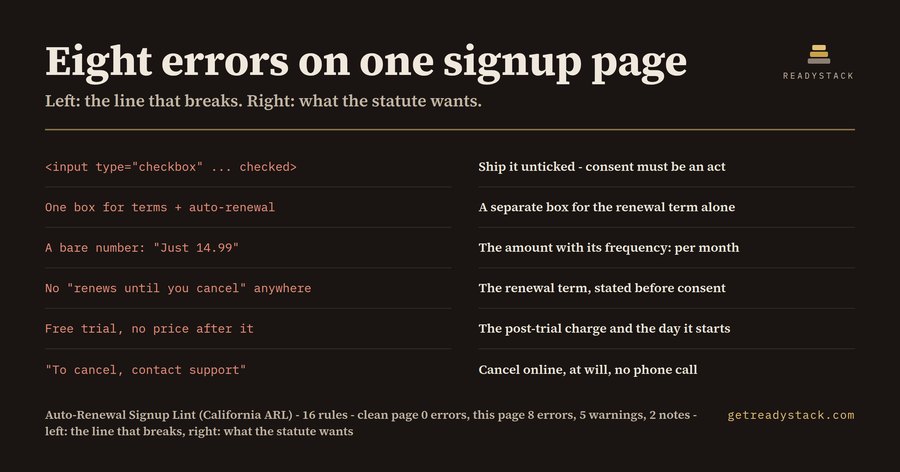
Auto-Renewal Signup Lint (California ARL)Lints subscription signup and pricing pages against California's Automatic Renewal Law as amended by AB 2863, in force 2026-01-01. Installation Launch VS Code Quick Open ( Ctrl+P), paste the following command, and press enter.Copied to clipboard |

Auto-Renewal Signup Lint (California ARL)
Your subscription signup page is a legal document that happens to be written in HTML. Since 1 January 2026, California's Automatic Renewal Law — Cal. Bus. & Prof. Code 17600–17606, as amended by AB 2863 — sets out what that page has to say, where it has to say it, and how the customer has to agree to it. This extension reads the page the way the statute does: 16 checks over the markup you actually ship. Point it at What it looks for
Two commands
The free check is the whole job for one page. The sweep is a different job — every page, and a file you own afterwards. Reading a findingRun it on the two fixtures shipped with the source. The clean page returns one informational line (the statute is in force, here is the date). The deliberately broken one returns 15 findings — 8 errors, 5 warnings, 2 notes — on a 29-line page: a pre-ticked bundled consent box, a trial with no post-trial price, "to cancel, contact support", an annual term with no reminder, and a comment claiming the page is compliant with the vacated federal rule. What this is notIt is a linter, not a lawyer. It reads markup and reports the shape of the disclosure; it cannot know your billing timeline, which state your customer is in, or what your terms page says. For scale: an hour of US outside counsel on a signup flow is commonly quoted at $300–$500, and that hour is still worth buying — this runs before you spend it, so the hour is spent on the hard questions rather than on a pre-ticked box. Remedy that makes it worth the ten minutes: goods or services billed under a non-conforming automatic renewal offer are an unconditional gift to the customer under Cal. Bus. & Prof. Code 17603. Same engine in the browserThe free web version at https://getreadystack.com/tools/autorenew-signup-lint runs Rules live in |