AI Output Disclosure Lint — SB 942
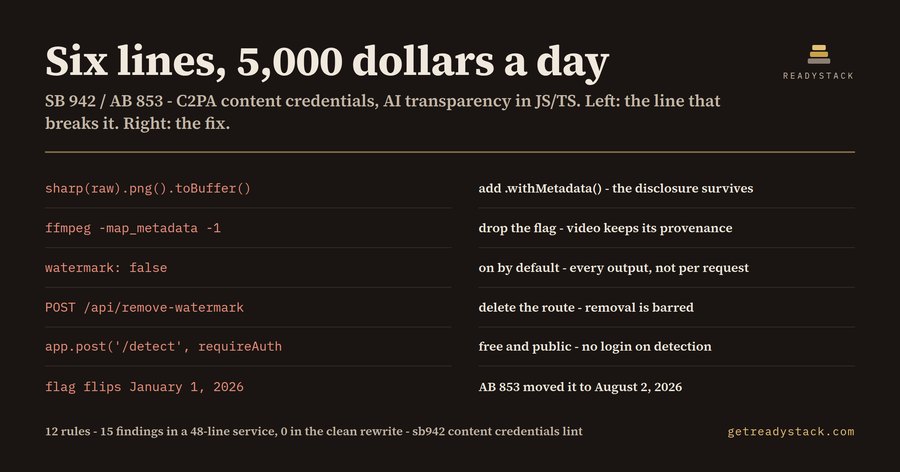
Your generation code says the compliance flag flips on January 1, 2026. That date is dead: AB 853 moved California SB 942 to August 2, 2026, and it has been operative ever since. Model-written service code repeats the repealed date because most of the text it learned from was written before the amendment.
This extension reads a JavaScript or TypeScript file and reports where the code drops the disclosures the California AI Transparency Act asks a covered provider for. 12 rules, each anchored to a duty in the statute:
| What it looks at |
Why the statute cares |
sharp() pipelines with no withMetadata(), withoutMetadata(), exiftool -all=, -map_metadata -1 |
the latent disclosure must survive the export, not be stripped by the resize or the transcode |
watermark: false, contentCredentials: false, signManifest: false |
the latent disclosure belongs in every output of a covered system, not in the ones a caller opts into |
generation calls with no c2pa / Content Credentials signer in the file |
nothing marks the output as machine made |
| no user-visible "AI-generated" string next to the returned asset |
the manifest disclosure a user may ask for |
/remove-watermark, stripCredentials, disableDisclosure |
the disclosure must be permanent or extraordinarily difficult to remove, to the extent technically feasible |
generation routes with no /detect route |
a covered provider publishes a free, publicly accessible AI detection tool for its own output |
requireAuth / checkSubscription on the detection route |
that tool has to be free and public, not gated |
prisma.*.create, analytics.track inside the detection path |
the tool may not collect or retain personal information from the people who use it |
issueLicense with no revoke anywhere |
96 hours from discovering a licensee stripped the disclosure to revoking that licence |
The statute reaches a covered provider — a publicly accessible generative AI system with over 1,000,000 monthly users or visitors in California — and the penalty is $5,000 per violation, per day, with each day counted separately.
What the two shipped fixtures measure
_fixtures/dirty.ts is a 48-line Express image service. The lint returns 15 findings on it, firing 11 of the 12 rules. _fixtures/clean.ts is the same service written with withMetadata(), a c2pa signer, an AI-generated label, an ungated /detect route and a revokeLicense function: 0 findings. Same engine, same rules file, no configuration between the two.
Free and full
Free, no key: lint the file in front of you — every rule, line numbers, and the clause behind each hit. That is a finished job for one file.
Full ($29 once, one licence key per person or CI seat, 7-day refund): sweep the whole workspace and write a dated evidence report, Markdown and CSV, that you can hand to counsel or fail a build on. A privacy attorney reading the same repository by hand bills $400–$600 an hour.
Key: https://buy.polar.sh/polar_cl_vKksAjW9Bi3k8yFOtHV0BWFyP0dGt5w8qsiIU2Q8Bxq
Browser version of the same engine, no install: https://getreadystack.com/tools/ai-disclosure-lint-sb942
Command
SB 942: Lint Open File — Command Palette. Runs on .ts, .js, .tsx, .jsx.
Rules live in rules.json as plain regex objects; the engine file is the same one the web page runs.

