LiberRPA Project Manager
If the images are not displayed, view this README on GitHub.
LiberRPA Project Manager is part of LiberRPA. It helps you create LiberRPA Projects, publish reusable Components, manage Component dependencies, and package Flow Projects for LiberRPA Executor.
Note:
Screenshots and animations in this document are provided for reference. As LiberRPA evolves, the current interface may differ slightly in appearance or wording, but these minor differences do not affect the documented workflow or functionality.
Extension logs:
This extension writes diagnostic messages to the liberrpa-project-manager channel in the VS Code Output panel.
Open View > Output and select the channel, or run Output: Show Output Channels from the Command Palette.
For troubleshooting, run Developer: Set Log Level..., select liberrpa-project-manager, and choose Debug or Trace. Info is normally sufficient for routine use.
This setting does not change the Python runtime log level used by a Flow Project or an individual Block.
Contents
Usage
Create a Project
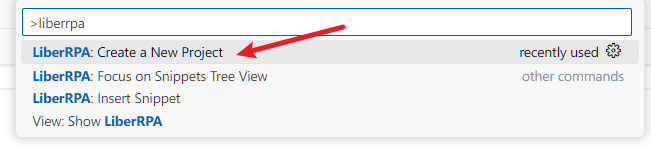
- Press
Ctrl+Shift+P and run LiberRPA: Create a New Project.
- Select the parent folder in which the new Project folder will be created.
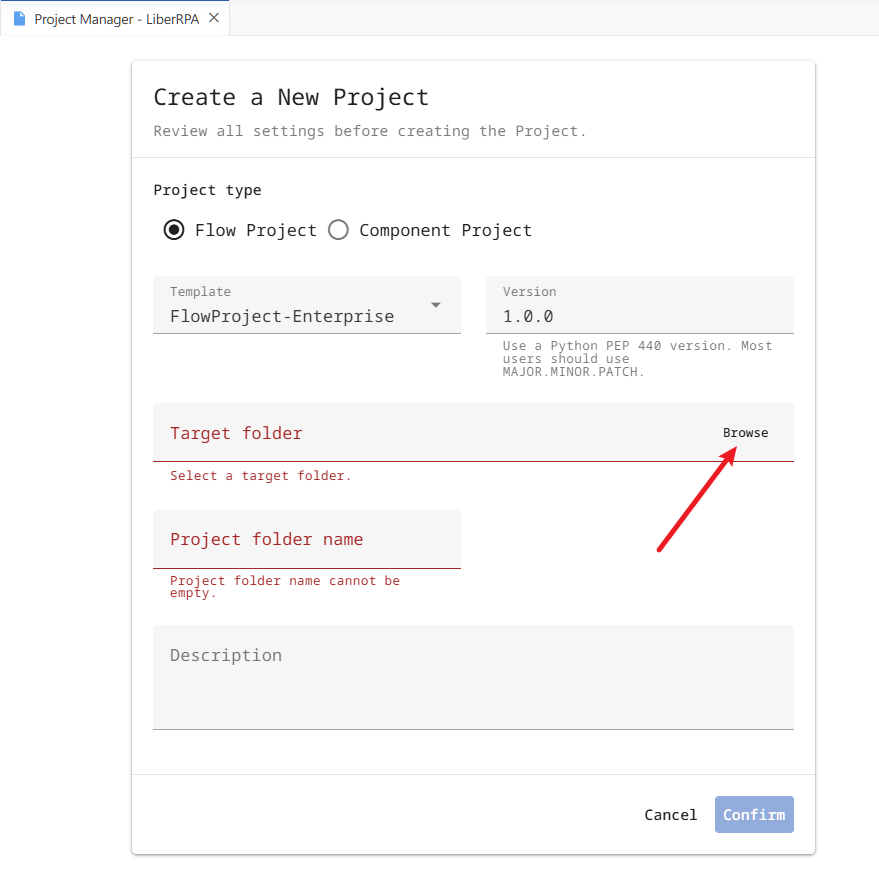
- Select the Project type and template, then enter the required Project information.
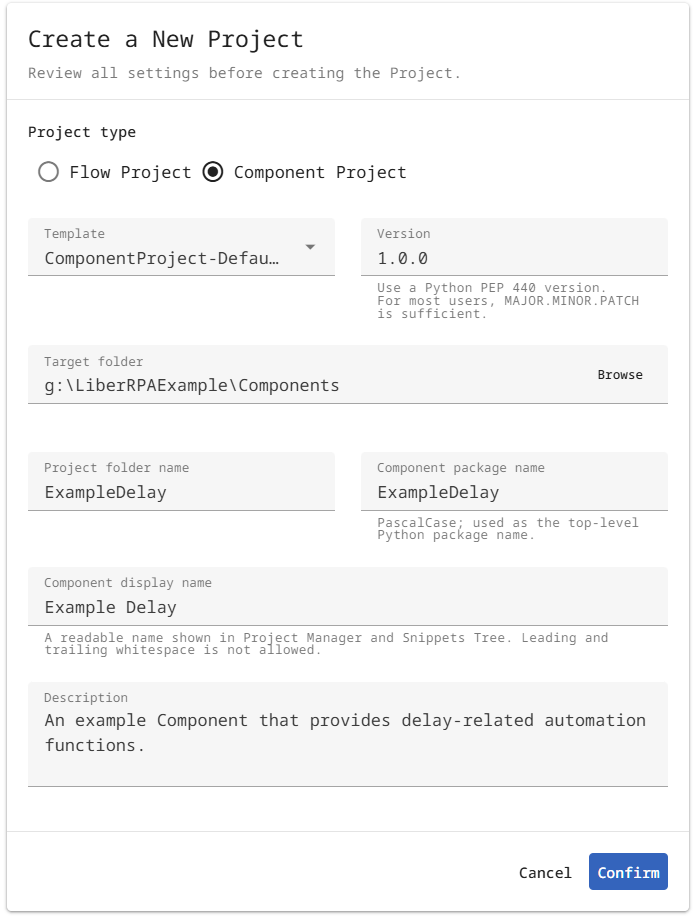
- Review the settings and click
Confirm.
- The new Project opens in a separate VS Code window.
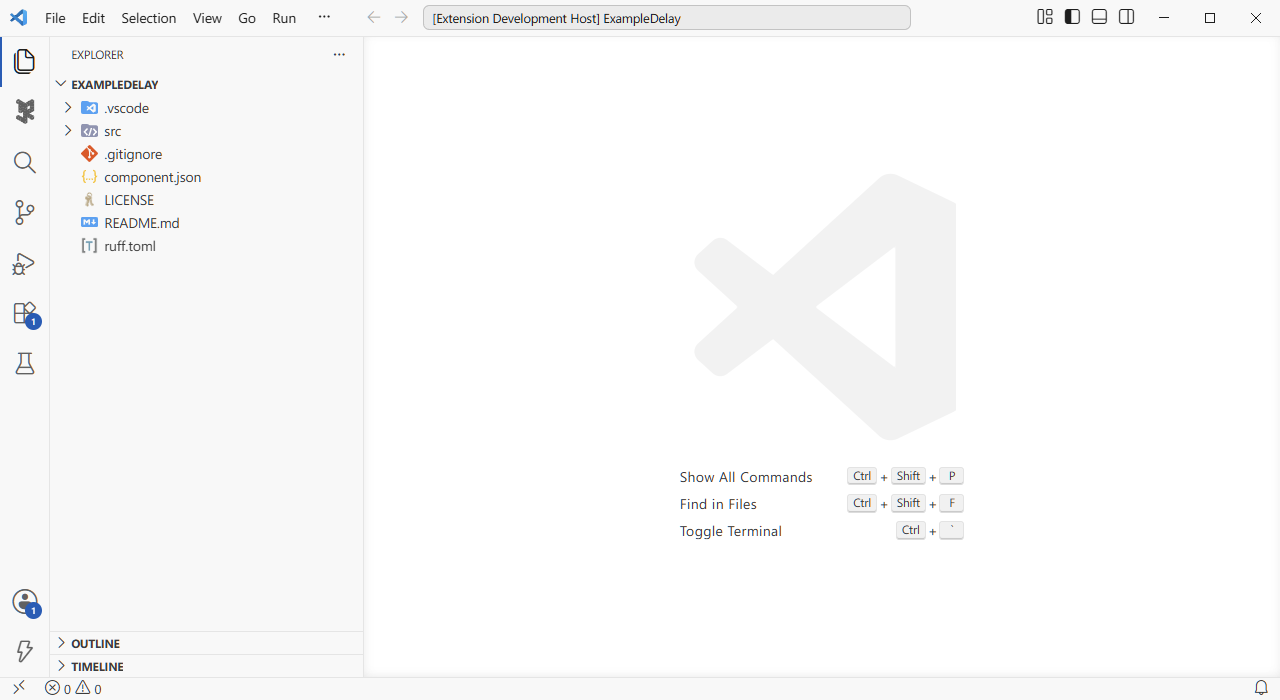
If the selected template contains .gitignore and Git is available, Project Manager also initializes a Git repository.
Customize Templates
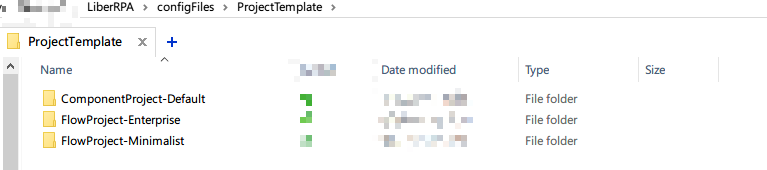
Project templates are stored at:
LiberRPA/configFiles/ProjectTemplate/
The safest way to create a custom template is to copy an existing template and modify the copy.
The template folder name must keep the matching prefix:
FlowProject- for a Flow Project template, for example FlowProject-MyTemplate.ComponentProject- for a Component Project template, for example ComponentProject-MyTemplate.
Keep the required Project files and structure for the selected Project type. Other files and folders may be added as needed.
Component Repository
LiberRPA Project Manager uses a local Component Repository to store Component Wheels published locally or imported from external sources.
The same Repository is shared by LiberRPA Projects that use the current LiberRPA installation. It is not stored inside an individual Flow Project or Component Project.
The default location is:
C:/Users/<UserName>/Documents/LiberRPA/ComponentRepository/
The path is configured by componentRepositoryPath in:
%LiberRPA%/configFiles/basic.jsonc
Running InitLiberRPA.exe creates the default Repository folder. A custom path must be an absolute path to an existing directory.
Use Project Manager commands to publish, import, and rebuild Repository content. Do not manually edit the Repository during normal use.
Develop a Component Project
A Component Project contains reusable Python code that can be published as a Component Wheel and added to other LiberRPA Projects.
Project Structure
Component source code must be placed under:
src/<PackageName>/
For example:
ExampleDelay/
├── src/
│   └── ExampleDelay/
│       ├── __init__.py
│       ├── py.typed
│       └── Preset.py
├── component.json
└── ...
The package folder directly under src must match packageName in component.json. Keep the generated __init__.py and py.typed files.
Public Component Functions
LiberRPA can generate Component Snippets from public top-level synchronous functions in public modules directly under src/<PackageName>/.
# FileName: Preset.py
# <LiberRPA imports: managed>
# This block is managed by LiberRPA. Do not edit it manually.
# ruff: isort: off
from liberrpa.Modules import (
    delay,
)

# ruff: isort: on
# </LiberRPA imports: managed>


def delay_seconds(seconds: float) -> None:
    """
    Delay for the specified number of seconds.

    Parameters:
        seconds: The non-negative number of seconds to delay.
    """
    delay(round(seconds * 1000))
Automatic Snippets are not generated from private modules or functions, async functions, nested functions, class methods, functions in __init__.py, or functions in nested subpackages. These objects may still be used internally by the Component.
Component Resources
Store Component-owned resources under the Component package and resolve them with get_component_resource_path():
# <LiberRPA imports: managed>
# This block is managed by LiberRPA. Do not edit it manually.
# ruff: isort: off
from liberrpa.Modules import (
    get_component_resource_path,
)

# ruff: isort: on
# </LiberRPA imports: managed>

strConfigPath = get_component_resource_path(
    relativePath="_Config/presets.json",
)
Do not use os.getcwd() to locate Component-owned files. The process working directory belongs to the running Project.
The Component Manifest is stored in component.json. It defines the Component identity, package name, display name, version, description, supported liberrpa range, and direct Component dependencies.
Keep packageName synchronized with the package folder under src. Do not change the Component ID after the Component has been published.
Versions and version requirements follow Python PEP 440. Increase version before publishing changed content. Published Component versions are immutable.
Before publishing, save the Project, review public names and docstrings, and resolve any dependency problems reported by Project Manager.
Publish a Component
Open the Command Palette and run LiberRPA: Publish Component.

The first publication uses two steps so that generated Snippets can be reviewed before the Wheel is created.
First Publish: Prepare Snippets
Review the Project and source scan summary, then click Publish Component.
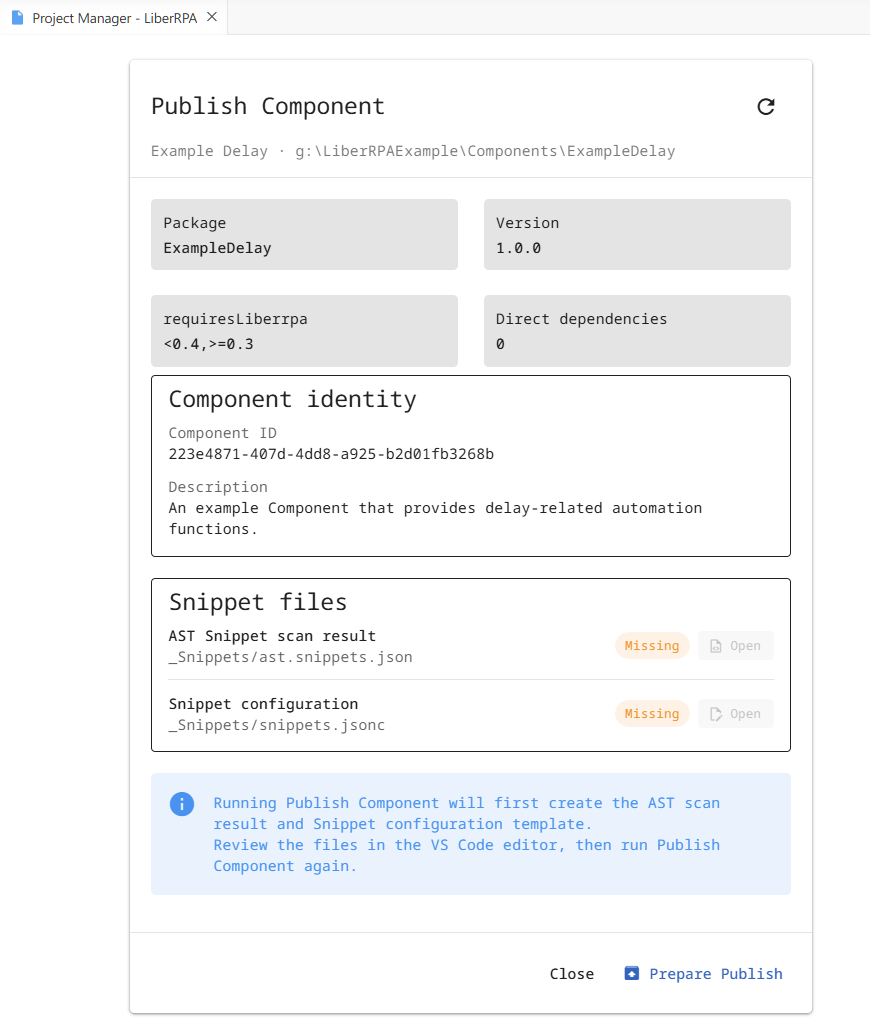
If _Snippets/snippets.jsonc does not exist, LiberRPA creates:
_Snippets/
├── ast.snippets.json
└── snippets.jsonc
ast.snippets.json is regenerated from the current source code. Do not edit it manually.snippets.jsonc belongs to the Component developer and is preserved during later publications.
No Wheel is created during this preparation step. Review the generated Snippets and edit snippets.jsonc when customization is needed.
The final Snippet Catalog must contain at least one Snippet. When no supported public function produces an AST-generated Snippet, add a hand-written Snippet associated with an existing public Component Module before publishing the Wheel.
Publish the Component Wheel
Run LiberRPA: Publish Component again. Project Manager regenerates and validates the Snippets, builds and validates the Wheel, and publishes it to the configured Component Repository.
After publication, review the Component version, Snippet summary, warnings, Wheel filename, and SHA-256 shown on the page. Detailed diagnostics are available in the Project Manager Output channel and the Component Management diagnostic log.
Use _Snippets/snippets.jsonc to:
- assign icons to Component categories;
- exclude selected generated Snippets;
- override selected generated Snippets;
- add hand-written Snippets;
- add imports required by those Snippets.
Project Manager provides JSON Schema validation, field and enum completion, liberrpa.Modules import-name completion, and Product Icon completion while editing this file.
See Component Snippet Configuration for the complete field reference and validation rules.
See the Example Delay Component walkthrough for a working publication example.
Publish Updated Versions
When published source code, resources, or Snippets change, increase version in component.json and publish again.
ast.snippets.json is regenerated during publication, while snippets.jsonc is preserved.
Publishing identical content with the same Component ID and version reports alreadyPublished. Publishing different content with the same ID and version is rejected.
Import Component Wheels
Use LiberRPA: Import Component Wheels to copy external LiberRPA Component Wheels into the configured local Component Repository.
Import and Add are separate operations:
- Import Component Wheels makes an external Wheel available in the local Repository.
- Add records a Component as a dependency of the current Project.
Importing a Wheel does not modify the current Project.
Import the Wheels
- Run
LiberRPA: Manage Components and click Import Wheels.
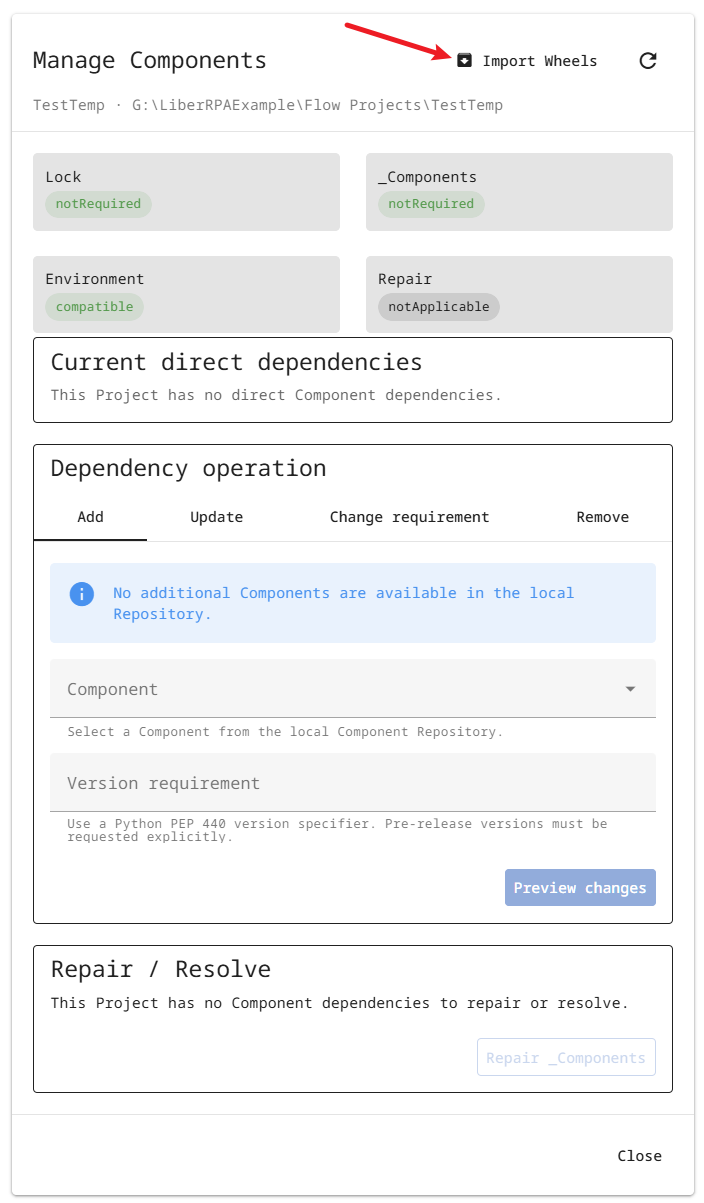 You can also run
 LiberRPA: Import Component Wheels directly.
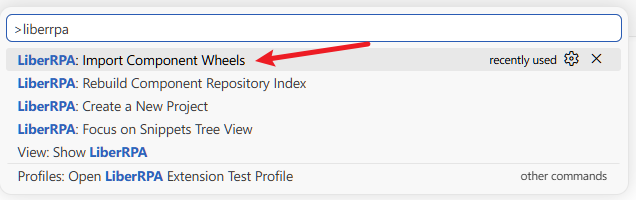
- Select one or more Wheel files stored outside the active Component Repository.
Example Wheels:
- Confirm the file selection and review the result.
When Import is started from Manage Components, the Repository Catalog refreshes automatically.
Multiple versions of the same Component can coexist in the Repository. Importing the exact same Wheel again is safe and does not create a duplicate entry. Different content cannot replace an already published Component ID and version.
After importing, use Add when the Component should become a dependency of the current Project.
Rebuild Component Repository Index
Component Wheels are the authoritative Repository artifacts. repository.json is a derived index that can be rebuilt from those Wheels.
Run LiberRPA: Rebuild Component Repository Index when Project Manager reports that the index is missing, invalid, or inconsistent with the stored Wheels.
- Open the Command Palette.
- Run
LiberRPA: Rebuild Component Repository Index.
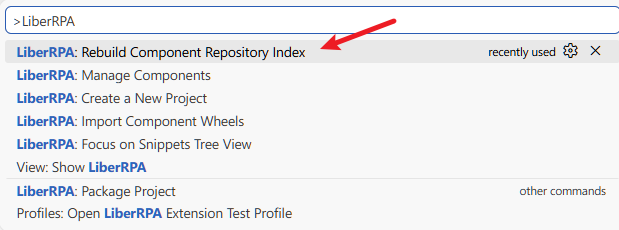
- Review the completion message and any warnings.
- Refresh or reopen Manage Components if it is already open.
Rebuild validates the stored Wheels and replaces repository.json. It does not import external Wheels, remove valid Wheels, or change any Project dependency files.
Manage Components in a Project
Project Manager manages Component dependencies for Flow Projects and Component Projects.
The Project Manifest (flow.json or component.json) stores direct requirements. Project Manager resolves them into exact versions in components.lock.json and rebuilds _Components from the selected Wheels.
Do not edit components.lock.json or _Components manually.
Open Manage Components
- Press
Ctrl+Shift+P and run LiberRPA: Manage Components.
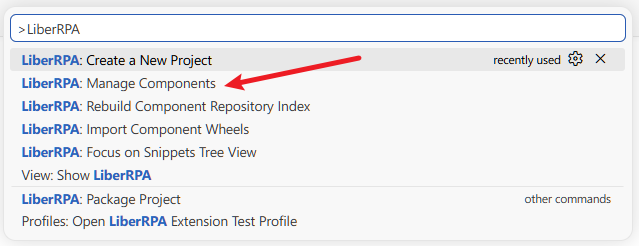
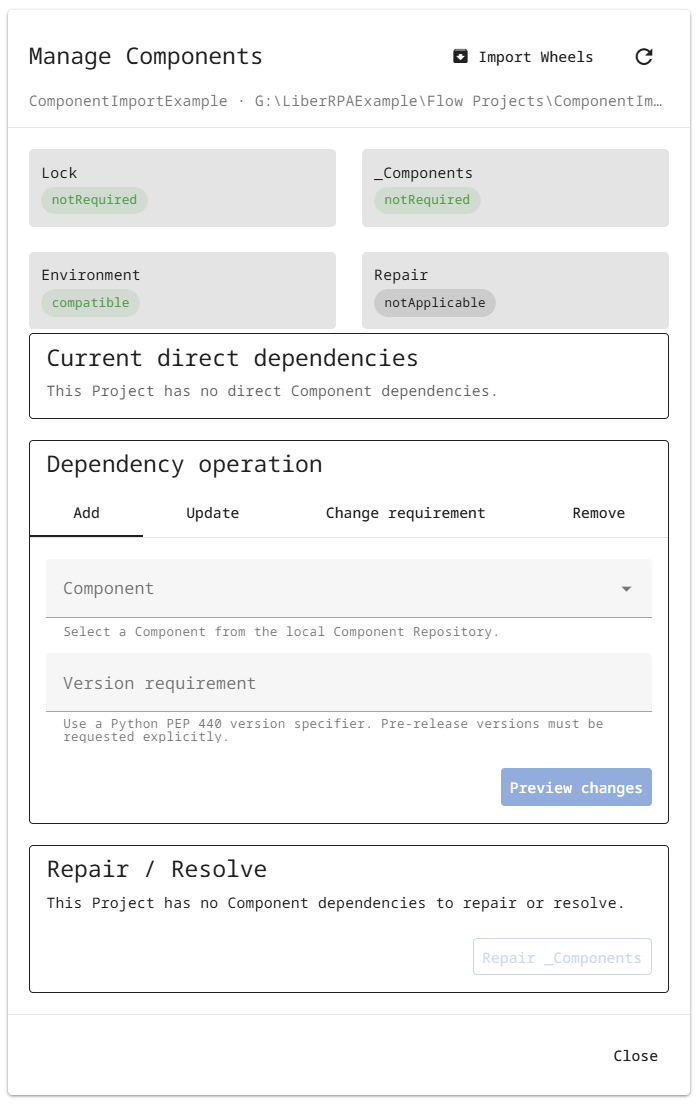
- Review the lock,
_Components, environment, repair, and direct dependency states shown on the page.
The Import Wheels button opens the Repository operation described in Import Component Wheels.
Preview and Confirm Changes
Add, Update, Change Requirement, and Remove use the same workflow:
- Select the operation and enter its input.
- Click
Preview changes.
- Review direct requirement changes and exact resolved Component changes.
- Click
Back to revise the operation or Confirm changes to apply it.
If Repository content changes after preview, Project Manager asks you to preview the plan again.
Add
Use Add to add a new direct Component dependency.
- Select the Component and review its PEP 440
Version requirement.
- Click
Preview changes.
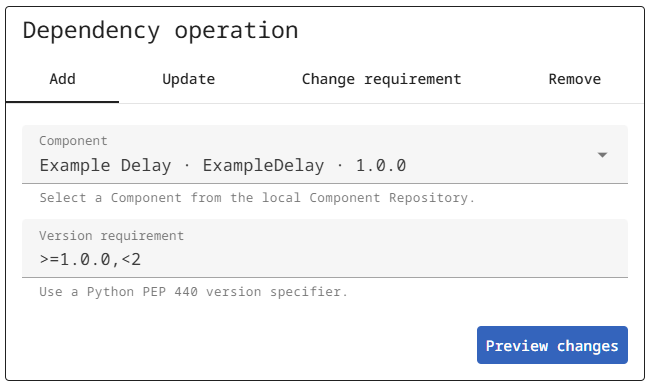
- Review the plan and click
Confirm changes.
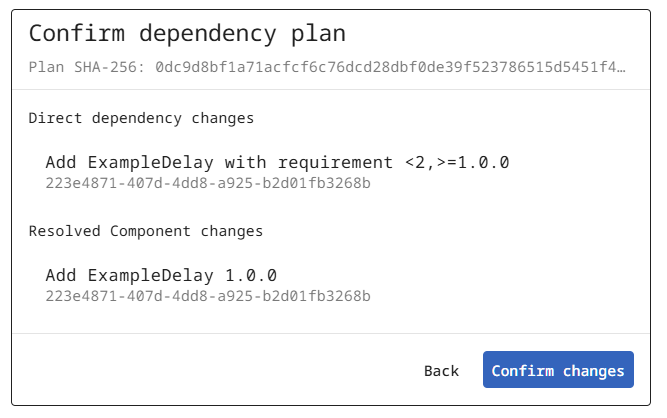
Project Manager records the direct requirement, resolves a compatible dependency closure, and rebuilds _Components.
Pre-release versions are selected only when the requirement explicitly permits a pre-release, for example ==1.2.0rc1.
Update
Use Update to search for newer versions that still satisfy the current requirements.
- Select one or more Components.
- Click
Preview changes.
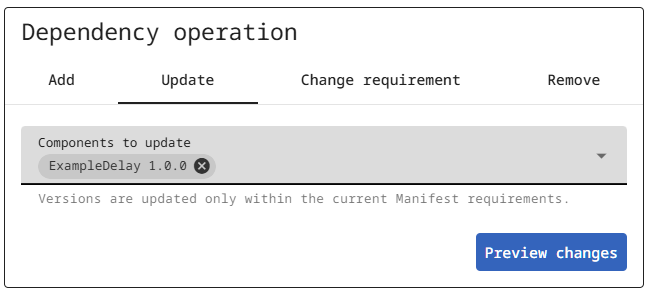
- Review the resolved version changes and click
Confirm changes.
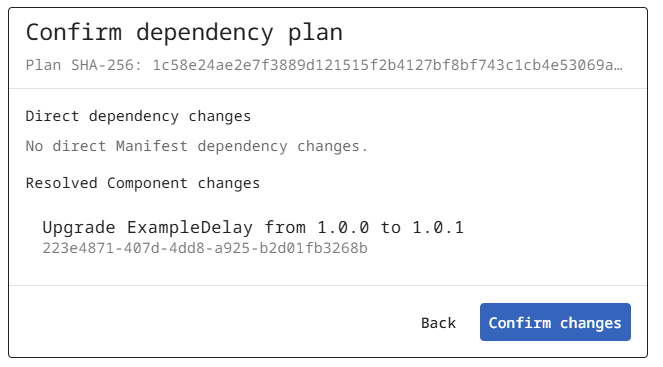
Update does not change the version requirements stored in the Project Manifest.
Change Requirement
Use Change requirement to edit the allowed PEP 440 range of a direct dependency.
- Select a direct dependency and enter the new requirement.
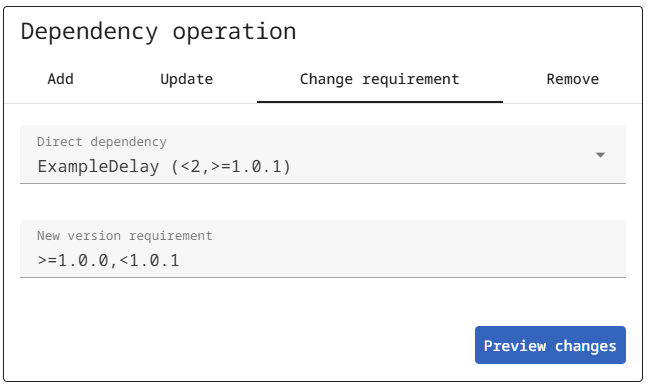
- Click
Preview changes.
- Review the requirement and resolved version changes, then click
Confirm changes.
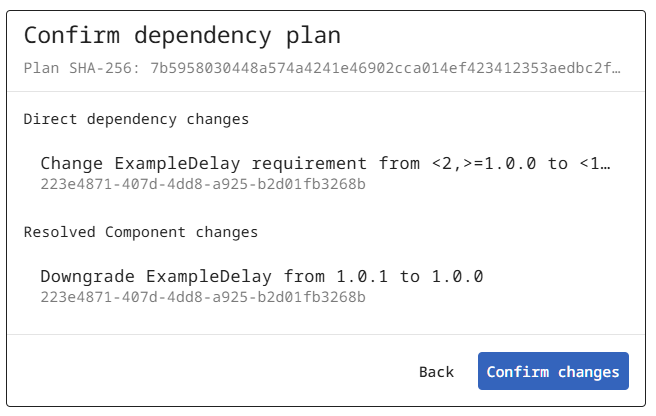
Changing a requirement may keep, upgrade, or downgrade the resolved version. If the current version remains valid, use Update afterward when you explicitly want a newer permitted version.
Remove
Use Remove to remove a direct Component dependency.
- Select the dependency.
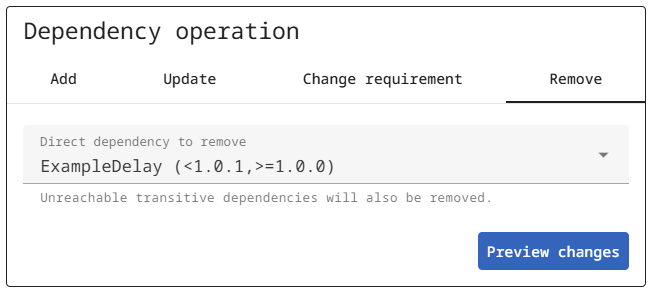
- Preview the changes.
- Review the direct and resolved removals, then click
Confirm changes.
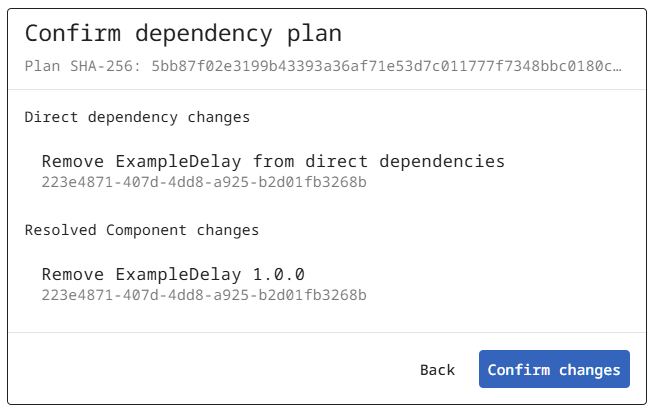
Transitive Components that are no longer required are removed automatically. Existing Python imports and calls are not removed; update affected source files yourself.
Repair _Components
Use Repair _Components when components.lock.json is valid but _Components is missing or damaged.
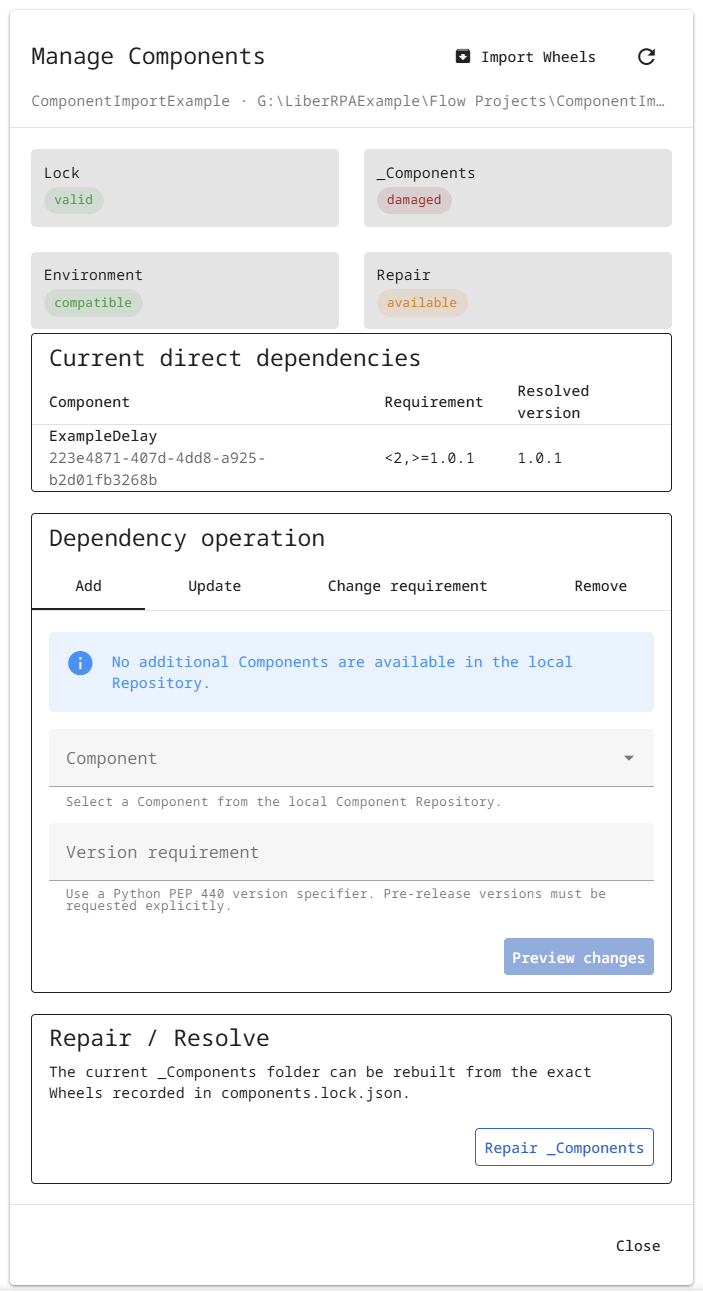
Repair rebuilds _Components from the exact Wheels and SHA-256 values recorded in the lock file. It does not change the Project Manifest, lock file, or resolved versions.
Resolve Dependencies
Use Resolve dependencies when components.lock.json is missing, invalid, or stale.
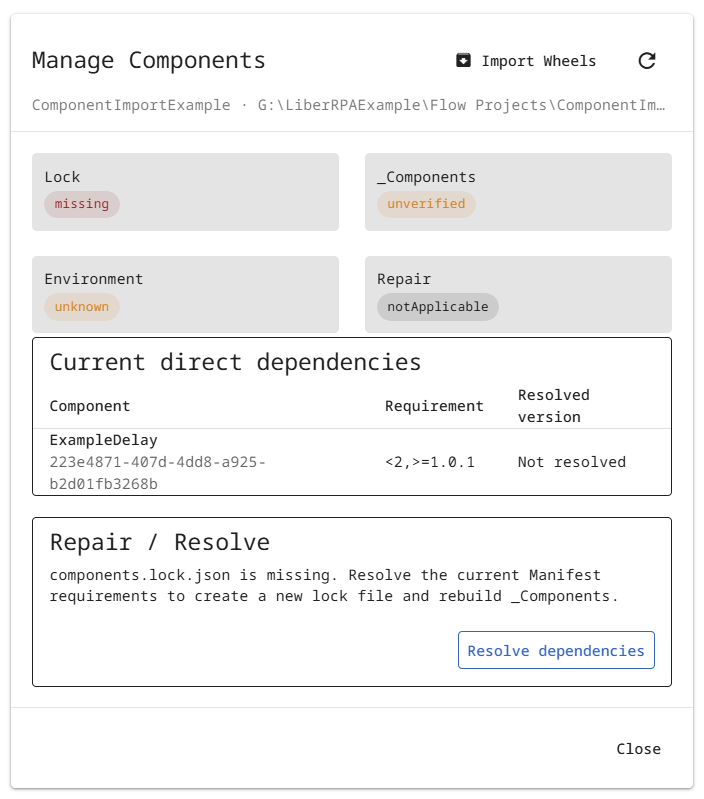
Project Manager resolves the current Manifest requirements again, creates a new lock file, and rebuilds _Components.
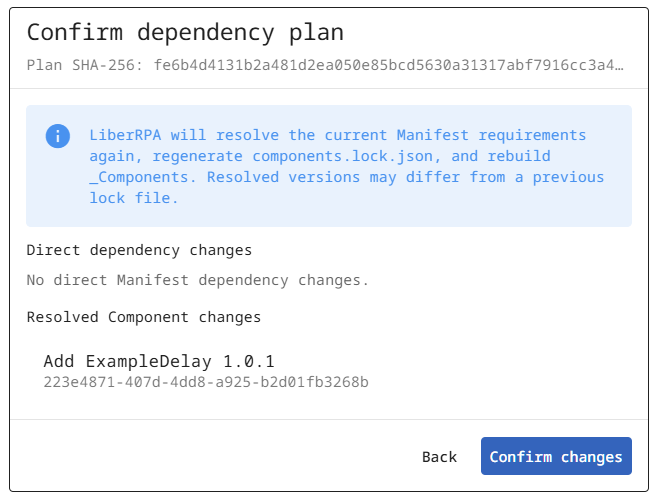
The new resolved versions may differ from an older lock file because resolution uses the current Component Repository.
Use an Added Component
Import an added Component through its public package:
from ExampleDelay import (
    Delay as ExampleDelay_Delay,
)
Do not import through _Components:
# Do not use this form.
from _Components.ExampleDelay import Delay
_Components is generated Project state and may be completely replaced by dependency operations. Do not edit it, copy files into it, or hard-code paths into it.
Use LiberRPA Snippets Tree to insert Component Snippets and maintain imports. A Snippet is a development convenience; excluding a Snippet does not remove the underlying Python API.
Access Component resources through the Component's public API. Do not construct paths into _Components from the Flow Project.
If Pylance temporarily reports a newly added Component as unresolved, run Python: Restart Language Server from the Command Palette. This refreshes Pylance's import analysis and does not affect the Project's Component state.
Complete Example
ComponentUsageExample-0.1.0.zip is a final-state Flow Project that uses ExampleDelay 1.0.1.
The example demonstrates generated and hand-written Snippets, Component resources, public APIs without Snippets, and exception handling through a Flowchart Exception Line.
To run it:
- Extract the archive to a folder.
- Open the extracted folder in VS Code.
- Select a compatible LiberRPA Python environment.
- Open
project.flow.
- Debug or run the Project.
The archive is a final-state snapshot. It does not replay Add, Update, Change Requirement, or Remove operations.
When debugging the expected Component error, enable User Uncaught Exceptions, press F5 after the debugger pauses, and allow the Flowchart to continue through its Exception Line.
Repair _Components requires the exact Wheel recorded in components.lock.json. Resolve dependencies resolves the current requirement again and may select another compatible version.
Package a Flow Project
Use LiberRPA Project Manager to create an .rpa.zip deployment Package from the current Flow Project.
The generated Package contains the Flow Project files required for installation and execution in LiberRPA Executor. The Project contents are stored directly at the archive root.
Create the Package
- Open the Flow Project as the only workspace folder.
- Run
LiberRPA: Package Project.
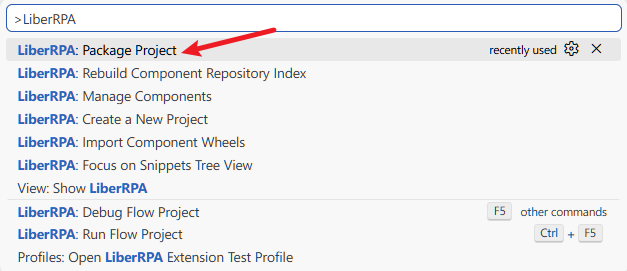
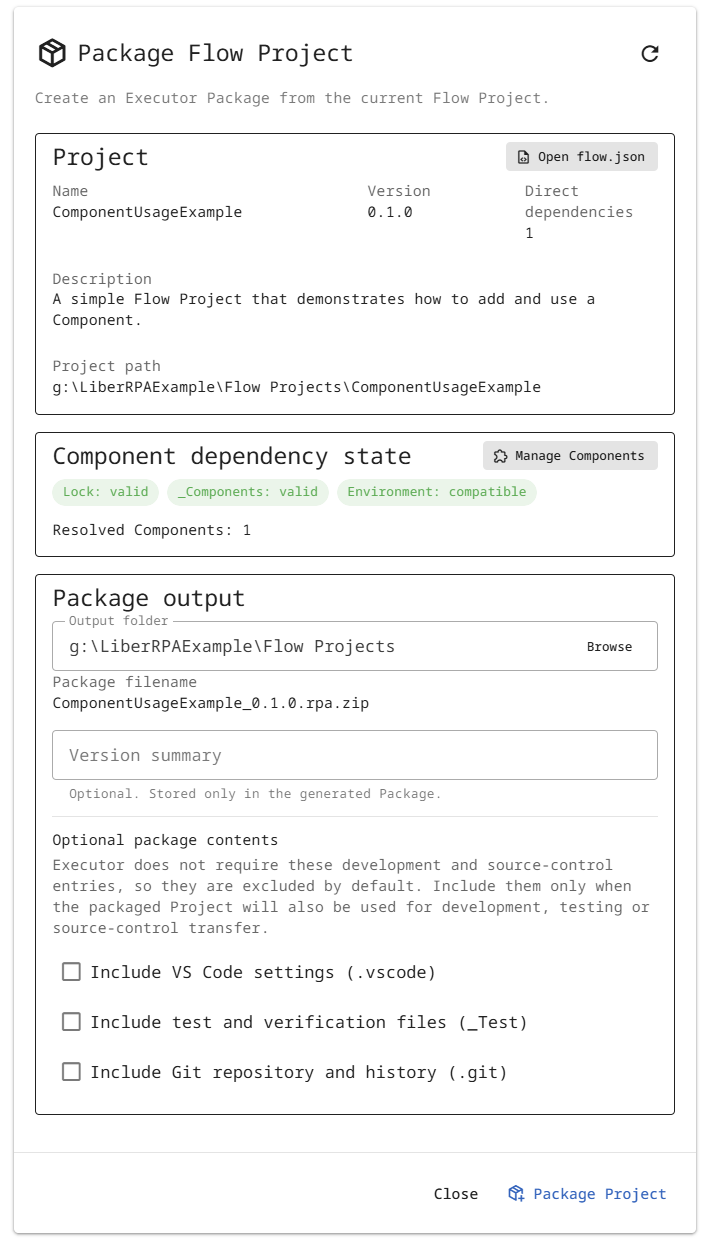
- Review the Project information and Component dependency state. Resolve any blocking issue shown on the page.
- Optionally enter a one-line
Version summary. It is stored only in the generated Package and does not modify flow.json.
- Review the output folder. The default is the parent folder of the current Flow Project; click
Browse to select another existing folder.
- Choose whether to include the optional Project-root entries described below.
- Review the generated
<name>_<version>.rpa.zip filename and click Package Project.
- Review the file count, folder count, uncompressed size, and archive size. Click
Reveal to show the Package in File Explorer.
Project Manager validates the Project, dependency state, environment, output folder, and target filename before packaging.
Treat the generated Package as an immutable deployment artifact. Executor installs Packages by Project name and version and does not overwrite an existing name/version pair. After changing the Project, increase flow.json.version and create another Package.
Optional Package Contents
The following Project-root entries are excluded by default because Executor does not require them:
| Entry |
Include it when |
.vscode/ |
The packaged Project will also be opened in VS Code and should retain Project-specific editor and run/debug settings. |
_Test/ |
Test scripts, sample data, or verification files are required for deployment validation or troubleshooting. |
.git |
An intentional source-control transfer is required..git may contain the complete Repository history and substantially increase the Package size. |
Review _Test for credentials, customer data, and environment-specific values before including it.
Including or excluding these entries changes only the generated Package. Before adding large models, videos, datasets, or other heavyweight resources, review the Executor Package Limits.
Package Rules
Project Manager excludes caches, compiled Python files, internal operation files, existing .rpa.zip files, and any root-level Package metadata from the source Project. Symbolic links inside the Project are not supported.
The output folder must exist, use an absolute path, and be outside the source Project.
Project Manager never overwrites an existing .rpa.zip. Change the Project name or version, select another output folder, or move the previous Package when another archive is required.
After the Package is created, it can be installed and executed through LiberRPA Executor.
Requirements
Run InitLiberRPA.exe before using LiberRPA Project Manager so that the LiberRPA environment variable, default directories, and Component Repository root are initialized.
Git is optional. It is needed only when Project Manager should initialize a Git repository for a template containing .gitignore.

