Skip to content
| Marketplace
Sign in
Visual Studio Code>Visualization>KTern Workflow StudioNew to Visual Studio Code? Get it now.
KTern Workflow Studio

KTern Workflow Studio

KTern.AI

|
4 installs
| (0) | Free
Visual Workflow Editor for KTern.AI CodeGenie Platform
Installation
Launch VS Code Quick Open (Ctrl+P), paste the following command, and press enter.
Copied to clipboard
More Info

KTern Workflow Studio

A Visual Workflow Builder for AI-Driven Automation

KTern Workflow Studio is a Visual Studio Code extension for designing AI-driven workflows on an intuitive visual canvas. You compose a workflow visually from modular, reusable components, and the workflows you build are executed by KTern.AI Codegenie. The Studio is the design surface; Codegenie is the execution engine.


Overview

KTern Workflow Studio closes the gap between workflow design and execution. Instead of authoring prompts and agent instructions by hand, teams compose workflows from modular components—prompts, skills, external tools, and control-flow logic—on a drag-and-drop canvas. Completed workflows are exported into formats that KTern.AI Codegenie can run directly.

The platform is general-purpose. It can be used to model and automate workflows for virtually any domain or use case, including:

  • Enterprise process automation
  • Integrating external MCP
  • Any domain-specific workflow you can describe as a sequence of steps and decisions

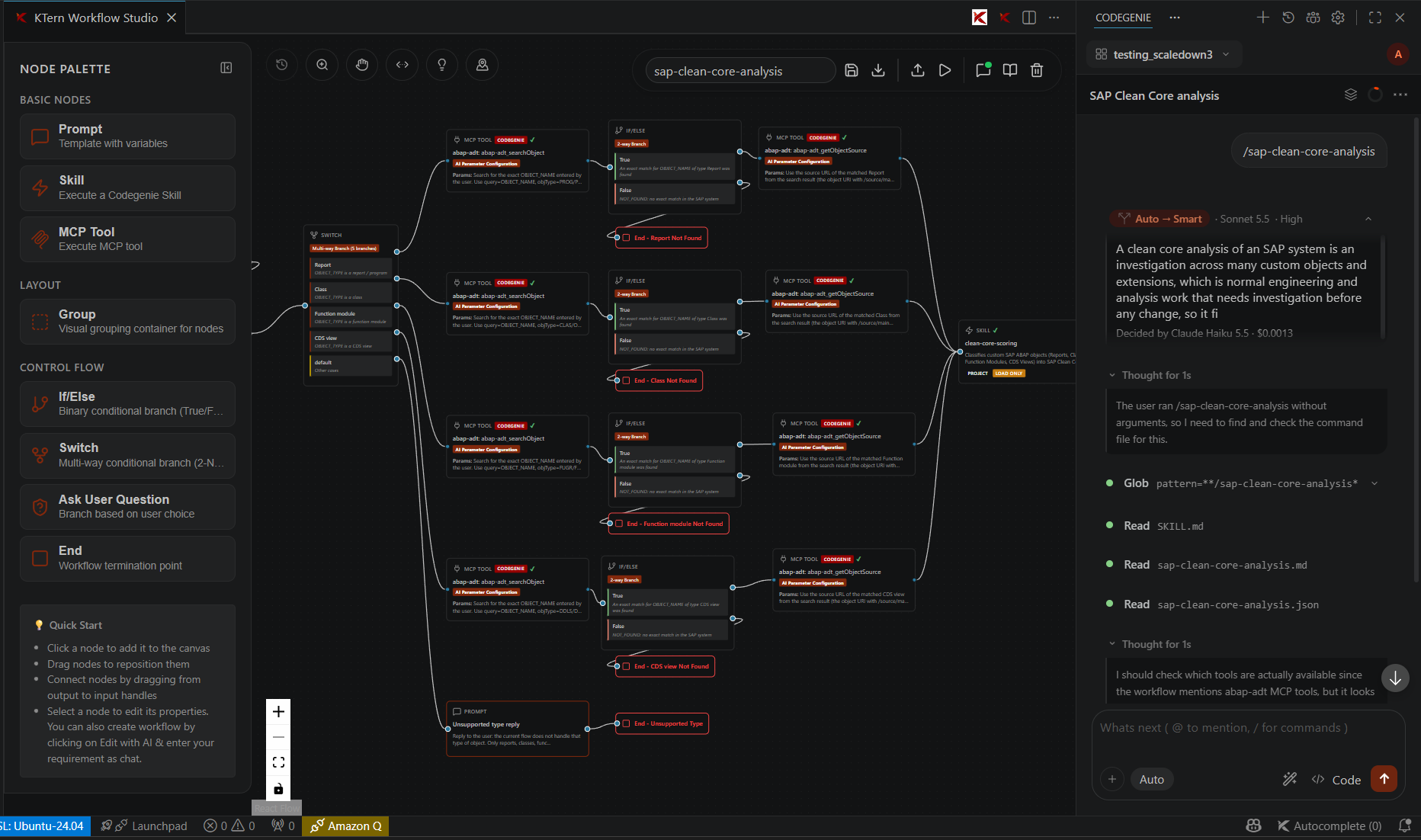
KTern Workflow Studio editor showing a visual workflow on the canvas alongside the AI assistant panel

The KTern Workflow Studio editor: a visual canvas, node palette, and integrated AI assistant working together in VS Code.


Core Capabilities

Visual Workflow Design

Compose workflows on a drag-and-drop canvas using reusable, individually configurable nodes. Connect nodes through input and output handles to model sequential, branching, and parallel execution paths.

AI-Assisted Authoring

Create and refine workflows conversationally with the Edit with AI assistant. Describe the desired behavior in natural language and let the integrated AI agent build or adjust the workflow on the canvas.

Flexible Tooling

Use any MCP (Model Context Protocol) tools and any skills that are configured in KTern.AI Codegenie. The Studio surfaces whatever your Codegenie environment provides, so your workflows can call into any connected service or capability.

Execution via KTern.AI Codegenie

The workflows you build here are not run by the Studio itself—they are executed by KTern.AI Codegenie. Export a workflow and run it directly from the editor to have Codegenie carry out the automation.


The Node Palette

Workflows are assembled from a curated set of nodes, organized by purpose in the Node Palette.

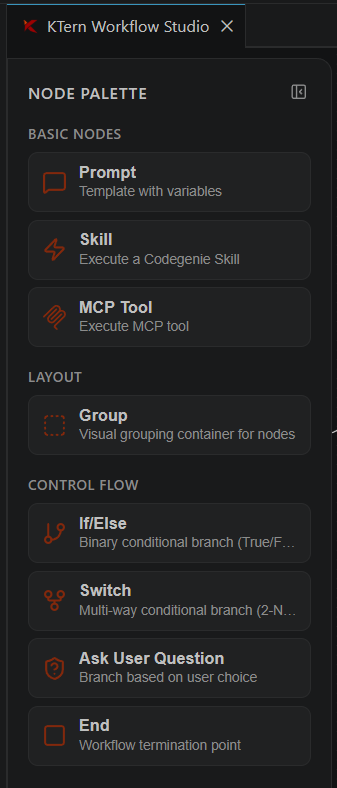
KTern Workflow Studio node palette showing basic nodes, layout, and control flow categories

Basic Nodes

Node Description
Prompt A template-driven node supporting dynamic variables using {{variableName}} syntax.
Skill Executes a Codegenie skill.
MCP Tool Invokes an external service or capability through an MCP tool configured in Codegenie.

Layout

Node Description
Group A visual container for grouping and organizing related nodes on the canvas.

Control Flow

Node Description
If/Else Binary conditional branching based on a true/false evaluation.
Switch Multi-way conditional branching across two or more cases.
Ask User Question Introduces a human-in-the-loop decision point that branches on the user's choice.
End Marks a workflow termination point. At least one is required per workflow.

Getting Started

Launch the Editor

  • Click the KTern Workflow Studio icon in the top-right corner of the editor, or
  • Open the Command Palette and run KTern Workflow Studio: Open Editor.

Build Your First Workflow

  1. Click a node in the palette to add it to the canvas.
  2. Drag nodes to reposition them, and connect them by dragging from an output handle to an input handle.
  3. Select any node to configure its properties in the property panel.
  4. Alternatively, open Edit with AI and describe your requirement in natural language.

AI Assistant Integration (Codegenie)

The integrated AI assistant panel connects the canvas to KTern.AI Codegenie, enabling conversational workflow authoring and access to the tools and skills configured in your Codegenie environment.

To work with external integrations:

  1. Open the AI assistant panel from the editor toolbar.
  2. Connect the KTern.AI Codegenie Agent Server and the MCP servers you want available.
  3. Any MCP tools and skills configured in Codegenie become available for use in your workflows.

When you request changes through the assistant, the MCP server starts automatically, reads the current workflow, applies the requested edits, and updates the canvas in real time.


Canvas and Editor Controls

The editor provides a focused, productive authoring environment:

  • Drag and position nodes freely across the canvas.
  • Connect nodes through their input and output handles to define flow.
  • Reset Workflow to clear the canvas and start fresh.
  • Focus Mode for distraction-free editing.
  • Minimap with configurable visibility (hidden, show on scroll, or always visible).
  • Interaction modes for panning, selection, and scroll-to-zoom or scroll-to-pan behavior.

Recommended Practices

  • Use clear, descriptive node names to produce readable exports.
  • Define multiple End nodes to represent distinct outcomes.
  • Encapsulate reusable logic in Skill nodes.
  • Centralize external connectivity through MCP Tools configured in Codegenie.

Next Steps

  1. Build an initial workflow combining a Prompt and a Skill or MCP Tool node.
  2. Connect the MCP tools and skills available in your KTern.AI Codegenie environment.
  3. Export and run the workflow directly from the editor.
  4. Refine and extend your workflows iteratively with the AI assistant.
  • Contact us
  • Jobs
  • Privacy
  • Manage cookies
  • Terms of use
  • Trademarks
  • Your Privacy Choices
  • Consumer Health Privacy
© 2026 Microsoft