AIWorkHub for VS Code
Plan. Delegate. Verify. Remember.
AIWorkHub is a repository-native control plane for multi-model software
development. It gives every repository an isolated task system, Source Graph,
durable project context, worker runtime and evidence-first review loop.
The extension opens as a retained editor tab and runs one repository-scoped
MCP stdio runtime on the workspace host. It does not open a browser, bind a
port, expose a LAN service or require an AIWorkHub cloud account.
What's new in 0.11.42
The Models view keeps every provider visible and keeps explicitly configured
routes reachable when a bounded catalog read comes back short. Rows are chosen
per provider only after every provider has been seen, routes named in
.aiworkhub/config/models.json are reserved under both their written and
canonical identities, and pins that do not fit past the hard ceiling are
counted as refused instead of disappearing.
Model counts no longer present an upstream-truncated list as an exact total.
Each row states the bound that produced it — declared but not discovered,
configured with its origin unknown past the host bound, or configured past the
source bound — and the view names the host that cut the tail instead of
blaming the editor cap for OpenCode rows.
Compact dashboard counters keep four significant digits, so 1000 reads as 1k
and 1001 as 1.001k rather than collapsing to the same label, 999999999 reads
as 1B, and the decimal separator follows your locale.
Windows native-CLI workers now run inside the repo-scoped AppContainer
profile and its kill-on-close Job Object when the platform, the host's
AppContainer APIs and the launch path all confirm it, and the confinement
report names the boundary actually in force instead of a fixed answer. The
wiring is proved by fake-Windows behaviour tests over the real launch path;
a live Windows canary has not run, so no live-Windows evidence is claimed.
A Windows extension host resuming from idle no longer loses repository
discovery to one transient handle, sharing or lock fault. The manifest read
retries exactly once, only for an authenticated transient cause, on a
brand-new descriptor that repeats every symlink, regular-file and identity
check. A missing, malformed, foreign or otherwise invalid manifest still
fails closed immediately.
Rejected validation-only candidates now lose their one-episode replay grant,
ensuring the next rework claim invokes a worker instead of repeating stale
validation forever.
Reviewer cleanup is parent-scoped, so rejecting one candidate cannot finalize
or cancel unrelated review work.
Review recovery now preserves fair cursor progress when its first action is
deferred, allowing later ready reviewer chains to run in the same bounded
reconciler pass.
Reconciler review recovery now advances a bounded batch of durable actions
per scan and continues past deferred chains. A busy review queue can no
longer strand newly seeded reviewers behind one action per multi-minute pass.
Task MCP writes now share a serialized writer boundary and reusable lock
descriptor, reducing SQLite contention and lock churn.
Toolchain receipt creation and validation now use one bounded executable
fingerprint contract, eliminating false identity drift for binaries larger
than 1 MiB during provider-free replay.
Durable toolchain snapshots are executable-identity checked before reuse;
stale cache facts are re-derived instead of blocking retained-candidate
validation before its first declared command.
Provider-free validation replay now preserves non-empty read_first
requirements in its authenticated toolchain identity.
Repeated validation-only replay can inherit the authenticated worker MCP gate
through a mechanically failed replay without launching the provider again.
Validation-only replay now accepts an exact authenticated retained delta
even when the canonical parent advanced after the original attempt.
Validation-only replay now carries the complete HMAC-bound task identity,
allowing retained candidates to rerun gates without false receipt mismatch.
Sealed review_ready candidates whose automatic reviewer child was never
created are recovered by reconciliation without manager-launched reviewers.
Mechanical review parks, retained-delta reroutes and pending launch failures
preserve their authoritative lifecycle across retries.
Read-only analysis and research no longer consume mutation-only validation or
reviewer work.
OpenCode workers receive isolated authentication, classic Snap launch support
under Landlock, and explicit capacity-refusal evidence.
VS Code LM finalization keeps valid partial finals while contradictory or
unauthenticated terminal evidence remains rejected.
Automatic quality-review launch moves worker completion through a
system-owned correctness, security, and code-quality chain without
prematurely waking the manager. After every required lens passes, one
authenticated aggregate binds the candidate and reviewer evidence and emits
exactly one manager callback. Review automation never accepts or rejects the
implementation target; the verified manager receives only the completed
decision packet. Legacy review receipts remain compatible without blocking
later chains.
Detailed older history stays in the
changelog.
Architecture at a glance
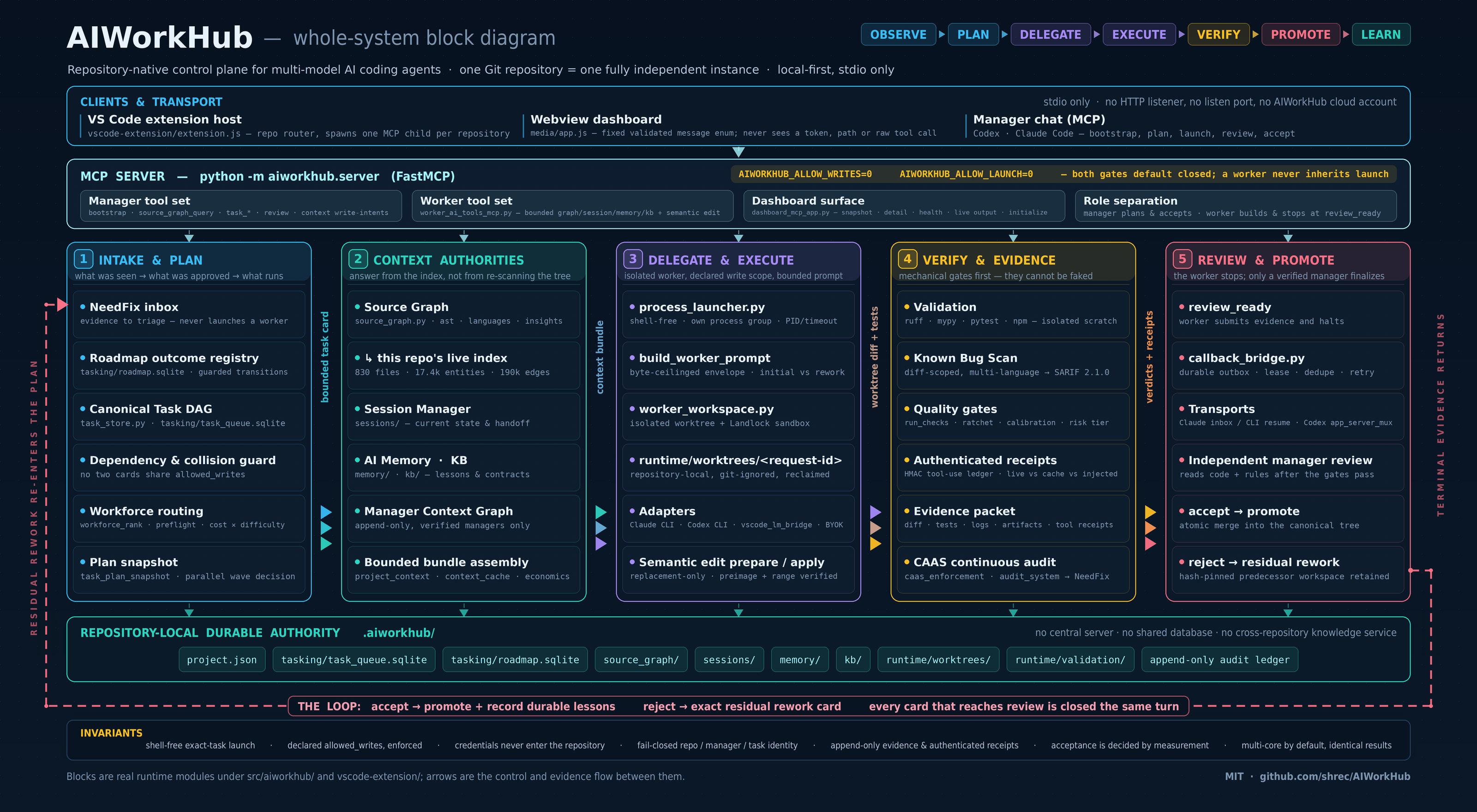 The complete AIWorkHub control plane, execution, evidence and improvement loop.
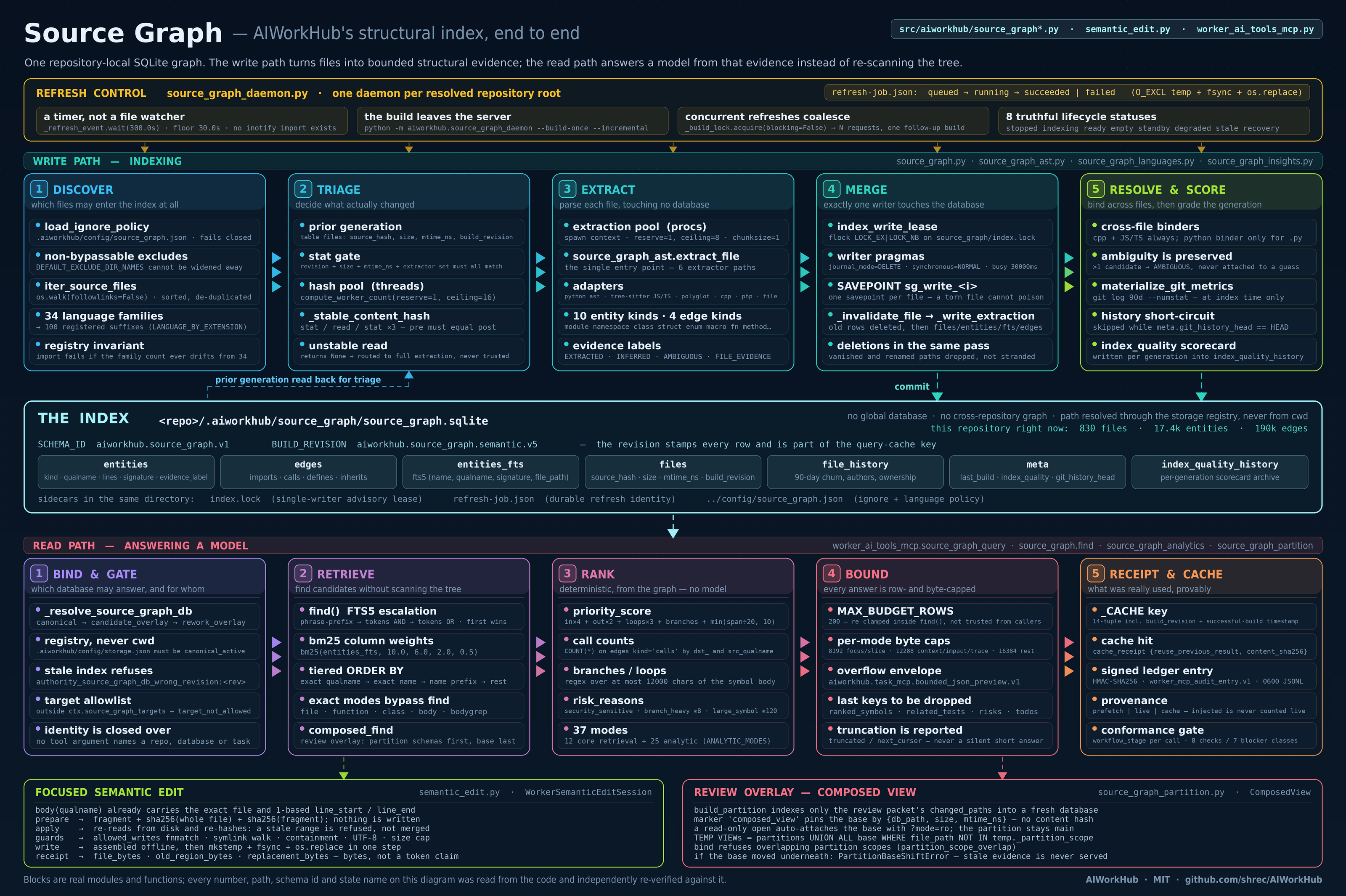 Incremental Source Graph refresh, index, query, semantic-edit and review-overlay paths.
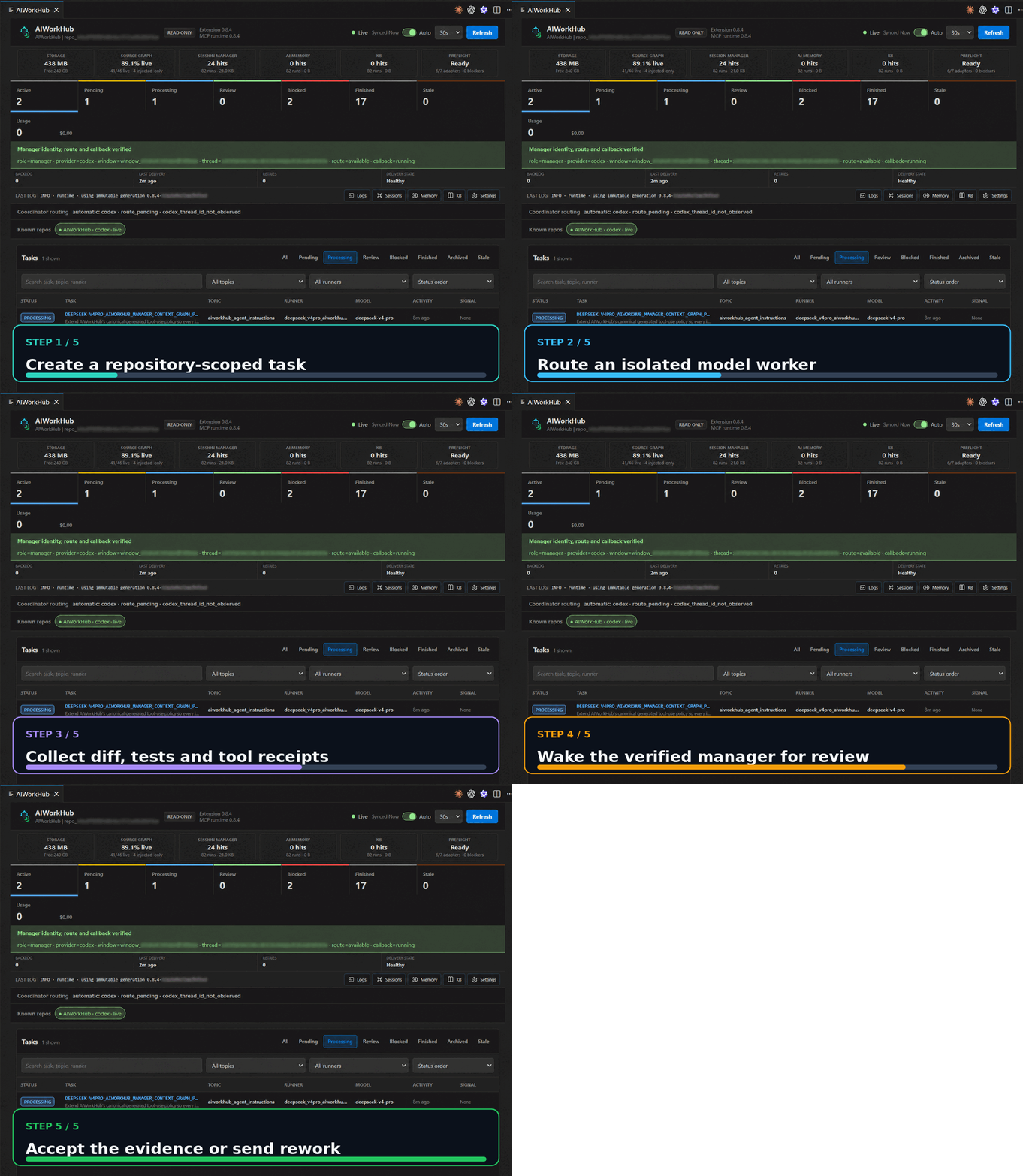 Create a bounded task, launch a model worker, inspect its evidence and accept or rework it.
Highlights
- Plan and inspect dependency-aware AI tasks from one operational dashboard.
- Delegate to supported local model adapters and track real terminal outcomes.
- Replace repeated raw-source discovery with a repository Source Graph covering
exactly 34 language/file families.
- Send focused code fragments through staged semantic edits and let the local
bridge assemble the hash-bound final envelope without model-side full-file
regeneration.
- Use exactly 37 currently exposed bounded Source Graph query modes for
symbols, calls, tests, impact, complexity, ownership, hotspots, gaps and
task-shaped context bundles.
- Preserve continuity through Session Manager, AI Memory and KB.
- Review diffs, tests, logs, artifacts, approval history and deterministic
Quality Evidence before acceptance.
- Run a changed-file Known Bug Scanner across C/C++/CUDA, Python,
JavaScript/TypeScript, Go, Java/Kotlin and PHP without treating heuristic
warnings as proven failures.
- Measure whether workers used Source Graph throughout the task through
authenticated tool-use receipts and continuous-use telemetry.
- Keep repositories isolated in separate
.aiworkhub/ authorities.
- Run on Linux (the canonical development and validation host), on WSL,
Remote-SSH and macOS as qualified client paths, and on native Windows only
at its measured coverage.
Operational dashboard
The retained dashboard combines the task DAG, live worker output, Review
Inbox, callback health, model readiness, tool-use statistics, storage
retention, Source Graph coverage and bounded viewers for logs, sessions,
AI Memory and KB. Settings remain repository-local under .aiworkhub/, so a
multi-window installation does not share task or context authority between
repositories.
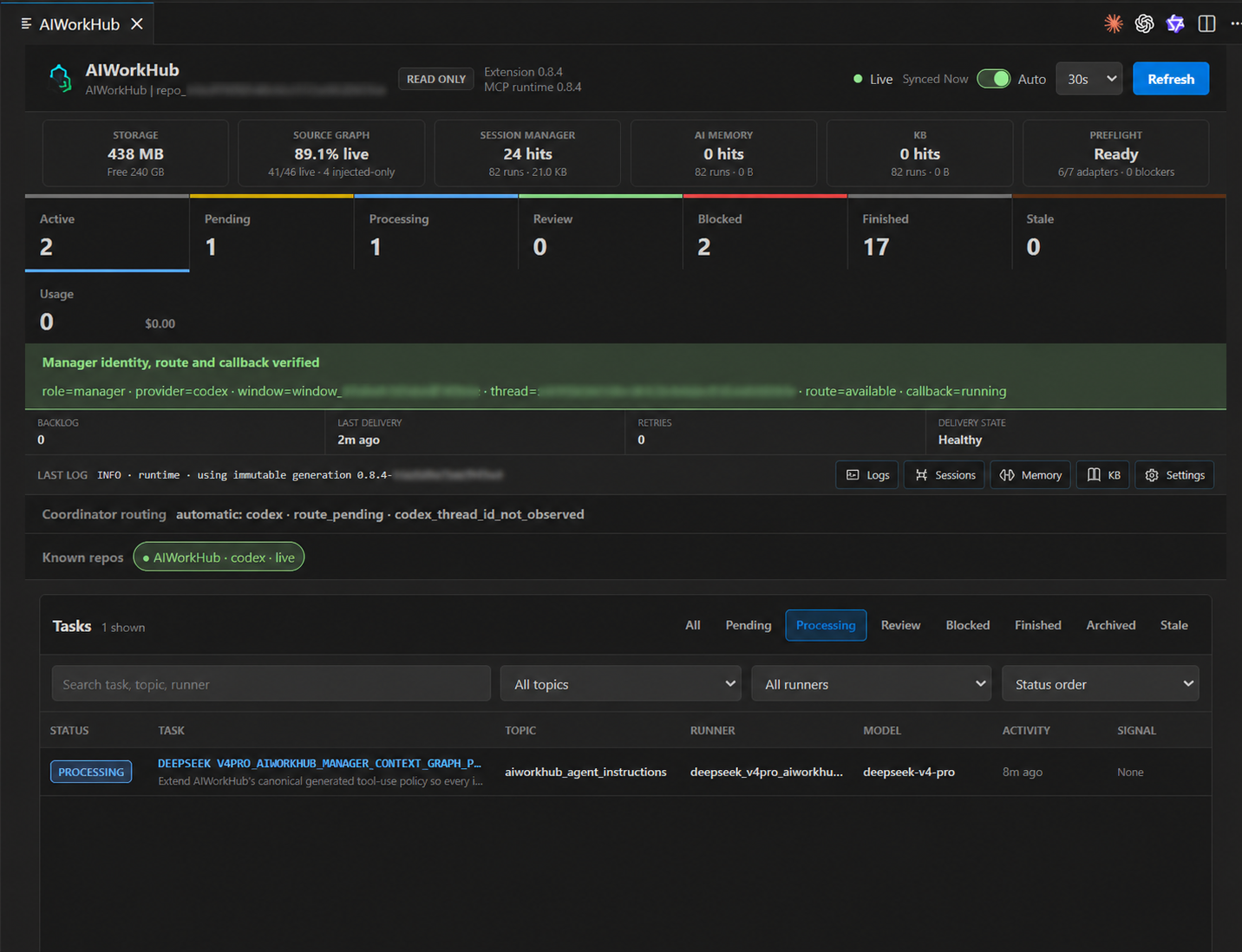 Tasks, callback health, source coverage, context stores, preflight and evidence in one retained editor tab.
Get started
- Install from the Marketplace (or install a release VSIX) and open a Git
repository in VS Code.
- Run AIWorkHub: Open Dashboard.
- Select the repository when using a multi-root workspace.
- Choose Initialize AIWorkHub on first use.
- Open a new Codex, Claude or MCP-capable chat after registration so the new
runtime tools are discovered by that chat process.
Initialization is explicit and idempotent. It creates repository-local state
only under .aiworkhub/ and starts the first Source Graph index in the
background.
For Claude Code, initialization also maintains the repository-local
.mcp.json server registration and the bounded AIWorkHub block in CLAUDE.md.
Open a new Claude chat after initialization or an AIWorkHub upgrade. That
direct chat is instructed to bootstrap as the manager, call manager Source
Graph before broad Read/Grep/Glob discovery, and re-query the graph when
its implementation or validation boundary changes. AIWorkHub-launched task
processes use the separate worker tool surface.
Run your first task
AIWorkHub is designed for a manager chat that delegates bounded work instead
of letting several models edit one checkout without coordination.
Start a new chat after initialization or upgrade and paste:
Use AIWorkHub as manager for the currently bound repository. Call
aiworkhub_manager_bootstrap first; verify repository identity, manager route,
callback, Source Graph and preflight. Do not edit or launch yet. Report what is
ready and what is degraded.
Then describe the desired outcome normally. Ask the manager to create bounded
cards and launch only independent, dependency-ready, non-colliding cards in
parallel. The MCP server also presents this lifecycle as a mandatory contract:
creating a task leaves it pending; exact claim plus launch establishes
processing; workers stop at review_ready; callbacks wake the current
verified manager; and only that manager accepts or rejects verified evidence.
- Check the dashboard header. Repository, MCP, Source Graph and callback
state should be ready; Preflight explains any unavailable optional
model adapters.
- Tell the manager what outcome you want. The manager creates a task card
with an exact objective, acceptance criteria, allowed writes, validation
commands and dependencies.
- The manager selects a ready adapter/model and launches the exact card.
Workers receive repository-scoped Source Graph, Session, Memory and KB
context and work in an isolated task workspace.
- Follow Live Output or continue other work. Terminal outcomes are durable
and the originating manager receives a callback when review is required.
- Open the task in Review. Inspect the bounded diff, tests, logs,
artifacts, tool-use receipts and independent reviewer evidence.
- Accept promotes the verified change and finalizes the task. Reject
records exact feedback and creates a bounded residual rather than silently
discarding the previous evidence.
Dependency cards remain pending until their prerequisites finish. Collision
checks prevent two active workers from owning overlapping write paths.
See the complete first-run and manager manual
for copy/paste planning/review prompts, Remote-SSH behavior and recovery after
an interrupted write acknowledgement.
Models and authentication
AIWorkHub does not proxy credentials or require an AIWorkHub account. It uses
models already authenticated in the corresponding editor or CLI. The table
lists observed runner families; Preflight reports which routes are actually
ready in this window. An optional adapter being unavailable does not block
otherwise ready models.
| Runner |
Typical adapter |
Requirement |
| Codex |
Codex CLI or VS Code Language Model |
Existing Codex login or one-time VS Code consent |
| Claude |
Claude Code CLI or VS Code Language Model |
Existing Claude subscription login or one-time VS Code consent |
| Copilot-hosted models |
VS Code Language Model |
GitHub sign-in and one-time model consent |
| DeepSeek |
VS Code Language Model or Copilot CLI fallback |
Provider visible in VS Code; fallback uses its own stored credential |
| GLM 5.3 |
VS Code Language Model or Copilot CLI fallback |
Provider visible in VS Code; fallback uses its own stored credential |
| Grok |
Observed Kilo/Grok worker route |
Existing provider login; Preflight reports whether that route is ready |
Source Graph and context
Source Graph is an incrementally refreshed structural repository index, not a
remote Sourcegraph service. It covers exactly 34 language/file families and
exposes exactly 37 currently exposed bounded Source Graph query modes.
Managers and workers start with low-token focus and slice queries, then
use calls, trace, impact, test mapping or typed bundles only when the task
needs them. Operations telemetry shows which modes were requested and
executed, returned evidence, workflow stage, latency, generation and
inter-call gaps.
Session Manager stores current state and handoffs; AI Memory stores durable
lessons; KB stores curated project facts; the optional Manager Context Graph
preserves bounded manager transcript evidence. All are repository-local and
have bounded viewers in the dashboard.
Commands
- AIWorkHub: Open Dashboard — open or reveal the retained editor tab.
- AIWorkHub: Select Repository — bind the dashboard in a multi-root window.
- AIWorkHub: Refresh Dashboard — refresh the current repository snapshot.
- AIWorkHub: Restart MCP Connection — replace only AIWorkHub's selected
repository MCP child.
Remote development
AIWorkHub is a workspace extension. In Remote-SSH, install it on the remote
extension host; its packaged Python runtime, MCP child and repository state run
beside the remote checkout. No port forwarding is required.
If the dashboard is not ready
- Connecting: use AIWorkHub: Restart MCP Connection once and inspect
the dashboard's last-log row. The extension restarts only its own child.
- A model is unavailable: open Preflight, confirm the provider is installed
and grant the one-time VS Code model consent when prompted.
- Source Graph is empty: initialize the repository, enable the required
language family in Settings and run a refresh.
- A chat cannot see tools: open a new chat after installation or upgrade so
that client performs MCP discovery against the current runtime.
- Windows upgraded from an old build: activation automatically migrates
legacy source/version
PYTHONPATH registrations to a host-stable packaged
runtime; no manual config.toml edit is required.
Trust and privacy
- Local stdio transport; no AIWorkHub network listener.
- Read-only and launch-disabled by default.
- Repository-specific state, route identity and audit trail.
- No AIWorkHub telemetry upload of prompts, source, credentials or memories.
- Explicit manager authority for context writes and task acceptance.
Read the full Getting Started guide,
Architecture,
Source Graph guide,
Manager Context Graph guide,
Security Policy and
Product Roadmap.
Development build
npm --prefix vscode-extension install
npm --prefix vscode-extension test
npm --prefix vscode-extension run package
code --install-extension vscode-extension/dist/aiworkhub-*.vsix
AIWorkHub is open source under the
MIT License.