
Professional SQL formatting for Visual Studio Code with multiple profile support — and the new Data Flow Explorer, a diagram of the tables, joins and data flow of your SQL.
New here? Open the SQLinForm Settings Panel first (Ctrl+Shift+P → "SQLinForm Settings Panel"). All formatting options live there, and its Format button is the quickest way to try them out on your SQL.
Demo
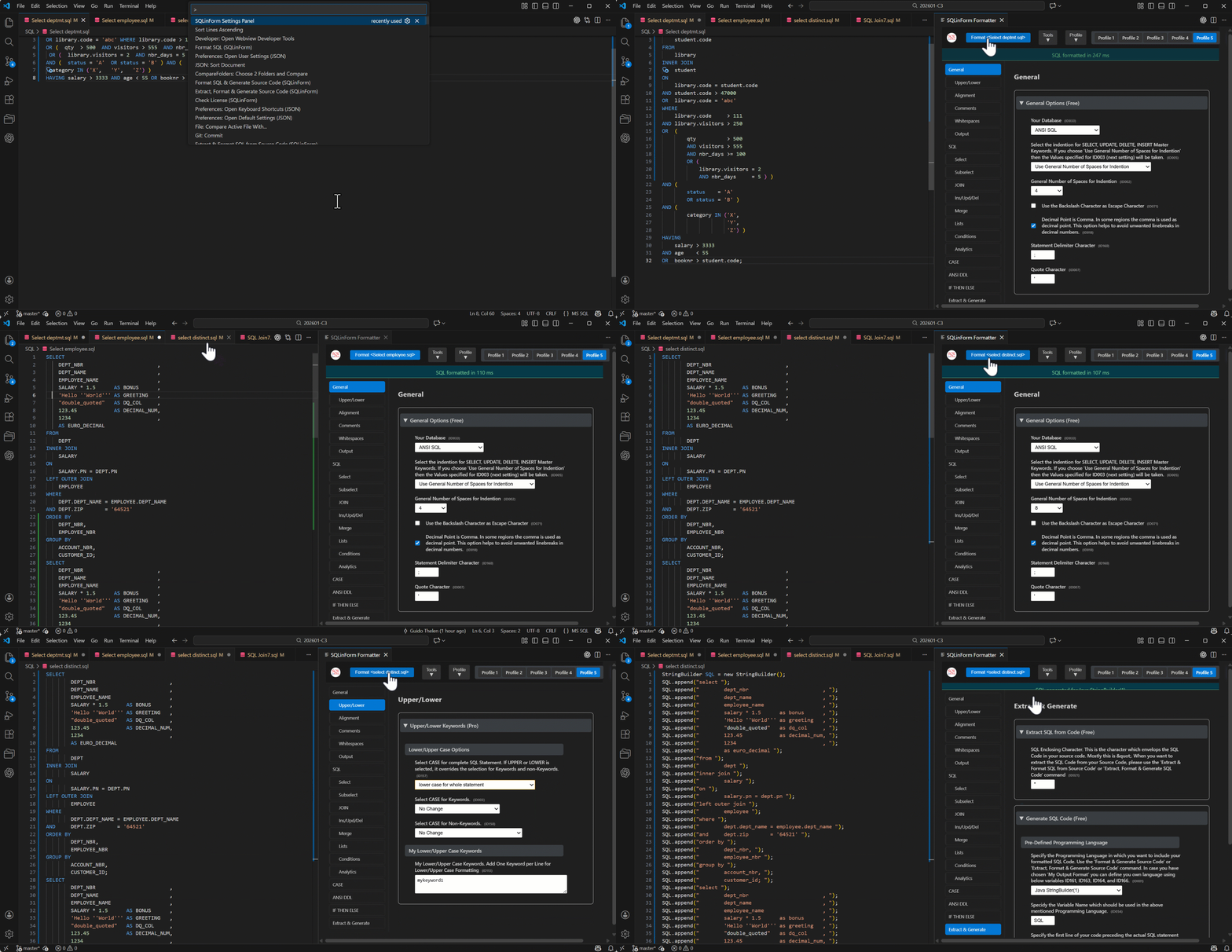
🚀 Quick Start
Start Here: Open the Settings Panel
⌨️ Press Ctrl+Shift+P (Cmd+Shift+P on Mac)
🔍 Type: "SQLinForm Settings Panel"
⏎ Press Enter
The Settings Panel is the home of SQLinForm. Every formatting option lives there, sorted into tabs — and the Format button in its header applies your settings to the SQL file you are working on. That is the everyday way to format: change an option, click Format, look at the result, repeat until the SQL looks the way you want it.
Two more reasons to open it as one of your first actions:
- ⚡ Instant formatting — the formatter loads in the background while the panel is open, so every later format is super fast.
- 🧭 Everything in one place — profiles, team folder, license, extract & generate: all in the panel toolbar.
SQLinForm also integrates with VS Code's native formatting system. You can format SQL the same way you format any other language:
| Action |
Windows / Linux |
macOS |
Description |
| Format Button |
Settings Panel |
Settings Panel |
Format the current file straight from the panel |
| Format Document |
Shift+Alt+F |
Shift+Option+F |
Format the entire SQL file |
| Format Selection |
Ctrl+K Ctrl+F |
Cmd+K Cmd+F |
Format only the selected text |
| Format on Save |
Enable in Settings |
Enable in Settings |
Automatically format when saving |
| Context Menu |
Right-click |
Right-click |
Select "Format SQL (SQLinForm)" |
| Command Palette |
Ctrl+Shift+P |
Cmd+Shift+P |
Type "Format SQL" |
To automatically format your SQL every time you save:
- Press
Ctrl+, (Mac: Cmd+,) to open VS Code Settings
- Search for
format on save
- Enable Editor: Format On Save
Switch Profiles
The active formatting profile is shown in the status bar (bottom right) when editing SQL files.
- Click the status bar item to switch between profiles
- Both Local and Team profiles are shown — selecting a profile from the other group switches automatically
- Or use
Ctrl+Shift+P (Mac: Cmd+Shift+P) → "Switch Profile (SQLinForm)"
Data Flow Explorer
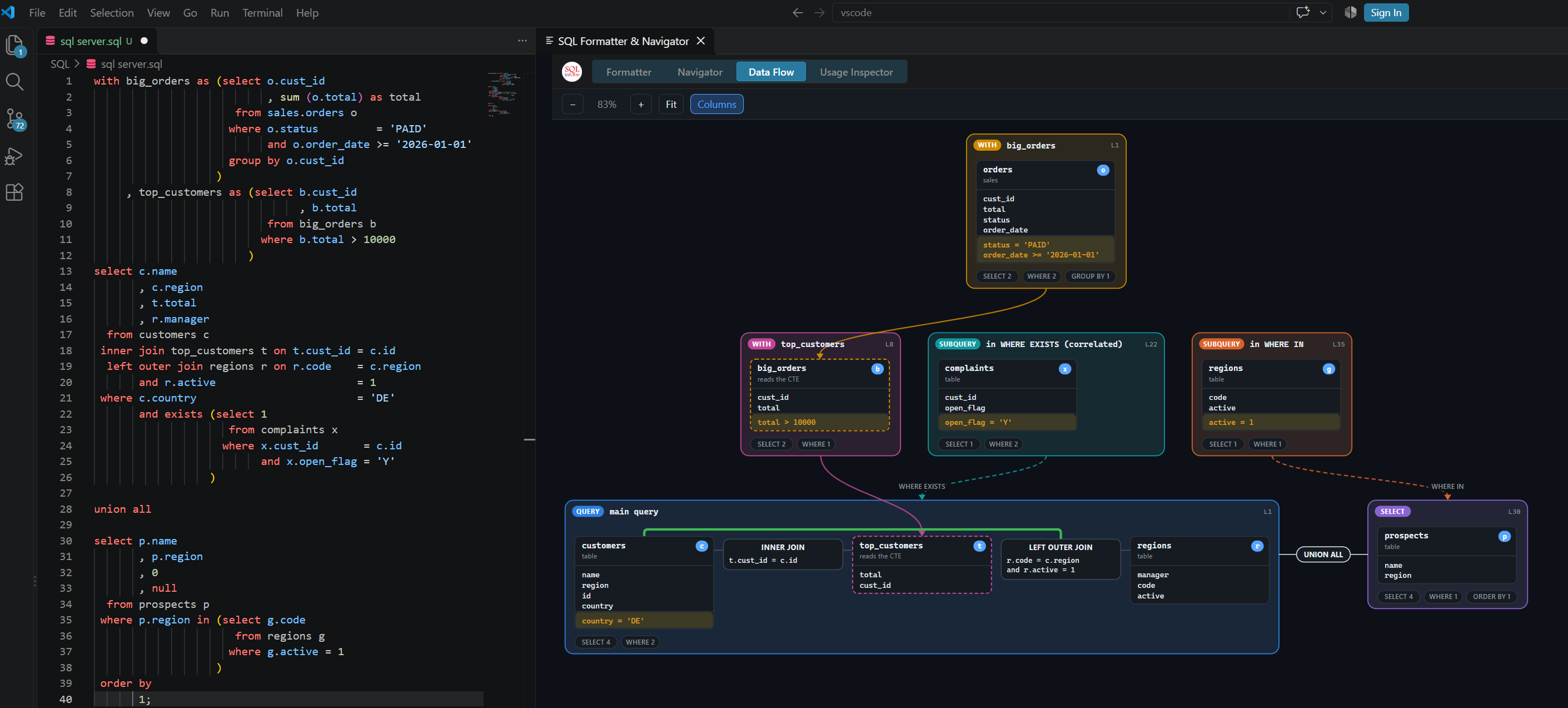
Understand SQL you did not write. The Data Flow Explorer draws a diagram of your existing SQL that shows what the text cannot show at a glance: which tables a query reads, how they are joined and how the data flows through CTEs, sub-queries and UNIONs. It is free, like the Navigator and the Usage Inspector.
Open it with the switch Formatter | Navigator | Data Flow | Usage Inspector at the top of the SQLinForm tab. Without an analysis it analyzes the SQL editor by itself.
What it shows:
- 🧱 Every query block (main query, CTE, derived table, sub-query, branch of a UNION) as a frame with its tables, the columns it uses and its filters
- 🔗 Joins as lines between the tables, with join type and condition
- ➡️ Data flow as arrows: from CTEs, derived tables and sub-queries into the queries that read them, through UNIONs and into the target of an INSERT
Work with it:
- 🖱️ Click a box to select its lines in the editor
- Analyze SQL — the diagram of the selection or of the whole file, without changing it
- ↗ Open in Browser — print the diagram or save it as PDF (
Ctrl+P in the browser)
- SVG — save the diagram as SVG file
Columns are shown for a table when the SQL names them with the alias or name of the table (o.total).
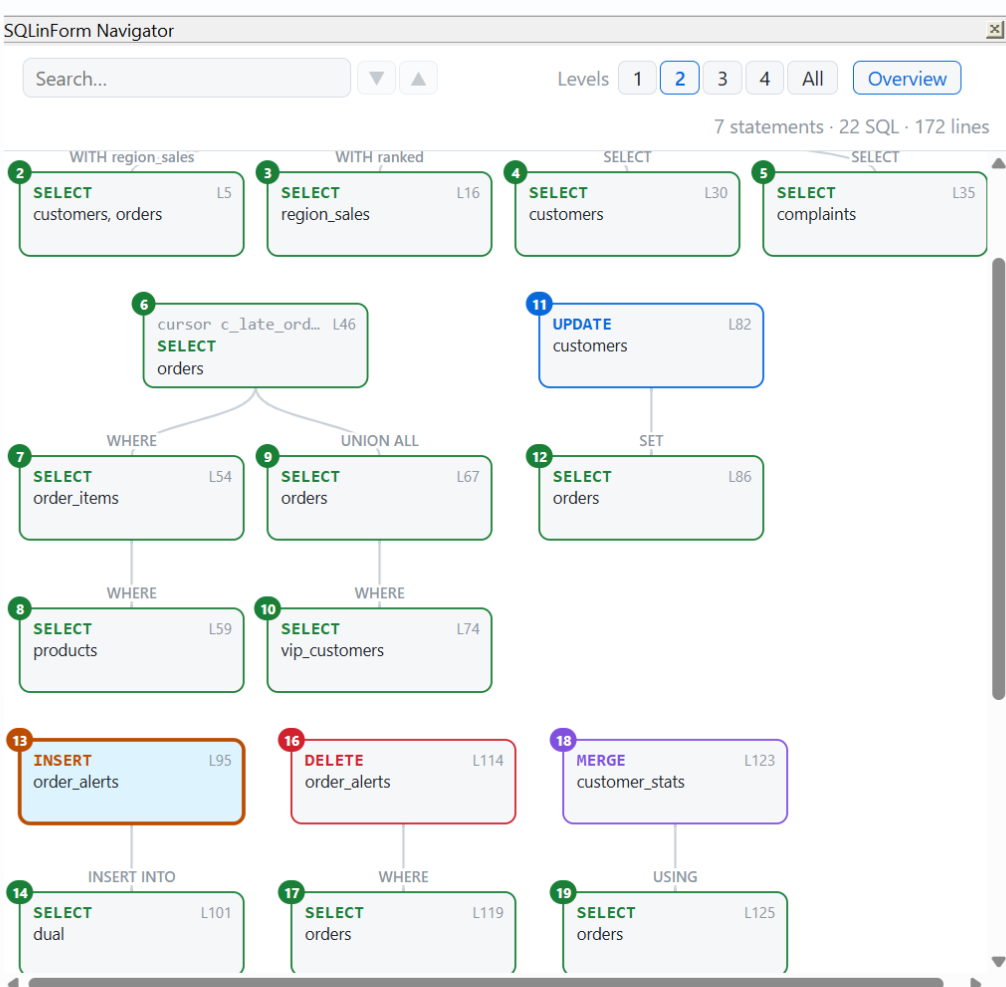
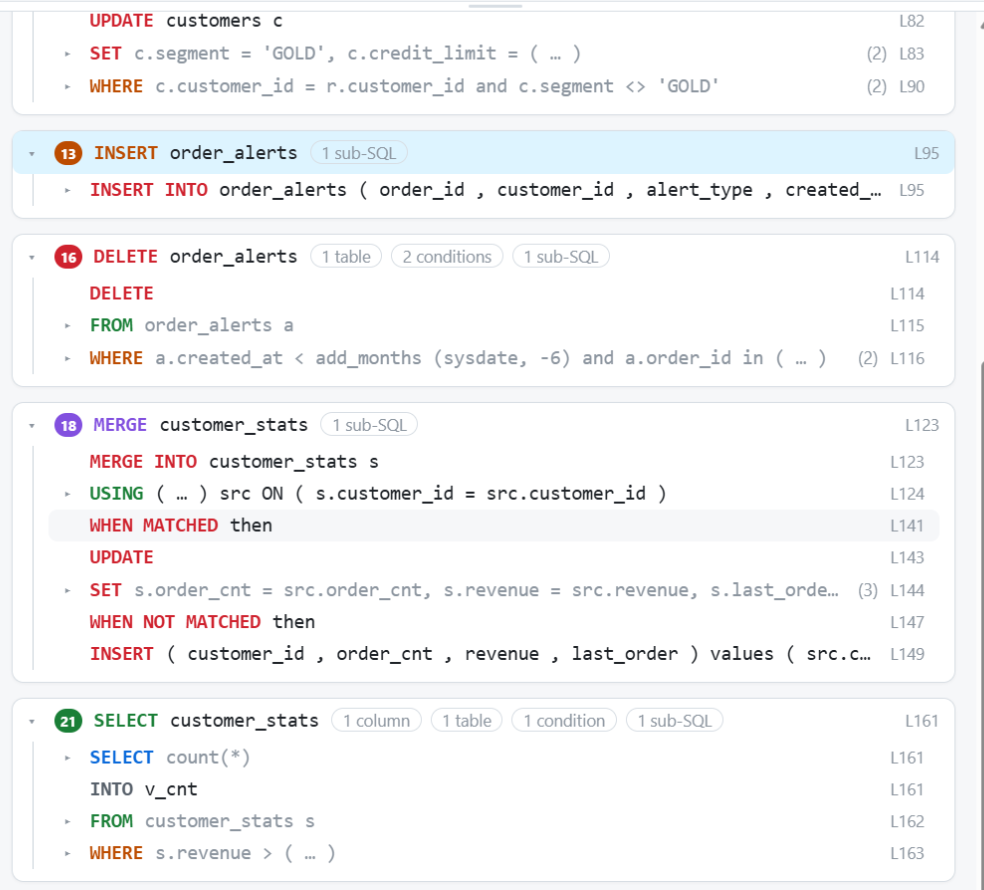 See the structure of your SQL at a glance: an overview graph of all statements with their sub-queries, CTEs and cursors, and a tree with the clauses, columns, tables and conditions of every statement.
Open it with one of these:
- The switch Formatter | Navigator | Data Flow | Usage Inspector at the top of the SQLinForm tab
Ctrl+Shift+P (Mac: Cmd+Shift+P) → "Show Navigator (SQLinForm)"- The SQLinForm menu in the editor title bar
Work with it:
- 🖱️ Click a row of the tree to jump to its line in the editor
- 🔦 Move the mouse over a box to highlight its lines in the editor
- 🔍 Search and Levels buttons in the tree; Overview shows or hides the graph (shown by default)
- Analyze SQL — the structure of the selection (several lines) or of the whole file, without changing it
- ↗ Open in Browser — print the Navigator or save it as PDF (
Ctrl+P in the browser)
- SVG — save the overview graph as SVG file
The Navigator follows your SQL after every format: Format SQL (SQLinForm), the Format button of the panel, Shift+Alt+F, Format Selection and Format on Save. After editing the SQL by hand, click Analyze SQL.
Usage Inspector
See how often each word of your SQL is used, for example to find a variable that is declared but never used. It shows the whole formatted SQL, including what the Navigator tree does not show, such as DECLARE.
Open it with one of these:
- The switch Formatter | Navigator | Data Flow | Usage Inspector at the top of the SQLinForm tab
Ctrl+Shift+P (Mac: Cmd+Shift+P) → "Show Usage Inspector (SQLinForm)"- The SQLinForm menu in the editor title bar
Work with it:
- 🖱️ Move the mouse over a word to see how often it is used and all the lines that contain it
- 📌 Click the word to keep the list open, click a line in the list to jump to it in the Usage Inspector and in the editor (after Analyze SQL the word itself is selected, after a format its line)
- 🔍 Search for a word to mark all its places
Comments are not counted, and uses in strings are counted separately, because a variable that is only used in dynamic SQL is not dead. Case is ignored. The result is a hint, not a proof: SET @x = 1 counts as a use.
🌟 Key Features
- ✨ Professional SQL Formatting with industry-standard rules
- 🗺️ Data Flow Explorer — a diagram of the tables, joins and the flow of the data through CTEs, sub-queries and UNIONs
- ⌨️ Native VS Code Integration — Shift+Alt+F (Mac: Shift+Option+F), Format on Save, Format Selection
- 📊 Status Bar Profile Indicator — see and switch the active profile with one click
- 🎭 5 Independent Profiles — different styles for different projects
- 👥 Team Profile Sharing — share formatting profiles via shared network or cloud directory
- 🔄 Cross-Plugin Sync — profiles shared across VS Code, SSMS, Notepad++, JetBrains, DBeaver, Desktop App
- 🧭 SQLinForm Navigator — overview graph and tree of your SQL, click a row to jump to its line
- 🔍 Usage Inspector — see how often each word of your SQL is used
- 🗄️ 28 Databases — SQL Server, PostgreSQL, Oracle, MySQL, DB2, BigQuery, Snowflake, Trino, Athena, and many more
- 💎 Free & Pro Versions — Pro version unlocks 200+ advanced options
📥 Installation
From VS Code Marketplace:
- Open Extensions (
Ctrl+Shift+X, Mac: Cmd+Shift+X)
- Search for "SQLinForm"
- Click Install
⚙️ Settings
If you want to temporarily disable SQLinForm as the default SQL formatter:
- Press
Ctrl+, (Mac: Cmd+,) to open VS Code Settings
- Search for
sqlinform.format.enable
- Uncheck the setting
When disabled, Shift+Alt+F (Mac: Shift+Option+F) and Format on Save will not trigger SQLinForm.
If you have multiple SQL formatters installed, VS Code will ask which one to use. You can set SQLinForm as the default:
- Press
Ctrl+, (Mac: Cmd+,) to open VS Code Settings
- Search for
default formatter
- Under
[sql], select SQLinForm
- Format Button — Format SQL directly from the Settings Panel with one click
- Smart File Display — Button shows current target file:
Format <filename.sql>
- Selection Support — Format only selected text or the entire document
- Formatter | Navigator | Usage Inspector — switch the tab between the formatting options, the SQLinForm Navigator and the Usage Inspector
- Extract SQL — Extract SQL from source code (Java, C#, etc.)
- Generate Code — Generate source code strings from formatted SQL
- Quick Access — Check License, Changelog, Website, and Feedback
- Import/Export Profile — Share formatting settings as JSON files
🔑 License
Free Version
- ✅ Full SQL formatting
- ✅ All 5 profiles
- ✅ Data Flow Explorer, Navigator and Usage Inspector
- ⚠️ Pro settings use defaults
Pro Version
- ✅ All 200+ advanced options
- ✅ Priority support
- 💎 Pro badge
Upgrade to Pro
📚 Documentation & Support
- 📖 Full Release Notes: see the Changelog tab on this Marketplace page, or Settings Panel → Tools → View Changelog
- 🌐 Website: sqlinform.com
- 📧 Support: info@sqlinform.com
💡 Common Questions
How do I format SQL?
→ Shift+Alt+F (Mac: Shift+Option+F) or right-click → "Format SQL (SQLinForm)"
How do I format on save?
→ VS Code Settings → enable "Editor: Format On Save"
Where are my settings?
→ Ctrl+Shift+P (Mac: Cmd+Shift+P) → "SQLinForm Settings Panel"
How to switch profiles?
→ Click the profile name in the status bar (bottom right), or Ctrl+Shift+P (Mac: Cmd+Shift+P) → "Switch Profile"
My old settings?
→ Automatically migrated to Profile 1
Team sharing?
→ Settings Panel → Local/Team menu → Set Team Folder
Publisher: GuTheSoftware
Made with ❤️ by the SQLinForm Team

