CommitBro — Bro Commit with AI
Every bro carries a diff he cannot explain.
He types fix stuff, and the night forgives him — but git never forgets.
Six months on, another bro runs git log and finds only silence
where a story should have been.
So commit, bro. Say what changed, and why it had to.
Code is what you wrote; the log is what you meant.
Generate detailed, comprehensive git commit messages from your changes using
any of 7 LLM providers — Gemini, OpenAI, DeepSeek, GLM, Anthropic Claude,
Kimi, or MiniMax — one click in the Source Control panel.
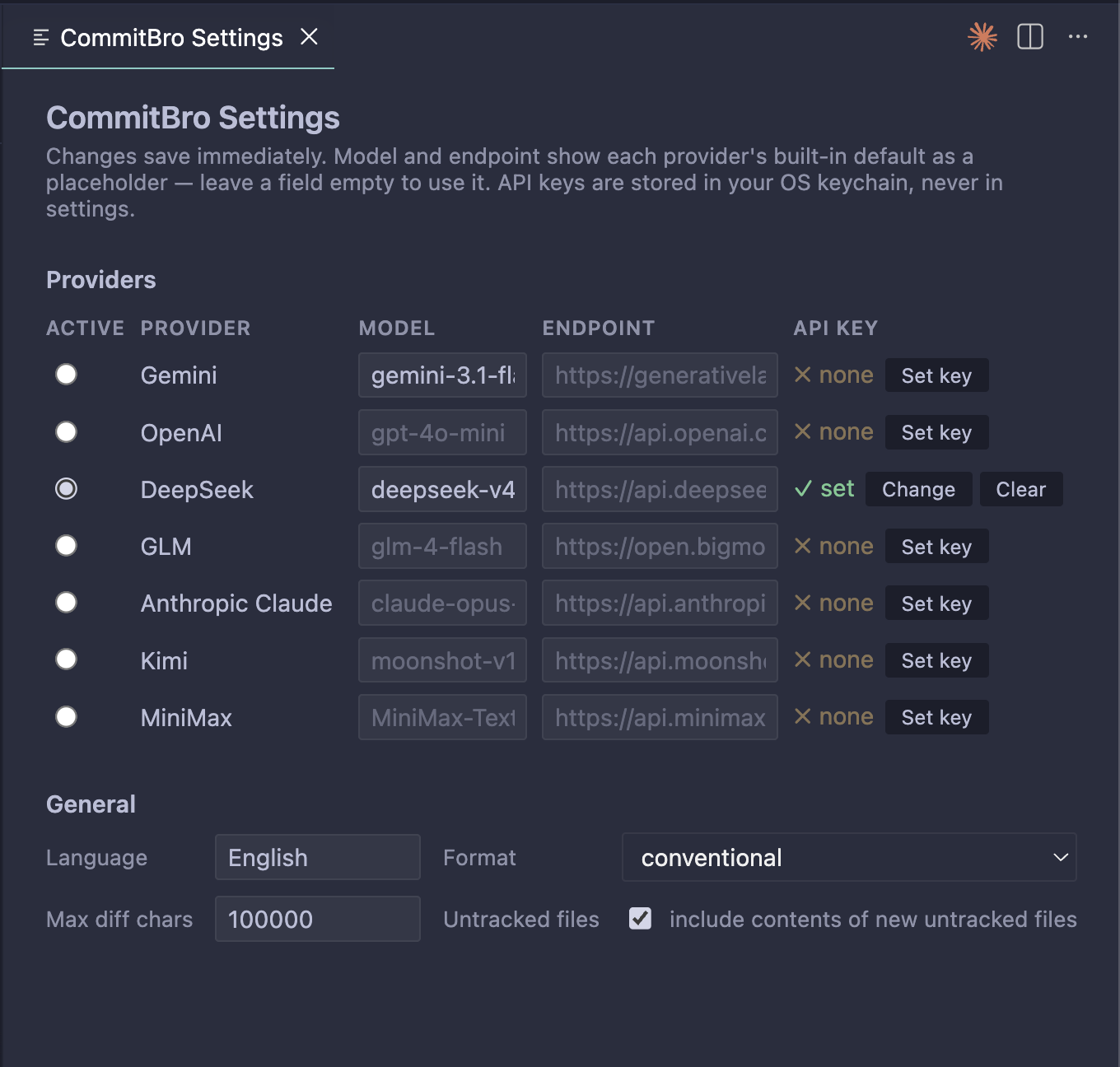
Every provider, model, endpoint, and key in one place — pick one, paste a key,
and you're done.
Features
- ✨ button in the Source Control title bar (and a Command Palette command).
- Analyzes all changes: staged, unstaged tracked, and new untracked files.
- Multi-repo workspaces: pick which git folder to act on from a Repository
dropdown, with a separate draft message kept per repo.
- Conventional Commits or freeform, in the language you choose.
- Switch provider, model, and API endpoint from the panel — no settings.json
editing required.
- Each provider's API key is stored securely in VSCode SecretStorage — never
in settings.
- Generated message streams in with a typewriter animation as it arrives.
Setup
- Open the CommitBro panel from the Activity Bar (left sidebar) and
expand its collapsible provider section, or set
commitBro.provider
directly in Settings.
- Pick a provider and set its API key — the panel's Set key button,
the CommitBro: Set API Key command, or paste it into the provider's
apiKey field in the commitBro.providers setting (it is moved to your
OS keychain and erased from the setting immediately).
- Click ✨ Generate.
Usage
The CommitBro panel works like Source Control, in one place:
- Make some changes in a git repository.
- Click ✨ Generate — the commit message box fills from all your changes.
Edit it if you like.
- Click ✓ Commit (stages everything with
git add -A, then commits) or
↑ Commit & Push (also runs git push, publishing the branch to origin
the first time). If new untracked files would be included, you're asked to
confirm first.
The two steps are reported separately, so a push that fails never hides a commit
that worked. When the commit lands but the push does not — no network, expired
credentials, a rejected non-fast-forward — you get "Committed, but the push
failed" with the reason git gave, and a Retry Push button that keeps
offering until the push succeeds or you dismiss it.
Workspaces with several git repositories
When the workspace holds more than one git folder — a monorepo of separate
repos, or several folders added to one window — a Repository dropdown
appears at the top of the panel. Everything (Generate, Commit, Commit & Push,
and the branch · N changes header) targets the repository shown there, so
what you see is what you commit.
Until you touch the dropdown it follows the active editor, so opening a file
picks its repo automatically. Choosing one explicitly pins it, and the pin
holds while you edit files elsewhere until you change it again or close that
repo. Each repository keeps its own draft message: switching repos swaps
the text box rather than carrying one repo's generated message into a commit on
another. CommitBro: Select Repository does the same from the Command
Palette or the panel's ··· menu.
The panel header (branch · N changes) shows what will be committed. The
collapsible section above the message box holds the provider dropdown, model
and endpoint overrides (blank = built-in default; hover the endpoint field to
see the full value), and key status/Set key button.
You can also trigger generation the classic ways: the ✨ button in the built-in
Source Control panel, or CommitBro: Generate Commit Message from the
Command Palette — both fill the Source Control message box.
Settings
| Setting |
Default |
Description |
commitBro.provider |
gemini |
Active provider: gemini, openai, deepseek, glm, anthropic, kimi, or minimax. |
commitBro.providers |
{} |
All per-provider settings in one map, keyed by provider id. Each entry may set model, baseUrl, and apiKey — see below. |
commitBro.language |
English |
Language for the generated commit message (e.g. English, Bahasa Indonesia). |
commitBro.format |
conventional |
conventional or freeform. |
commitBro.maxDiffChars |
100000 |
Maximum characters of change context sent to the provider. |
commitBro.includeUntracked |
true |
Include contents of new untracked files in the analysis. |
Per-provider settings
The easiest editor is CommitBro: Open Settings — the GUI table pictured at
the top of this page, no JSON involved. Under the hood everything specific to
one provider lives in a single commitBro.providers entry:
"commitBro.providers": {
  "openai": {
    "model": "gpt-4o",
    "baseUrl": "https://my-proxy.example/v1",
    "apiKey": "sk-..."
  }
}
model / baseUrl — omit or leave blank to use the provider's built-in
default. Both are also editable from the panel's provider section.apiKey — a write-through input: the key is moved to secure storage
(your OS keychain) and erased from this setting immediately, so it normally
reads empty. An empty field means the key is stored safely, not missing.
Keys under an unrecognized provider name are left in place and reported,
never silently deleted.
The separate models, baseUrls, and apiKeys maps of older versions are
folded into commitBro.providers automatically on first activation.
Regional endpoints
A few providers default to a mainland-China endpoint; international accounts
need a baseUrl override, for example:
- Kimi (Moonshot AI):
https://api.moonshot.ai/v1
- GLM (Zhipu AI):
https://api.z.ai/api/paas/v4
- MiniMax:
https://api.minimaxi.com/v1
Commands
- CommitBro: Generate Commit Message
- CommitBro: Set API Key
- CommitBro: Clear API Key
- CommitBro: Select Repository — in a workspace with several git folders,
choose which one CommitBro acts on.
- CommitBro: Open Settings — opens the extension's own settings editor: a
table of all seven providers (model, endpoint, API key status with Set/Clear
buttons per row), the active-provider picker, and the general options. No
JSON editing needed; also reachable from the gear icon on the panel.
Upgrading from an older version? Command ids have changed twice —
geminiCommit.* (Gemini-only), then aiCommit.*, and now commitBro.*.
Update any custom keybindings that reference the old ids. See CHANGELOG.md.
Migrating from an earlier version
Existing installs are migrated automatically the first time this version
activates: settings and stored API keys from either older namespace —
geminiCommit.* or aiCommit.* — are copied to their commitBro.*
equivalents, including installs that skipped a version. Where both exist,
aiCommit.* wins, being the more recent. The old settings and keys are left
in place (not deleted), so downgrading stays possible.
Develop
npm install
npm run compile      # bundle to dist/extension.js
npm test             # run unit tests
Press F5 in VSCode to launch an Extension Development Host.

