DevAssure O2 Agent
The DevAssure O2 Agent Extension embeds intelligent testing directly into your development environment.
It understands your code changes, determines impacted flows, and generates or updates end-to-end tests accordingly.
No context switching. No manual upkeep.
Just describe flows in natural language. O2 turns them into executable UI tests.
Learn More - https://www.devassure.io/o2-testing-agent
How it works
After you log in and initialize a project, the extension uses a .devassure folder in your workspace for configuration and test cases. You can test your code branch or commit, the agent will scan the changes and generates test scnearios to validate the change. Agent can execute the tests in a browser and generate reports. You can also add tests as YAML files or CSV, then run them from the DevAssure sidebar (Tests view) or from the editor via CodeLens. Execution logs stream in the Run Logs panel, and you can open reports from the History view or from archived zip files.
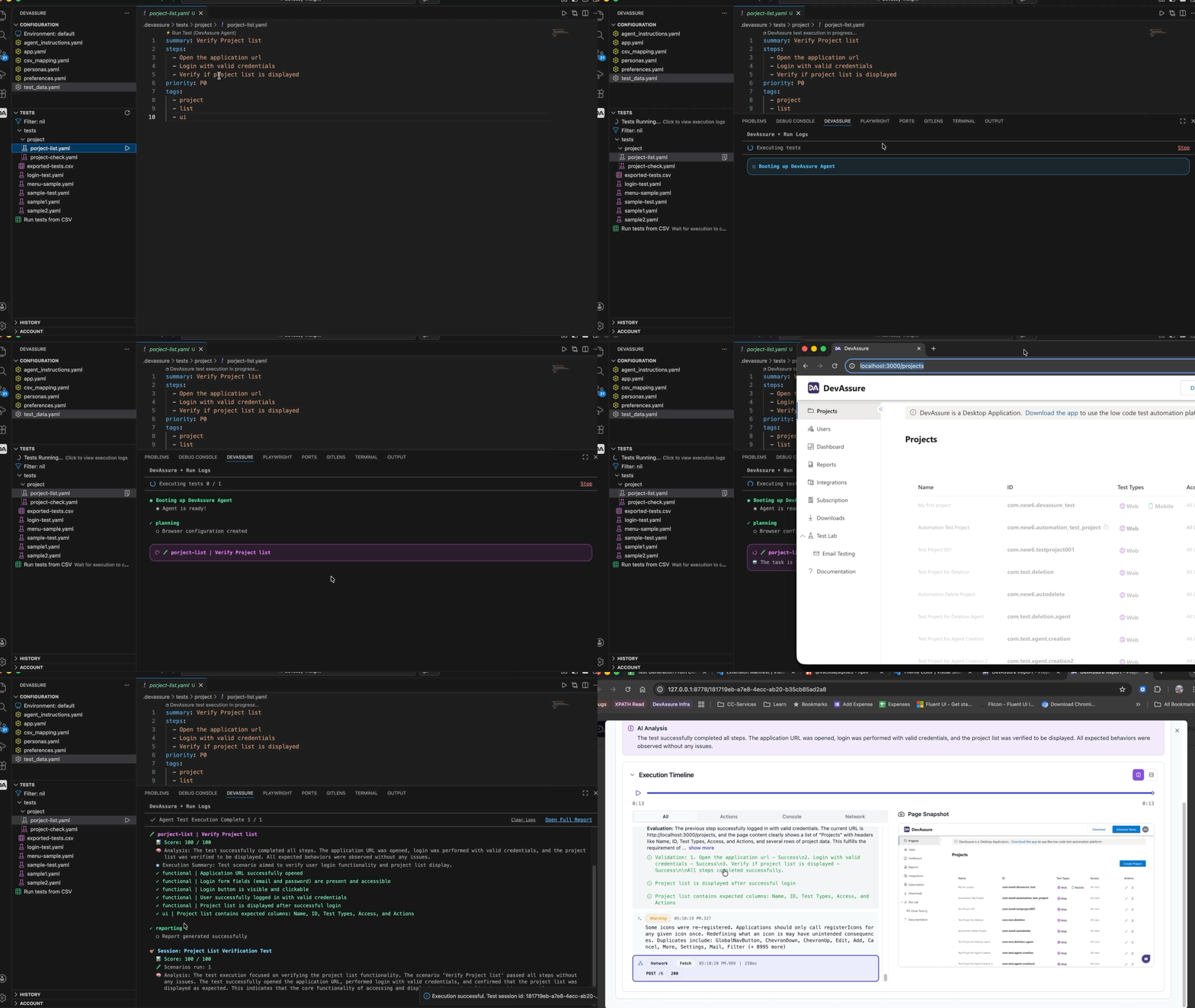
Execute tests from yaml and get intelligent reports
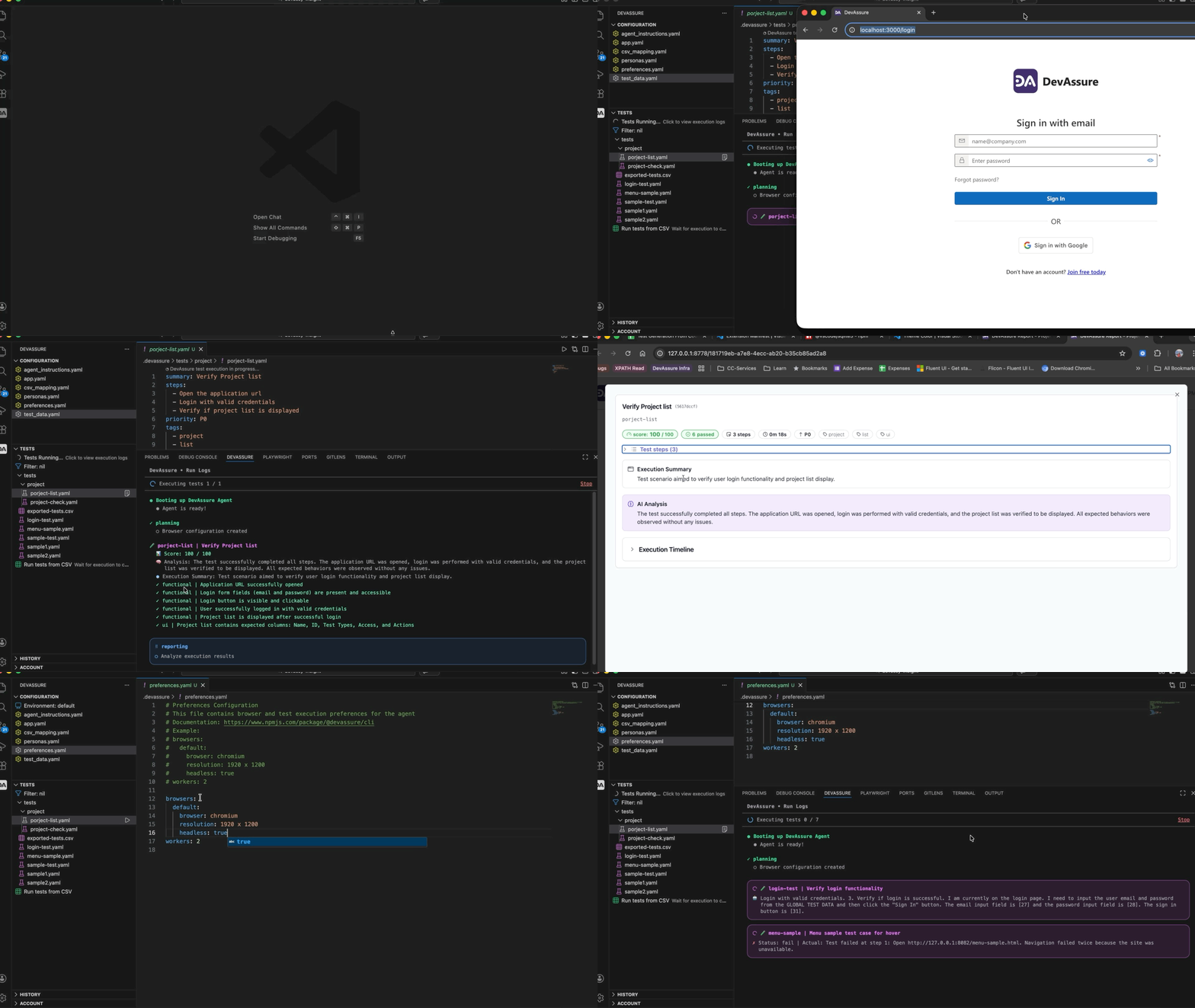
Setup Instructions
Login
- In the left sidebar, click the DevAssure icon to open the DevAssure view, then click Login (shown in the welcome content when you are not logged in).
- Your browser opens for OAuth2 authentication with DevAssure.
- Alternatively, use DevAssure: Add Auth Token from the Command Palette or DevAssure view to authenticate with a token (see Add auth token).
Initialization
- In the DevAssure left sidebar, click Initialize DevAssure (shown in the welcome view when no project is configured).
- When prompted, choose the workspace folder to initialize.
- Enter your app URL, app description, and one or more personas (name and short description).
- The extension creates a
.devassure folder with configuration files and a sample test. If .devassure already exists, you will be asked whether to override it.
The .devassure folder
The parent directory of .devassure is the project path. All DevAssure configuration and tests live under .devassure/:
| Path |
Purpose |
app.yaml |
App description and rules for the agent |
personas.yaml |
(Optional) User personas used in tests |
test_data.yaml |
Default URL, users, and test data per environment |
agent_instructions.yaml |
Instructions for the agent during execution |
preferences.yaml |
Browser and execution preferences (e.g. headless, workers) |
csv_mapping.yaml |
Column mappings when running tests from CSV |
tests/ or test/ |
Directory for test case YAML files and optional CSV files |
actions/ |
Directory for action YAML files (reusable step groups) |
hooks/ |
Hook YAML files (before_all, after_all) executed once per run |
tools/ |
Custom tools; tools/index.yaml defines tools and optional setup/settings |
Configuration YAML files (overview)
- app.yaml –
description (multi-line) and rules list for the agent.
- personas.yaml – Optional personas with
description and optional fields (e.g. age_group, region).
- test_data.yaml – Top-level keys are environment names (e.g.
default, uat). Each has url, users, and any custom test data. The extension’s Environment setting selects which key is used.
- agent_instructions.yaml –
instructions list of strings for the agent (e.g. retry rules, fallbacks).
- preferences.yaml –
browsers.default (e.g. browser: chromium, resolution, headless) and workers.
- csv_mapping.yaml – Maps CSV column names to test case fields:
summary, steps, priority, tags (and optionally folder).
Sample configuration files
All configuration files live under .devassure/. Below are sample contents for each file type.
app.yaml – App description and rules for the agent:
description: >
  About my app
  in multi line
rules:
  - User can't create more than 3 projects
  - Any data deleted can't be restored
personas.yaml – (Optional) User personas used in tests:
normal_user:
  description: No admin access can do all other operations
  age_group: 18-30
  gender: M
  region: USA
admin:
  description: Admin can add or delete other users and manage privileges
deactivated_user:
  description: Login is deactivated by admin
expired_user:
  description: License has expired
test_data.yaml – Default URL, users, and test data per environment. If a key is not present for the selected environment, the default data is used:
default:
  url: 'http://localhost:3000'
  users:
    default:
      user_name: 'user@test.com'
      password: 12345678
    admin:
      user_name: 'admin@test.com'
      password: 12345678
  stripe_data:
    allowed_card:
      card: 4444 4444 4444 4444
    wrong_cvv:
      card: 1234 1234 1234 1234
      expiry: 10/28
      cvv: 123
  test_otp: 1122
uat:
  url: 'http://uat.myapp.com'
  users:
    default:
      user_name: 'user@uat.com'
      password: 12345678
    admin:
      user_name: 'admin@uat.com'
      password: 12345678
  test_otp: 2345
agent_instructions.yaml – Instructions for the agent during test execution:
instructions:
  - Reload the app and retry if app shows warning server is busy
  - Sign up a new user and proceed if any of the given logins are not working
preferences.yaml – Browser and execution preferences:
browsers:
  default:
    browser: chromium
    resolution: 1280 x 720
    headless: true
workers: 2
csv_mapping.yaml – Column mappings when running tests from a CSV file. Maps CSV column names to test case fields:
summary: Summary
steps: Steps
priority: Priority
tags: Tags
Sample test case (e.g. .devassure/tests/sample-test.yaml):
summary: Sample test case
steps:
  - Open the application url
  - Verify if the page loads successfully
  - Verify if there are no error messages
priority: P1
tags:
  - sample
  - ui
Adding test cases
YAML test cases
Add .yaml or .yml files under .devassure/tests/ (or .devassure/test/). Each file should define at least summary and steps; priority and tags are optional.
Example:
summary: Sample test case
steps:
  - Open the application url
  - Verify if the page loads successfully
  - Verify if there are no error messages
priority: P0
tags:
  - sanity
  - app-load
From the extension
In the DevAssure sidebar, open the Tests view. Right-click the tests root (or any folder under it):
- Add Folder – Creates a new subfolder (e.g.
my-suite).
- Add Test Case – Prompts for a name, creates a new
.yaml file with placeholder content (summary, priority, tags, steps), and opens it in the editor.
Running tests
From the left panel (Tests view)
- Single file: Click the run (play) icon on a test file, or use the context menu Run Test. Only that file is executed.
- Folder or all tests: Click the run icon on a folder or on the tests root to run all tests in that scope. The saved filter (see Filters) is combined with the folder scope when running a folder.
- While a run is active, a Tests Running... item appears; click it to open the Run Logs panel.
From the editor (CodeLens)
- Open a test file under
.devassure/tests/ (or test/). A CodeLens Run Test (DevAssure Agent) appears at the top; click it to run that file.
- Open a CSV file under
.devassure/. A CodeLens Run Test Rows (DevAssure Agent) appears; click it to run tests from that CSV.
Test code changes and Create test plan (Tests view)
In the Tests view, two items let you work with git changes in your repository:
Test code changes
- Where: Click Test code changes in the Tests view (requires a git repo at the project path).
- Flow: Choose For a branch or For a commit, then:
- For a branch — Two quick picks: branch to test (default: current branch) and base branch (default: repo default).
- For a commit — Quick pick of the 20 most recent commits or type a commit ID (default: current commit / HEAD).
- Result: The agent analyzes the diff, generates test scenarios for impacted flows, and runs them in a browser session. Progress appears in the Run Logs panel.
Create test plan
- Where: Click Create test plan in the Tests view (below Test code changes).
- Flow: Same mode picker and branch/commit inputs as Test code changes.
- Result: The agent analyzes the diff and proposes test scenarios without executing them. When complete, the Run Logs panel shows a scenario table (Label, Scenario, Priority, Tags), View full plan, and Execute plan buttons.
If no DevAssure project is selected, execution is in progress, or setup is still running, these items may be disabled or show a wait message.
Run Logs panel
The DevAssure panel in the bottom panel area shows Run Logs – the live execution feed for the current session. Open it by clicking Tests Running... in the Tests view when a run is active, or by opening the bottom panel and selecting the DevAssure tab, then Run Logs.
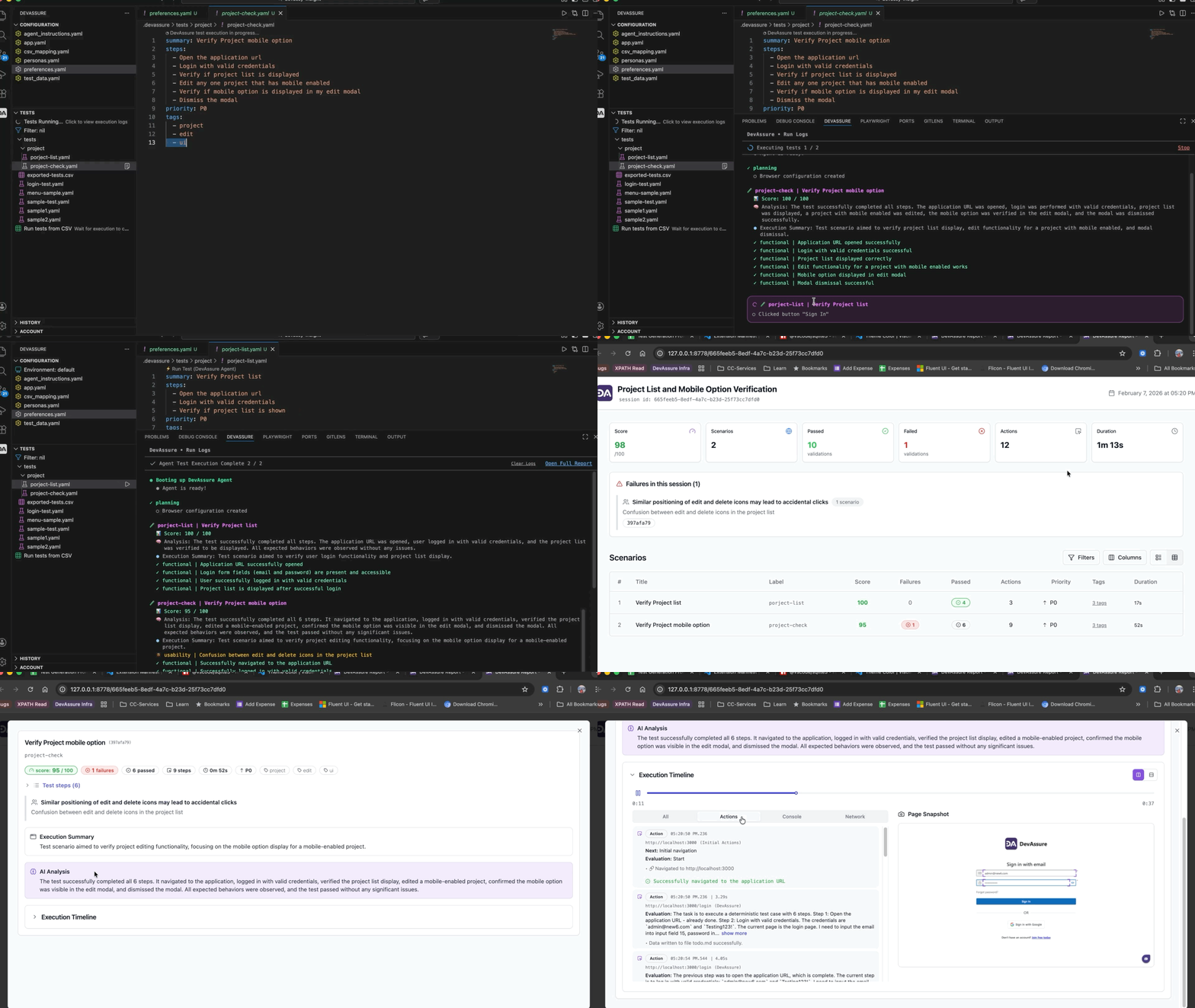
Running tests from a CSV file
CSV mapping config (csv_mapping.yaml)
Create .devassure/csv_mapping.yaml to map your CSV column headers to test case fields. Supported keys: summary, steps, priority, tags (and optionally folder).
Example:
summary: Summary
steps: Steps
priority: Priority
tags: Tags
If your CSV uses different headers (e.g. from TestRail or Jira), set the right-hand side to the exact column name from your CSV. For example, if your export has columns "Title" and "Steps (Expected Result)", use summary: Title and steps: "Steps (Expected Result)" in csv_mapping.yaml.
Default mapping
If csv_mapping.yaml is missing, the agent may expect default column names such as Summary, Steps, Priority, Tags. For custom CSVs, add csv_mapping.yaml so columns map correctly.
- Run a specific CSV: In the Tests view, CSV files under
.devassure/tests/ (or test/) show a run icon. Click it to run that CSV (the saved filter applies to which rows are run).
- Run tests from CSV: Use the Run tests from CSV item at the bottom of the Tests view. A file picker opens (defaulting to
.devassure); choose a CSV file to run.
From Editor (CodeLens)
Open a CSV file under .devassure/ in the editor. The CodeLens Run Test Rows (DevAssure Agent) runs that CSV with the current filter.
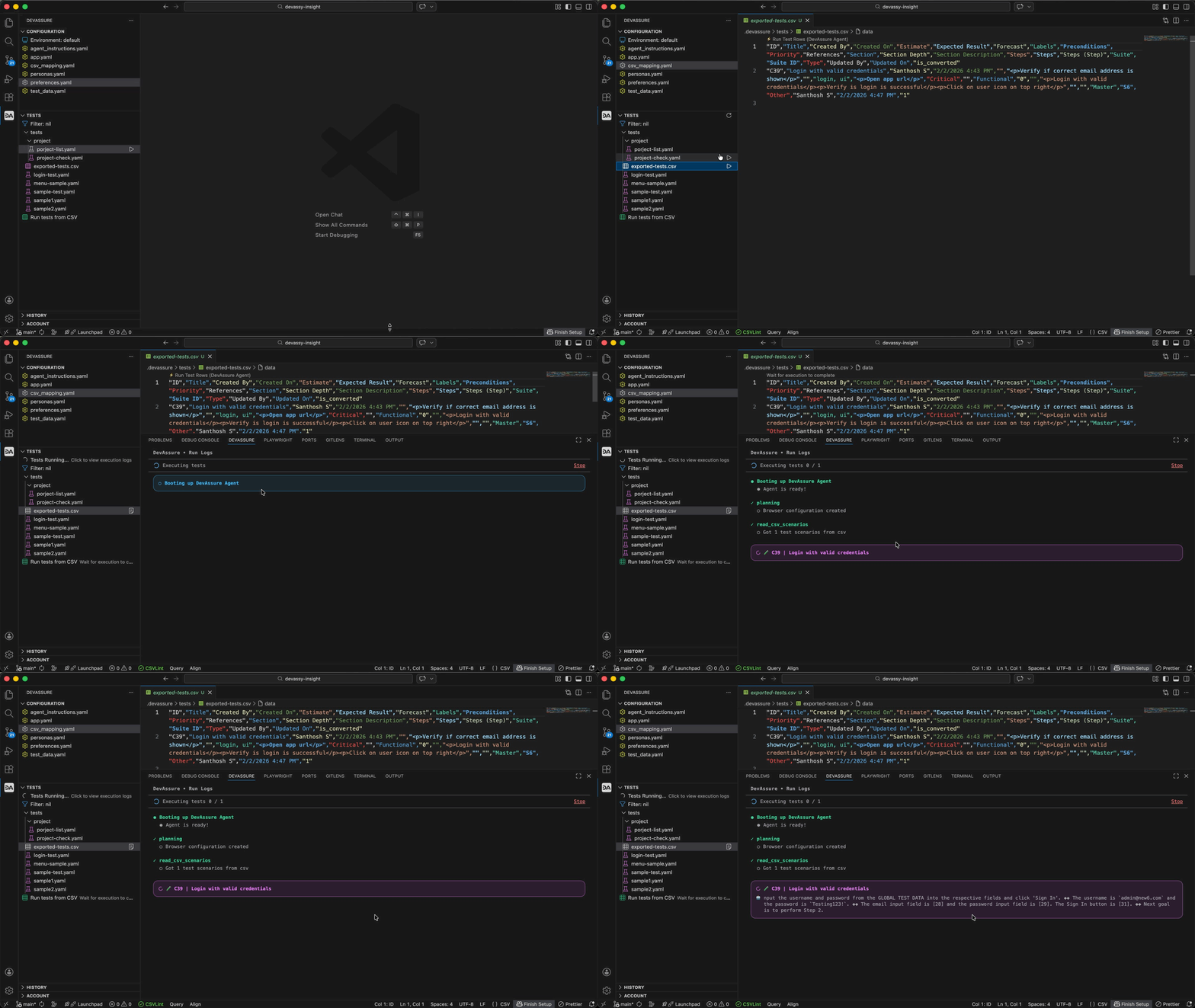
Configuration files
| File |
Purpose |
app.yaml |
App description and rules for the agent |
personas.yaml |
Optional user personas |
test_data.yaml |
URL, users, and test data per environment |
agent_instructions.yaml |
Agent instructions during execution |
preferences.yaml |
Browser (e.g. chromium), resolution, headless, workers |
csv_mapping.yaml |
CSV column → test field mapping |
tests/ or test/ |
Test case YAML and optional CSV files |
See Sample configuration files above for full YAML examples.
Filters
How to apply filters
In the DevAssure Tests view, click the Filter: … row (it shows the current filter or “nil”). An input box opens. Enter a filter string and press Enter to save.
Saving and clearing filters
- To save: Enter a valid filter and confirm. The filter is stored in workspace state and used for the next folder or CSV run.
- To clear: Open the filter input and submit an empty value (or clear the text and confirm).
Invalid syntax is rejected with an error and not saved.
Supported fields and operators
- Fields:
tag, priority, folder, query
query performs a text match on summary, steps, and tags.
- Operators:
= for field values; && and || between clauses; parentheses for grouping.
Examples:
tag=smoke && priority=P0query=login(tag=user && priority=P0) || (tag=dashboard && priority=P1)
Where filters apply
Filters apply when running tests, not to the file tree:
- Folder run: Running a folder from the Tests view uses the folder scope combined with the saved filter.
- CSV run: Running a CSV file (from the sidebar or Editor) applies the saved filter to the rows in the CSV.
The Tests view always shows all files and folders; it is not filtered by the saved filter.
Reports / History
History view
Open the DevAssure sidebar and select History. The view lists the last 20 test sessions. Each entry shows the session title, ID, and timing.
Opening a report from history
Click a session in the History view. The extension opens that session’s report in your default browser. If no report server is running, it starts one and reuses it when possible.
View all sessions: Use the View all sessions item at the bottom to open the report server without a specific session.
Resuming a test session
You can resume a previously run test session to continue execution from where it left off:
- In the DevAssure sidebar, open the History view.
- Right-click a session entry and choose Resume (or use the resume action from the context menu).
- The extension resumes that test session; the Run Logs panel shows the execution feed.
Resume is only available for sessions that support resumption and when no other run is in progress.
Archiving a report
To save a session's report as a zip file (e.g. for sharing or offline viewing):
- In the DevAssure History view, right-click the session you want to archive.
- Choose Archive report (or the archive action from the context menu).
- When prompted, select the output folder for the archived report.
- The extension creates
devassure-results-<session-id>.zip in that folder. You can use Open Report from Archive to view it later.
Exporting JUnit XML
To export a session’s results as a JUnit XML file (for CI systems or other tools that consume JUnit reports):
- In the DevAssure History view, right-click the session you want to export.
- Choose DevAssure: Export Junit XML (in the context menu).
- When prompted, select the output folder.
- The extension writes
junit-report-<session-id>.xml in that folder. A notification offers Show to reveal the file in your file manager.
Opening a report from archive
If you have an archived report zip (for example, one saved with Archive report from the History view):
- In the History view title bar, click Open Report from Archive (archive icon).
- Choose a
.zip file in the file picker.
- The report is served from the archive and opened in the browser (no database is used).
Actions
Actions are used to group steps that can be reused across multiple tests. To call an action you can simply mention the action name as a step in the test file.
Fields in action file
| Field |
Description |
name |
The name of the action. It is used to call the action from the test file. |
description |
A short description of the action. |
steps |
A list of steps that make up the action. |
Example action file
Example 1 (e.g. .devassure/actions/login_as_admin.yaml):
name: login_as_admin
description: Login to the app as admin using google
steps:
  - Open admin portal url
  - Click on Google login button
  - Enter admin email and password
  - If MFA is asked, enter the authenticator OTP
  - If allow access is asked, click on allow access
Example 2 (e.g. .devassure/actions/manager_user.yaml — multiple reusable actions in one file):
- name: add_manager_user
  description: Add a manager user to the app
  steps:
    - Go to users page
    - Click on Add User button
    - Enter email
    - Enter role as Manager
    - Once team dropdown appears assign any team to the user
    - Enter random user details
    - Click on Add User button

- name: view_manager_user
  description: View the manager user in the users list
  steps:
    - Open users list page
    - Search for the manager user by email
    - Verify the manager user is visible in the list
Usage in test file
In your test case, reference actions by name in the steps list:
steps:
  - login_as_admin
  - add_manager_user
  - view_manager_user
  - Verify whether the manager’s status is active.
In the DevAssure sidebar, the Tests view shows an actions tree (when .devassure/actions exists). Right-click the actions root or a folder to Add Action (creates a new action YAML with name, description, steps template).
Library tools are inbuilt tools that users can include in the project by listing the required tools in a library.yaml file.
Sample library.yaml (e.g. .devassure/library.yaml):
tools:
  - 'authenticator'
  - 'faker:*'
faker
Faker provides fake data generators for tests:
| Tool |
Description |
first_name |
Generate a random first name |
last_name |
Generate a random last name |
full_name |
Generate a random full name |
email |
Generate a random email address |
phone |
Generate a random phone number |
authenticator
Authenticator provides TOTP (Time-based One-Time Password) helpers:
| Tool |
Description |
get_authenticator_otp |
Generate a TOTP code from an authenticator secret. The authenticator secret must be passed to generate the code. |
In the DevAssure Tests view, a Tools tree is shown when .devassure/tools/index.yaml exists; you can open index.yaml or reveal the tools folder from there.
Tools let you run custom commands or programs and consume their output. The configuration lives in .devassure/tools/index.yaml.
Requirement: tools/index.yaml is required for tools to work. It must exist at .devassure/tools/index.yaml (relative to your project path).
Tools can run any command or program; the runner executes the command and consumes its output. For custom code or scripts, put the tool code inside the .devassure/tools folder and reference the execution command in tools/index.yaml (e.g. exec: node script.js or exec: npm run myTool).
Note: You can use any programming language or program. You are responsible for setting up dependencies (e.g. Node.js, Python, venv, system binaries).
Mandatory fields
Each tool must have name, description, and exec:
| Field |
Description |
| name |
Unique identifier for the tool (e.g. used when invoking the tool). |
| description |
Short description of what the tool does. |
| exec |
Command(s) to run. Can be a single line or a multi-line string. Supports ${argName} substitution for args. |
Optional per-tool fields include cwd and args (see below).
Minimal example:
tools:
  - name: "getProjectDetails"
    description: "Get project details from api"
    cwd: "api-tools"
    args:
      - name: projectId
        type: string
    exec: npm run getProjectDetails ${projectId}
- cwd (optional): Working directory for the command. It is relative to the tools folder (
.devassure/tools). If omitted, the working directory is the tools folder. Absolute paths are also supported.
- args (optional): List of parameters. Each has
name and type; see Supported arg types and optional args below.
Optional top-level configuration: settings and setup
settings: Default options applied to every tool run and every setup step. For all fields except env, the value on the tool or setup step is used when present; values in settings are fallback when the tool or step does not define that field. For env, the list of environment variables is merged: settings env vars and the tool/setup step env vars are combined (tool/setup entries override settings when the same key is used).
setup: Optional list of steps run once per session before scenario executions start (e.g. install dependencies). Each step can specify name, cwd, exec, and any of the settings fields; inheritance from settings applies when a step omits a field.
cwd behavior
- Relative: Resolved from the tools folder (e.g.
cwd: "api-tools" → .devassure/tools/api-tools).
- Default: If
cwd is not provided, the working directory is the tools folder.
- Absolute: Absolute paths are supported (e.g.
cwd: "/opt/scripts").
| Option |
Applies to |
Description |
| timeoutSec |
Tool / setup |
Maximum execution time in seconds (e.g. 10). |
| output.start / output.end |
Tool / setup |
Markers in stdout; only content between these markers is captured as the tool output. Strongly recommended when the process prints a lot of extra content (logs, progress). Your script should print the actual result between these markers. |
| env |
Tool / setup |
List of KEY: value environment variables added or overridden for the process. |
| ignore_failure |
Tool / setup |
If true, a non-zero exit or failure does not fail the run (e.g. optional setup). Default is false. |
Output start and end markers
When the command prints a lot of unwanted content (logs, progress, debug), use output.start and output.end in settings (or on the tool). The runner captures only the stdout between these two markers. Print the markers and the necessary output from your script.
JavaScript example: print the markers, then the result, then the end marker:
// In your script (e.g. getProjectDetails.js)
const startMarker = "__TOOL_OUTPUT_START__";
const endMarker = "__TOOL_OUTPUT_END__";

// ... do work, then:
console.log(startMarker);
console.log(JSON.stringify(result));
console.log(endMarker);
In tools/index.yaml you would set output.start and output.end to match (e.g. __TOOL_OUTPUT_START__ and __TOOL_OUTPUT_END__).
Supported arg types and optional args
Supported types: string, number, boolean, object. Use type in each arg.
Optional args: Add optional: true to an arg. If not provided, it may be omitted or passed empty depending on how you use it in exec (e.g. "${projectName}" for an optional string).
Example with multiple types and one optional arg:
tools:
  - name: "exampleTool"
    description: "Example with string, number, boolean, object args"
    args:
      - name: id
        type: string
      - name: count
        type: number
      - name: verbose
        type: boolean
      - name: options
        type: object
      - name: projectName
        type: string
        optional: true
    exec: node run.js ${id} ${count} ${verbose} "${options}" "${projectName}"
- Single line:
exec: npm run getProjectDetails ${projectId}
- Multi-line: Use YAML multi-line (e.g.
exec: | with following lines). Useful for running several commands in sequence (e.g. warmup, main command, cleanup):
exec: |
  npm run warmupTestingProcess
  npm run getProjectDetails ${projectId} "${projectName}"
  npm run cleanupTestingProcess
The following example shows settings (timeoutSec, output markers, env, ignore_failure), setup (one step with cwd and exec), and tools with optional arg and multi-line exec:
settings:
  timeoutSec: 10
  output:
    start: "__TOOL_OUTPUT_START__"
    end: "__TOOL_OUTPUT_END__"
  env:
    - BUILD_ENV: "dev"
    - DB_NAME: "legacy-db"
  ignore_failure: false
setup:
  - name: "Install dependencies"
    cwd: "api-tools"
    exec: "npm install"
tools:
  - name: "getProjectDetails"
    description: "Get project details from api"
    cwd: "api-tools"
    args:
      - name: projectId
        type: string
      - name: projectName
        type: string
        optional: true
    exec: |
      npm run warmupTestingProcess
      npm run getProjectDetails ${projectId} "${projectName}"
      npm run cleanupTestingProcess
Hooks
Hooks are stored in .devassure/hooks/ and are useful for shared setup/cleanup steps around a run.
before_all runs only once before all selected tests in the session.after_all runs only once after all selected tests in the session.- You can add multiple hook files in
.devassure/hooks/ (for example, split by area or suite).
Hooks folder
.devassure/
  hooks/
    auth-hooks.yaml
    cleanup-hooks.yaml
Each hook file can define before_all, after_all, or both.
Example hook files
# .devassure/hooks/auth-hooks.yaml
before_all:
  summary: Prepare authenticated session
  steps:
    - Open the application URL
    - Log in as admin user from test_data
# .devassure/hooks/cleanup-hooks.yaml
after_all:
  summary: Cleanup test artifacts
  steps:
    - Log out from the application
    - Remove test users created during the run
Skip hooks in VS Code
Use DevAssure: Set skip hooks (devassure.setSkipHooks) to control whether hooks are executed for this workspace.
true skips before_all and after_all.false runs hooks (default behavior).Clear removes the workspace override and restores default behavior.
Advanced features
Switching environments
In the DevAssure Configuration view, click Environment: …. Enter an environment name (e.g. dev, uat, prod) that matches a top-level key in test_data.yaml. The selected environment is used for all subsequent test runs in that workspace.
Switching between multiple .devassure folders
If your workspace contains more than one project with a .devassure folder (e.g. multiple repos or packages):
- Open the DevAssure Configuration view.
- In the view title bar, click Select .devassure folder (folder icon).
- In the picker, select either the
.devassure folder or its parent directory. The path must be inside the current workspace.
- The extension uses that project path for Configuration, Tests, and all runs until you change it again.
Set debug enabled
Use DevAssure: Set debug enabled (devassure.setDebugEnabled) from the Command Palette to toggle verbose debug logs for the current workspace.
true enables debug logs.false disables debug logs (default).
Set cloud reports
Use DevAssure: Set cloud reports (devassure.setCloudReports) from the Command Palette to control whether reports are synced to cloud for this workspace.
true syncs reports to cloud (--sync-to-cloud on agent start).false does not sync reports to cloud (default).
Add auth token
Instead of logging in via the browser, you can add an authentication token. Generate a token from app.devassure.io and run the DevAssure: Add Auth Token command (Command Palette or from the DevAssure view) to add it. The extension will validate and store the token so you can use DevAssure without signing in through the browser. This is useful for CI, headless environments, or when you prefer token-based authentication.
URL and browser settings
The application URL and browser behavior for test runs come from your project configuration.
Application URL
Set the base URL in .devassure/test_data.yaml under each environment key (for example, default.url). Use the Environment control in the Configuration view to switch which environment's data is used for the next run (see Switching environments).
Headless mode
Control whether the browser window is visible during runs in .devassure/preferences.yaml under browsers.default.headless. Set headless: true to run without a visible browser window, or headless: false to show the browser UI.
Advanced test_data
You can keep reusable test data as separate YAML files under .devassure/test_data/ (for example test_data/user.yaml, test_data/stripe.yaml).
Then include/merge them into .devassure/test_data.yaml using !include, so you can reuse the same data across environments without duplicating it.
Examples
Reusable test_data YAML (users in one file)
# .devassure/test_data/user.yaml
users:
  default:
    user_name: 'user@test.com'
    password: 12345678
  admin:
    user_name: 'admin@test.com'
    password: 12345678
Reusable test_data YAML (stripe in one file)
# .devassure/test_data/stripe.yaml
stripe_data:
  allowed_card:
    card: 4444 4444 4444 4444
  wrong_cvv:
    card: 1234 1234 1234 1234
    expiry: 10/28
    cvv: 123
Include reusable test_data into your test_data config
# .devassure/test_data.yaml (or scenario config)
default:
  url: 'http://localhost:3000'
  <<: !include test_data/user.yaml
  payments:
    <<: !include test_data/stripe.yaml
    test_otp: 1122
TestRail Integration
DevAssure can fetch test cases from TestRail instead of local YAML/CSV. Configure credentials once, optionally set how results are posted back, then run cases from the Tests view.
Adding config
- Open the DevAssure Configuration view (sidebar).
- In the view title bar, click DevAssure: Add Provider Config (gear icon), or run the same command from the Command Palette (
devassure.addProviderConfig).
- If no TestRail config exists yet, choose testrail when prompted.
- Enter URL, username, API key, and optionally project ID (leave empty when your account has only one project).
Settings are stored locally in an encrypted file. Re-run the command to update individual fields; existing values are pre-filled.
Setting post config
Before running TestRail cases, configure whether results are sent back to TestRail:
- Command Palette: DevAssure: TestRail post result settings (
devassure.testRailPostResultSettings) — quick picks for:
- Post results to TestRail — on/off
- Log defects to TestRail — on/off (only when post results is enabled)
- Attach videos to TestRail —
Never, On-Failure, or Always (only when post results is enabled)
- Workspace settings (same values, editable in Settings):
devassure.testrail.postResults (default: false)devassure.testrail.logDefects (default: false)devassure.testrail.attachVideos — never | on-failure | always (default: never)
Log defects and attach videos apply only when post results is enabled.
Run tests
After TestRail config is present, the Tests view shows two items at the bottom:
Run TestRail cases
Run TestRail cases (devassure.runTestRailCases):
- Project — picked from TestRail if
project_id is not in config; otherwise uses the saved project.
- Suite — prompted when the project uses multiple suites.
- Optional Section, Priority, and Labels (comma-separated for labels). Press Enter with an empty value to skip.
- Starts a session using the saved post-result settings from Setting post config.
Run TestRail cases by id
Run TestRail cases by id (devassure.runTestRailCasesById):
- Enter comma-separated case IDs.
- Starts a session for those cases with the same post-result settings.
Execution logs appear in the Run Logs panel like any other DevAssure run. TestRail run options (project, suite, labels, and similar) are separate from the workspace Filter used for local YAML/CSV runs.
Proxy
If the HTTP_PROXY or HTTPS_PROXY environment variables are set, the extension will use them to proxy requests. You can also set the proxy in the extension settings: DevAssure: Http Proxy (devassure.http_proxy) and DevAssure: Https Proxy (devassure.https_proxy). Settings take precedence over environment variables when both are present.
CI/CD
The VS Code extension is designed for interactive development in the IDE. For automated pipelines, use the DevAssure CLI or one of the built-in CI/CD integrations:
Authenticate in CI with a DevAssure API token (generate one from app.devassure.io). See the @devassure/cli package for CLI command options.
FAQ
How to add new test cases?
Add YAML files under .devassure/tests/ (or test/), or use the Tests view: right-click the tests root or a folder → Add Test Case or Add Folder. For CSV, add the CSV under .devassure/ (e.g. in tests/) and optionally configure .devassure/csv_mapping.yaml.
Is test case YAML always needed or can we use CSV only?
No. You can use CSV only: place the CSV in .devassure/ (e.g. under tests/), add csv_mapping.yaml if your columns don’t match the defaults, then run from the Tests view or via CodeLens on the CSV file.
What are the mandatory fields for a test case?
For YAML test cases, summary and steps are required. priority and tags are optional. For CSV, the mapped columns must provide at least the equivalent of summary and steps (via csv_mapping.yaml).
How to add a new environment?
Add a new top-level key (e.g. uat) and its data in .devassure/test_data.yaml. Then in the extension, set Environment (Configuration view) to that name (e.g. uat).
What are the supported browsers?
Controlled by .devassure/preferences.yaml under browsers.default.browser. The default is chromium. Other engines (e.g. firefox, webkit) may be supported; see preferences.yaml and DevAssure documentation.
How to run with headless mode?
In .devassure/preferences.yaml, set browsers.default.headless: true.
How to run the tests in Continuous Integration?
The VS Code extension is for local and IDE use. For pipelines, use the CI/CD integrations for GitHub Actions, GitLab, or CircleCI, or run the @devassure/cli directly with token authentication.

