Bandit Stealth
A real coding agent inside your IDE — without the subscription. Runs locally on your own GPU for free, or on our cloud when you need more horsepower.




Bandit reads your codebase, writes changes, runs commands, and stays out of your way. Local-first by default on any Ollama model — your code never leaves your machine. Optional Bandit cloud when you want managed inference with zero local setup.
- Your choice of model. Runs locally on any Ollama model — Gemma 4, Qwen 3.6, Devstral, your custom fine-tune. Or point at Bandit's hosted gateway for managed inference with thinking mode and zero local setup.
- Works alongside you. Bandit autonomously explores your code, reads and writes files, runs shell commands — every write gated by a unified-diff approval so you're never surprised.
- Permission modes with a floor you can trust. Read-only plan mode, prompt-everything ask, and auto for routine work — cycled with shift+tab and always visible on screen. Destructive calls (deletes, force-push, credential files, egress) ask every time, in every mode, and that's not configurable.
- Integrated with the editor. Auto-context attaches the right files without you picking them.
@-mention any file (or folder — drill in until you find it). Inline diffs stream into the editor as the agent works.
- Powerful agentic features. Skills the agent can author itself, plan preview with go/no-go confirmation, session checkpoints with
/rewind, hooks for CI guardrails, and a tool-use loop with pre-write language validation (TypeScript / Python / JSON / C#).
- Voice that's actually pluggable. Speech-to-text and text-to-speech are independent of the chat provider. Use Bandit cloud, OpenAI-compatible Whisper (faster-whisper-server / whisper.cpp HTTP / OpenAI / LiteLLM), ElevenLabs, a local Piper server, or any custom URL. Run Ollama locally for chat + a self-hosted Whisper for voice and never touch a cloud account.
- Type a message while Bandit is replying. The composer keeps accepting input while the agent streams — your follow-up shows as a "queued" pill and fires automatically when the current turn finishes. The Stop button next to the spinner cancels the active turn AND clears your queue.
! runs straight in your integrated terminal. Type !npx create-vite my-app in the composer and the next Enter opens VS Code's integrated terminal and runs the command there with full TTY (so interactive scaffolders work). The agent doesn't see the output; this is a user-invoked escape hatch with the same blocked-pattern guards as the safe path (rm -rf, mkfs, dd if= always refused). A yellow SHELL MODE banner appears in the composer the moment you type ! so you can't miss the mode change.- Cross-repo discovery built in. Ask the agent to "open the auth-api repo" or "edit the stt-api Dockerfile" and it locates the repo via
find_directory — sweeps ~/Documents/GitHub, ~/GitHub, ~/Projects, ~/code, ~/dev, ~/repos, ~/work, ~/src, plus the parent of the active workspace. No more "where is that repo?" round-trips.
- Installs CLIs and packages on demand. When you ask Bandit to install
ripgrep, httpie, the GitHub CLI, etc., it picks the right package manager (brew, npm install -g, pip install, cargo install, gem install, go install) and runs it through the permission gate — you approve, it installs.
- Twelve themes. Stealth Light / Stealth Dark / Midnight (defaults) plus Onyx, Charcoal, Dracula, Nord, Tokyo Night, Solarized Dark, Catppuccin Mocha, Solarized Light, and Sepia. Auto-mirror VS Code's light/dark or pick a Bandit theme to override.
New to Bandit?
Visit burtson.ai/stealth for the product tour, model comparison, and recommended configurations.
Prefer the terminal?
Same runtime, same skills, same tool-use loop — in a shell instead of the IDE.
curl -fsSL https://burtson.ai/bandit-stealth-cli/install.sh | sh
# or: npm install -g bandit-stealth-cli
bandit
Flip banditStealth.useTerminal on and the Activity Bar icon (and Alt+Shift+B) will open the CLI in VS Code's integrated terminal instead of the chat panel. Toggle back any time via Bandit Stealth: Toggle Terminal Mode.
See @burtson-labs/bandit-stealth-cli on npm — a public package today, open source soon. Node.js 20+, works against the same local and cloud providers as the extension.
Independent, opinionated, and honest about it
Bandit Stealth is built by Burtson Labs — a small independent shop, not a venture-funded research lab. The goal is simple: make agentic coding tools that work well without gating them behind enterprise pricing.
The deal:
- Local is free, forever. Point Bandit at Ollama and you never owe us a dollar. No account, no network calls on your code — and telemetry is off by default (opt-in, see below).
- Cloud is optional. If you'd rather skip the local setup, the hosted gateway runs tuned models with thinking mode ready to go. Rolling-window limits and transparent usage in the Account tab.
- The roadmap is public. Every release note and open rough edge lives in the repo. File an issue and you're talking to the people writing the code.
Quick start
Install a model (local-first default). Two commands on a Mac:
brew install ollama
ollama pull gemma4:26b         # best balance for 32 GB+ Macs
Install this extension — you're already here.
Open the Bandit Stealth view from the Activity Bar. Start typing.
That's it. No API keys, no cloud services, and telemetry off by default. Prefer managed inference instead? Switch the provider to bandit in settings and paste an API key.
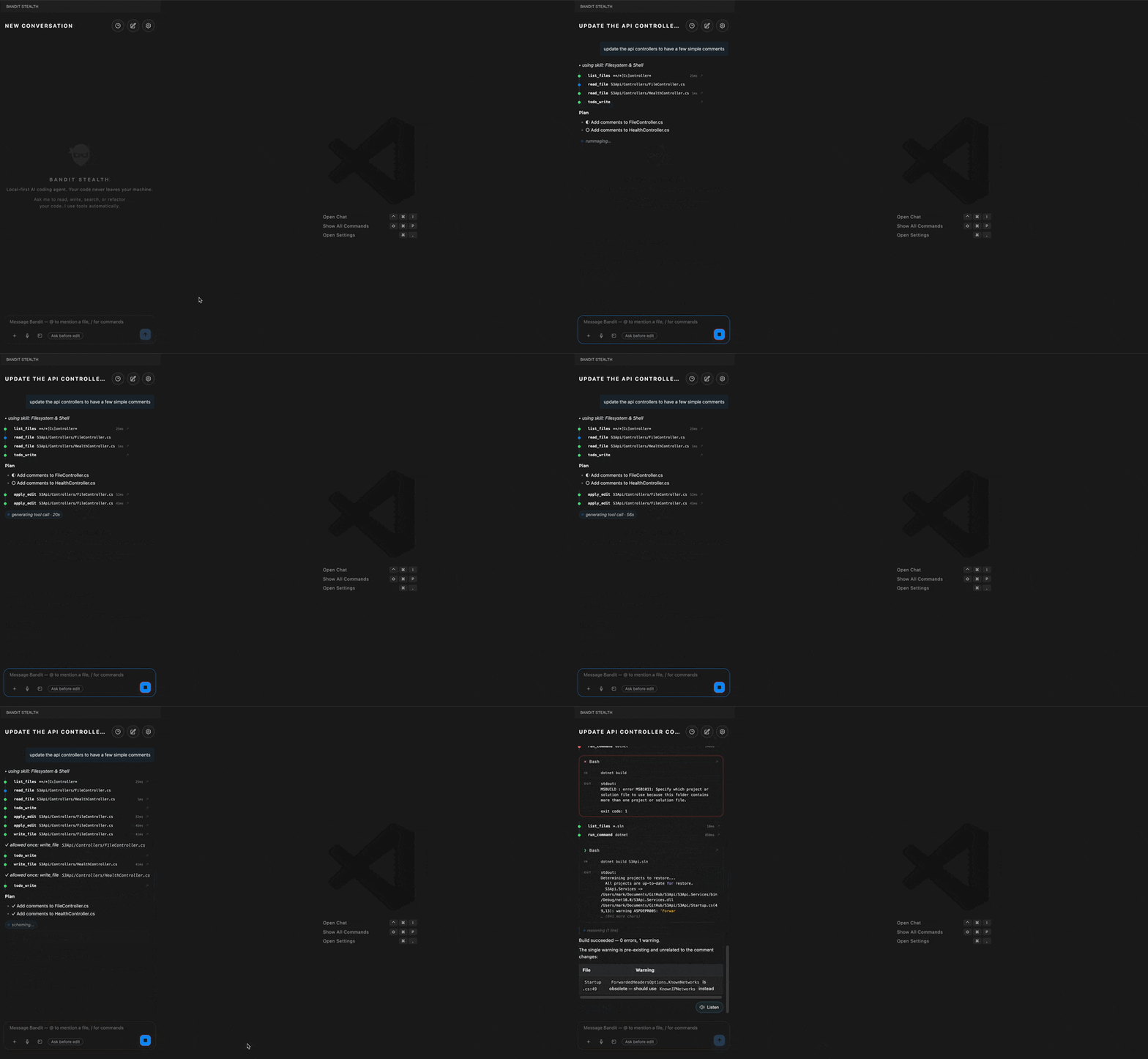
See a quick session in action
|
A real session, sped up 6×.
Bandit runs the whole agent loop right in the side panel — listing and reading files, searching the codebase, and planning its approach — with every tool call streaming live so you see exactly what it's doing. Edits land behind a diff you approve.
~33 seconds · captured in VS Code · recording unedited
|
Recommended models
Bandit auto-detects each model's capabilities and picks the right execution path (native tool calling vs. text-parse). Any Ollama model works — the table below is our tested shortlist, ordered by what we've actually validated on real codebases.
| Model |
Where |
Notes |
bandit-logic (cloud) |
Bandit gateway (API key) |
Default. Agent-tuned wrapper around Qwen 3.6 27B with thinking mode. Strongest cloud pick for tool-use loops — what we recommend trying first. |
qwen3.6:27b |
Local / high-VRAM GPU or Mac 48 GB+ (~17 GB) |
Best local pick. Same family as bandit-logic, runs offline. Native tool calling, 256 K context, multimodal. Probes the filesystem first instead of asking for clarification — real agent behavior. |
gemma4:26b |
Local / Mac 32 GB+ (~17 GB) |
Solid alternative. Fast, multimodal, 128 K context. Good default when Qwen 3.6 is too heavy for your hardware. |
gemma4:e4b |
Local / laptop-class (~3 GB) |
Lightweight pick that punches above its weight. Validated on real Bandit runs — clean tool sequencing (ls → narrow → read_file), no hallucinated paths. Right choice when you want a local agent that doesn't pin your fans. |
gemma4:31b |
Local / Mac 64 GB+ or GPU node |
Bigger context, sharper reasoning for complex refactors. |
devstral:latest |
Local / Mac 32 GB+ |
Mistral's agent-tuned model — strong tool use. |
bandit-core:12b-it-qat |
Local / Mac (~9 GB) |
Our Gemma-12B fine-tune. Fits most laptops, agent-aware. |
bandit-core-1 (cloud) |
Bandit gateway (API key) |
Lightweight cloud option. Faster first-token than bandit-logic, but less reliable on multi-step agent tasks. |
Models we don't recommend (for agent work)
Bandit is an autonomous agent harness — it expects the model to discover repo structure, plan edits, and emit tool calls without being hand-held. Some otherwise-impressive models aren't trained for that workflow and produce unexpected results:
gpt-oss:120b and other reasoning-tuned models — post-trained for OpenAI's harmony tool-call format, not the XML/native protocols Bandit uses. Tends to narrate intent ("I'll search for the controllers...") without ever emitting an actual tool call. Great for math/reasoning Q&A in chat; poor for filesystem agent loops.qwen2.5-coder:32b and other code-completion-tuned models — post-trained for "given context, write code" benchmarks. On ambiguous prompts it asks the user for paths instead of probing the workspace itself. Solid pick if you give it concrete, fully-specified tasks; underwhelming as an autonomous agent.qwen3.6:35b — the larger Qwen 3.6 variant stalls in reasoning-only output and ignores the harness's "act now" nudges. The 27B is the better production pick from this family.
If you want to test models outside the recommended list, expect the harness's reasoning-only / narrate-but-no-action / partial-completion detectors to fire frequently. Those are signal, not noise — they mean the model isn't a great fit for autonomous agent work.
Live UX touches
Small affordances we ship in both the CLI and the side-panel composer:
? shortcuts overlay (CLI). Type ? at an empty prompt and a keyboard cheatsheet pops above the input — input triggers, hotkey chords, common slash commands. Backspace it and it's gone. Live, no scrollback noise.!-prefix shell escape. Type !cmd to run something straight in the shell:
- CLI — first use shows a full warning + y/N gate; every call after gets a yellow box reminding you the command bypasses the agent's allow-list and approval gate.
- Extension — typing
! lights up a yellow SHELL MODE banner above the composer with the field border tinted amber. Submitting opens the integrated terminal (Bandit · shell) and runs the command there with full TTY access — exactly what create-vite, ng new, or any other interactive scaffolder needs.
- Queue while streaming. Both the CLI and the side-panel composer accept new prompts while the agent is mid-turn. The CLI status bar shows
queued: N · Esc to stop; the composer shows a N queued · sends after this turn pill below the textarea. Stop the active turn (Esc in CLI, Stop button in composer) and the queue clears with it.
- Live command output.
npm install, pip install, cargo build, watch_command npm run dev — anything that takes more than a few seconds streams its output to your terminal as it arrives, dimmed, while the spinner keeps animating. No more wondering if a 20-second npm install is hung.
- Notifications when attention is needed. The extension surfaces VS Code notifications when the panel is hidden and Bandit needs approval, when a background task finishes or fails, when a turn fails, and when a long turn completes. Configure with
banditStealth.notifications.enabled and banditStealth.notifications.minTurnMs.
/doctor setup check. The CLI and IDE both render a no-model-call diagnostic of workspace, git state, project memory, provider/API key or Ollama model visibility, active model profile, watchdog setting, and next best actions. It is the first stop when Bandit feels confusing.- Retry and fallback for model stalls. Both hosts tag no-token stalls as watchdog errors, retry text-tool calls when replay is safe, and degrade native tool calls to Bandit's text protocol when a model/gateway parser flakes. The extension uses the same first-token watchdog sizing as the CLI; tune it with
banditStealth.watchdogMs or BANDIT_NO_TOKEN_WATCHDOG_MS.
/insights report. A self-contained HTML report — cross-repo win synthesis, rolling activity, tool-usage stats, languages touched, longest streak, peak day, top errors, optional AI-generated "what you shipped" / "where Bandit got in your way" summary. Built from your global sessions plus workspace/global turn logs; nothing leaves your machine unless you ship the HTML yourself or click the Share mailto button./trace and /profile. The IDE and CLI share the same debugging data. In the IDE, the Trace Logs toolbar button, Command Palette command, or /trace opens a turn browser with all/needs-attention filters, workspace/global source labels, prompt/final previews, metrics, permission/retry/fallback counts, a timeline, and an Open JSONL action. The CLI keeps the markdown view: /trace list browses recent workspace/global turns and /trace failed filters recovery/debugging runs. /profile explains the active model's behavior profile — native vs text tools, fallback policy, safe context budget, thinking default, parallelism, and known failure modes.
Custom model behavior overrides use the same workspace file in both hosts: .bandit/model-profiles.json. Set match prefixes plus protocol, context, prompting, and reliability fields when a local model needs a different harness path than the built-in defaults; the extension watches the file and reloads it when it changes. The loop uses those profile values for native-vs-text selection, native fallback policy, output-budget serialization, and max parallel tool calls.
Permission modes — plan, ask, auto
One shared permission engine gates every tool call in both hosts, and the active mode is always on screen: a colored chip on the CLI's input frame (and on the mid-turn composer while Bandit works), a status-bar item and composer pill in the editor.
plan — read-only. Bandit reads, searches, and runs read-only shell (git diff, ls, grep); every edit, write, state-changing command, delete, and network-write is refused, so it presents a plan instead of acting. Great for "tell me what you'd do first."ask (default). Every non-allowlisted call prompts with a risk-tiered permission card.auto. Routine work (reads, in-project edits, builds/tests) runs unprompted. Destructive calls always ask — deletes, writes outside the project, force-push, global installs, credential files, network egress. That floor is not configurable, on purpose.dangerous exists for CI/sandboxes only and cannot be enabled from chat — env var or settings file, deliberately.
shift+tab cycles ask → auto → plan in the CLI; click the status-bar item or composer pill in the editor. /permissions shows the mode, session grants, and an audit of everything auto mode approved without asking.
Experimental previews
Shipping dark, behind flags, while they earn their defaults:
- Live-session remote control (
/remote on). Registers your running CLI session with Bandit cloud so it can be watched and driven from another surface: your turns mirror up, input sent from the web runs in the same conversation on your machine (read-only plan mode by default). /remote off stops it; bandit runner is the headless sibling that accepts one-shot dispatched tasks.
- Graph runs (
BANDIT_GRAPH=1). A dependency-graph runtime over the same tool loop: bandit graph demo (two parallel read-only scans → a synthesized brief), bandit graph plan "<task>" (the model classifies direct / loop / graph and proposes a DAG — you see it before anything runs; --run executes with every node read-only), bandit graph resume (checkpointed runs restore finished nodes instantly), and /graph in the REPL (status · inspect <node> · why <node> · retry <node>). Per-node capability envelopes and completion contracts are enforced by the host, never the model.
MCP — Model Context Protocol, both directions
Bandit speaks MCP as both a client and a server. Any MCP server you can spawn plugs into the same tool-use loop the IDE uses for read_file / apply_edit. Conversely, any MCP-speaking client (Claude Desktop, Cursor, Cline, Continue, etc.) can drive Bandit's native tools through the standard JSON-RPC envelope.
As a client — Configure at ~/.bandit/mcp-servers.json (global) or .bandit/mcp-servers.json (workspace, takes precedence). Each server's tools surface as <server>.<tool> so collisions with native tools are impossible. Standard MCP schema — copy a working config from any other MCP-speaking client and paste it in:
{
  "mcpServers": {
    "github": {
      "command": "npx",
      "args": ["-y", "@modelcontextprotocol/server-github"],
      "env": { "GITHUB_PERSONAL_ACCESS_TOKEN": "ghp_..." }
    }
  }
}
Connector wizards — Settings → Connections has one-click setup for GitHub, Slack, GitLab, and a generic "+ Custom" path that takes a name + raw command line + env block. Each writes a fully-formed config to mcp-servers.json and pre-trusts the fingerprint so first-spawn doesn't double-prompt. CLI parity via /mcp add github <token>, /mcp add slack <bot-token> <team-id>, /mcp add gitlab <token>, /mcp add custom <name> <cmd…>.
Activation modes — every server can be set to always (registers on every prompt — current default) or on-mention (only registers when the user's prompt mentions the server name or a trigger keyword). Lets you wire up 5+ MCP servers without paying for 30+ tool definitions in every prompt budget. Auto-derived triggers for well-known providers (slack, github, gmail, gdrive, calendar, outlook, postgres, mongo, filesystem, …); explicit triggers: [...] in the config layers on top.
Trust gate — first spawn of any server requires user approval (Allow once / Always allow / Deny). "Always" persists a fingerprint of the command + args to ~/.bandit/mcp-trust.json; revoke from Settings → Connections or /mcp revoke <name>.
As a server — bandit mcp serve (CLI subcommand) turns Bandit into an MCP server that exposes its native tool surface (read_file / write_file / apply_edit / replace_range / list_files / ls / search_code / find_directory / run_command / …) over stdio. Drop one entry into Claude Desktop / Cursor / Cline / Continue's mcpServers config and that client can drive Bandit's tools through the same JSON-RPC envelope it uses for every other server. --read-only strips write/exec tools so a client gets a view-only window into your codebase.
Servers spawn lazily on first invocation. A failed server logs its error and the rest of the agent loop keeps running on native tools only. Off by default — no config file means no behavior change.
Voice — pluggable providers, independent of chat
Speech-to-text and text-to-speech are configured separately from the chat provider. Run Ollama locally for chat and pair it with whichever voice setup matches your privacy / cost / latency preference. The Bandit-API-key gate only fires when you've actually picked Bandit cloud as your voice provider — local-only setups (Ollama chat + self-hosted Whisper + Piper TTS) work without a cloud account.
Open Settings → Voice to configure:
Speech-to-text providers
- Bandit cloud —
/api/stealth/stt/transcribe. Needs a Bandit API key.
- OpenAI-compatible Whisper — works with OpenAI's
/v1/audio/transcriptions, faster-whisper-server, whisper.cpp HTTP, LiteLLM, vLLM-Whisper. Bring any URL with the standard multipart file + model shape.
- Custom URL — any endpoint that takes multipart audio in and returns JSON
{ text }.
Text-to-speech providers
- Bandit cloud — Brian voice through the Bandit gateway.
- OpenAI —
/v1/audio/speech with tts-1 / tts-1-hd. Works with OpenAI itself, LiteLLM, any compatible proxy.
- ElevenLabs —
/v1/text-to-speech/{voice} with xi-api-key auth.
- Piper — local Piper HTTP server (POST text/plain or JSON). Zero-cost, fully offline.
- Custom URL — any endpoint that takes
{ text, voice } and returns audio bytes (or JSON { audio: <base64>, mimeType }).
| Setting |
Default |
Description |
banditStealth.voice.autoSpeak |
false |
Auto-narrate short assistant responses (>120 words are skipped). |
banditStealth.voice.maxAutoSpeakWords |
120 |
Word-count cap for auto-speak. |
banditStealth.voice.micEnabled |
false |
Show the mic button in the composer for voice prompts. |
banditStealth.voice.stt.provider |
bandit |
bandit / openai-whisper / custom. |
banditStealth.voice.tts.provider |
bandit |
bandit / openai / elevenlabs / piper / custom. |
banditStealth.voice.stt.url / tts.url |
— |
Endpoint URL when the provider isn't bandit. |
banditStealth.voice.stt.apiKey / tts.apiKey |
— |
Bearer / API key for the chosen provider. |
banditStealth.voice.stt.model / tts.model |
whisper-1 / tts-1 |
Model name for OpenAI-compatible providers. |
banditStealth.voice.voiceId |
en_US-brian-premium |
Voice identifier (Bandit voice id, OpenAI voice name, ElevenLabs voice id). |
Code blocks, tool calls, and diff cards are automatically stripped from spoken text — Bandit reads the model's prose, never the code. A speaker icon on every assistant message plays on demand regardless of the auto-speak setting.
Account & Usage (cloud only)
Open Settings → Account → View usage to see what you're burning. Two rolling windows, Claude-style:
- 5-hour session — resets on a rolling clock from your first request
- 7-day weekly — longer-horizon cap for steady use
Limits by plan: Free 100 / 500 · Pro 500 / 5,000 · Team 2,000 / 20,000. Hit the ceiling and you'll get a rate-limit toast with a "View usage" deep link and a countdown to the next reset. Need more headroom? Email team@burtson.ai.
The CLI exposes the same breakdown via /usage with colored meters.
CLI slash commands (quick reference)
Install once with curl -fsSL https://burtson.ai/bandit-stealth-cli/install.sh | sh (or npm install -g bandit-stealth-cli), then run bandit in any project. Type ? at the prompt for the live overlay; /help for the full list.
| Command |
What it does |
/doctor |
Check setup, provider, workspace context, permissions, active profile, and next best actions. |
/auto on \| plan \| off |
Permission mode: auto (routine runs unprompted), plan (read-only), ask. shift+tab cycles without typing. |
/permissions |
Current mode + session grants + an audit of everything auto mode approved without asking. |
/remote on \| off \| status |
Live-session remote control — mirror this session to the cloud and drive it from another surface (plan-mode default). |
/graph [inspect\|why\|retry <node>] |
Inspect the last graph run: per-node state, evidence, root-cause of blocked nodes, targeted retry (experimental, BANDIT_GRAPH=1). |
/plan <goal> |
Heuristic plan for the goal, then y/N to run it — queues the goal for the tool loop. |
/plan-preview on |
Every prompt gets a plan preview + y/N before the model runs. |
/insights |
Generate a self-contained HTML report — cross-repo wins, activity, tool stats, top-touched files, languages, streak, peak day, errors, optional AI summary, mailto share. |
/trace, /trace list, /trace failed, /trace <id> |
Inspect turn traces from workspace/global .bandit/turns; in the IDE this opens the Trace Logs viewer. |
/usage |
Cloud session + weekly breakdown with reset countdowns. |
/model [name] |
Show or switch the active model (Ollama list ranked by current match). |
/provider <ollama\|bandit> |
Hot-swap providers without restarting. |
/rewind [id] |
Restore a file from a checkpoint — /rewind last is the common shortcut. |
/think on \| off \| auto |
Force chain-of-thought mode for reasoning-capable models this session. |
/profile [model] |
Show the model behavior profile that governs tool protocol, fallback, context budget, and reliability guardrails. |
/compact |
Collapse older tool results to keep the context window happy. |
/session list, /session resume <id> |
Multi-session memory — every conversation is persisted to ~/.bandit/sessions/. |
/ollama [url] |
Show or set the Ollama endpoint — /ollama default resets to http://localhost:11434. |
/mcp, /mcp tools <name>, /mcp add github <token>, /mcp activation <name> <mode>, /mcp revoke <name> |
Full MCP management surface — list, add, configure, trust, drive any MCP server. |
/theme |
Pick a color palette — 12 shipped: Stealth Light/Dark, Midnight, Onyx, Charcoal, Dracula, Nord, Tokyo Night, Solarized Dark/Light, Catppuccin Mocha, Sepia. |
/init, /commit, /review, /refactor, /test, /explain, /onboard, /changelog |
Skill-driven assistants — repo bootstrap, conventional commits, code review, refactor suggestions, test gen, explain-this-code, onboarding checklists, changelog drafts. |
While the agent is mid-turn: Esc stops the run and clears the queue. Typing a follow-up + Enter pushes it onto the queue (queued: N in the status row); the agent picks it up automatically when the current turn finishes.
Configuration
Open VS Code Settings and search Bandit Stealth:
| Setting |
Default |
Description |
banditStealth.provider |
ollama |
ollama (local) or bandit (cloud) |
banditStealth.ollamaModel |
gemma3:12b |
Any Ollama model ID |
banditStealth.ollamaBaseUrl |
http://localhost:11434 |
Ollama endpoint. One-click reset: Settings → Providers → Ollama Endpoint has a "Use default" button that flips it back to http://localhost:11434. |
banditStealth.thinkingMode |
auto |
Chain-of-thought override (auto / on / off) |
banditStealth.watchdogMs |
-1 |
No-token watchdog override in ms (-1 auto, 0 off, positive value pins the timeout). BANDIT_NO_TOKEN_WATCHDOG_MS still wins. |
banditStealth.enableToolUse |
true |
Agentic tool-use loop |
banditStealth.voice.* |
— |
See Voice section above |
Security guard & hooks
Beyond the per-write approval gate, you can lock down what the agent is allowed to do via a settings file — read from ~/.bandit/settings.json (global, every workspace) and <workspace>/.bandit/settings.json (per-project), merged.
{
  // Opt-in built-in guard (off by default). Blocks catastrophic tool calls
  // BEFORE they run — rm -rf /, curl … | sh, disk wipes, fork bombs, writes
  // to /etc or ~/.ssh, credential exfil. Defense-in-depth against the model.
  "security": { "guard": { "enabled": true } },

  // Your own shell commands at loop checkpoints — NOT just guardrails. PreToolUse
  // can block (non-zero exit aborts the call); PostToolUse / Stop are fire-and-
  // forget for formatters, version bumps, notifications, CI, etc.
  // Placeholders: {{name}}, {{primary}}, {{duration}} (PostToolUse only).
  "hooks": {
    "PreToolUse":  [{ "match": "write_file", "command": "./scripts/guard.sh {{name}}" }],
    "PostToolUse": [{ "match": "write_file|apply_edit", "command": "prettier --write {{primary}} || true" }],
    "Stop":        [{ "command": "terminal-notifier -message 'Bandit finished' || true" }]
  },

  // Per-tool permission policy.
  "permissions": { "deny": ["run_command:rm *"], "ask": ["run_command"] }
}
Same format and behavior as the CLI — settings written once apply to both the IDE and the terminal.
Telemetry (opt-in, off by default)
Bandit is telemetry-capable but ships with it off. Nothing is sent unless you turn it on. When you do, it emits OpenTelemetry — a trace per turn plus usage metrics (tokens, time-to-first-token, turn duration) — over standard OTLP/HTTP. Prompt and response text are never sent; only metadata, run through secret redaction.
- Bandit Cloud users can flip it on to see their usage in Bandit's hosted dashboards — it ships to
otlp.burtson.ai authenticated with your Bandit account.
- Everyone else can point it at their own OTLP collector (Grafana/Tempo, an OTel Collector, App Insights, …).
Enable it in ~/.bandit/config.json (shared with the CLI):
{
  "telemetry": {
    "enabled": true,
    "endpoint": "https://otlp.burtson.ai",   // Bandit Cloud — or YOUR collector
    "mode": "metrics+traces"                   // or "metrics-only"
  }
}
See the CLI telemetry docs for the full reference.
Remote GPU
Running a bigger model on a remote Ollama instance? Set banditStealth.ollamaNodeUrl to the remote endpoint and banditStealth.ollamaModel to your larger model. Requests route to the remote node; everything else stays local.
Rented GPU (RunPod / Vast.ai / Lambda)
When you want to run a model your local hardware can't fit — or just want H100-class throughput for a session — Bandit talks to any Ollama endpoint, including rented GPU pods. The setup is the same shape on every provider: spin up a pod with Ollama running on port 11434, copy the proxy URL, paste it into Bandit.
RunPod (recommended — simplest UX):
- From the RunPod template gallery, pick any Ollama template (search "ollama"). Choose your GPU (H100 SXM for 27-32B models; multi-GPU only needed for 70B+).
- Once the pod boots, copy the public proxy URL — RunPod exposes it as
https://<pod-id>-11434.proxy.runpod.net.
- In VS Code: set
banditStealth.ollamaBaseUrl to that URL and switch the model dropdown to whichever tag you'll pull.
- SSH into the pod and pull the model:
ollama pull qwen3.6:27b (or whichever tag matches what you set in step 3).
- Use Bandit normally. Tool calls, edits, voice — everything works against the remote endpoint.
Vast.ai / Lambda Labs: same pattern. Look for an Ollama-preloaded image, expose port 11434, set banditStealth.ollamaBaseUrl to the host's public URL.
Recommended models for rented GPU:
qwen3.6:27b (~17 GB) — same model as bandit-logic. Native tool calling, vision, 256K context. Best general-purpose pick.qwen2.5-coder:32b (~20 GB) — code-specialist post-train, strongest on file edits and refactors.- Avoid
gpt-oss:120b for agent loops — it's a reasoning model post-trained for OpenAI's harmony tool-call format and doesn't follow Bandit's text protocol reliably. Great for math/proofs, poor for tool use.
Cost note: rented H100s run ~$2/hr. A typical agent session burns 10-20 minutes — under $1. Tear the pod down when you're done; the model weights persist in network storage if you keep that around.
Requirements
- VS Code 1.75+ or Cursor 0.40+
- Ollama running locally or remotely (unless you use the Bandit cloud provider)
- Python 3 on
PATH (used by a few agent helpers)
Troubleshooting
Ollama not detected — make sure it's running: ollama serve. The extension checks on startup and shows a setup guide if it can't connect.
Model not installed — the extension detects missing models and offers to pull them automatically.
Slow first token on Qwen 3.6 — thinking mode is on by default for reasoning-capable models. It's where the agent decides what tool to call, so leave it on for multi-step work. Turn it off (banditStealth.thinkingMode: off) when you only need fast Q&A.
Response feels incomplete — if an agent stops mid-plan, check the session log at .bandit/turns/<timestamp>.jsonl. Every tool call, tool result, and LLM message is recorded so you can see exactly where it stopped.
Docs & Support
Bandit Stealth is built by Burtson Labs and released under the Apache License 2.0. The terminal CLI and the monorepo source live at github.com/Burtson-Labs/bandit-agent-framework.
| |

