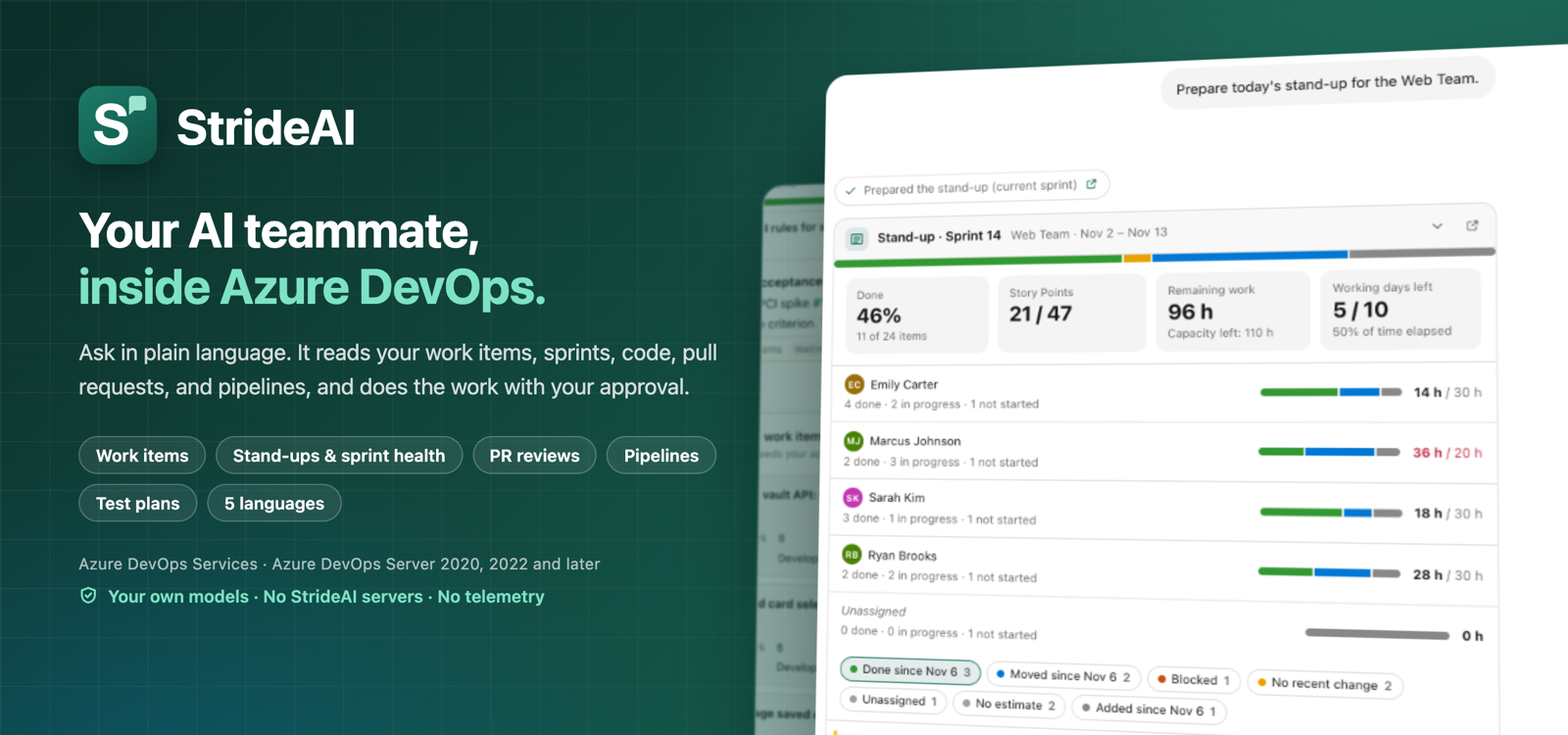
StrideAI: your AI teammate for Azure DevOpsChat with your Azure DevOps project. StrideAI reads your work items, sprints, code, pull requests, pipelines, and test plans, answers in plain language, and does the work for you, such as creating tasks, reviewing code, or moving unfinished work to the next sprint. Nothing changes until you approve it. It runs entirely in your browser with your own models: Azure OpenAI, Microsoft Foundry (including the model router and Claude), OpenAI, Anthropic Claude, or any OpenAI-compatible API. It uses your own Azure DevOps permissions, and there is no StrideAI server in between. Built for the whole team: product owners, Scrum Masters, developers, testers, and release managers. Your data stays in your hands
The details are under Privacy and data below. Why teams use it
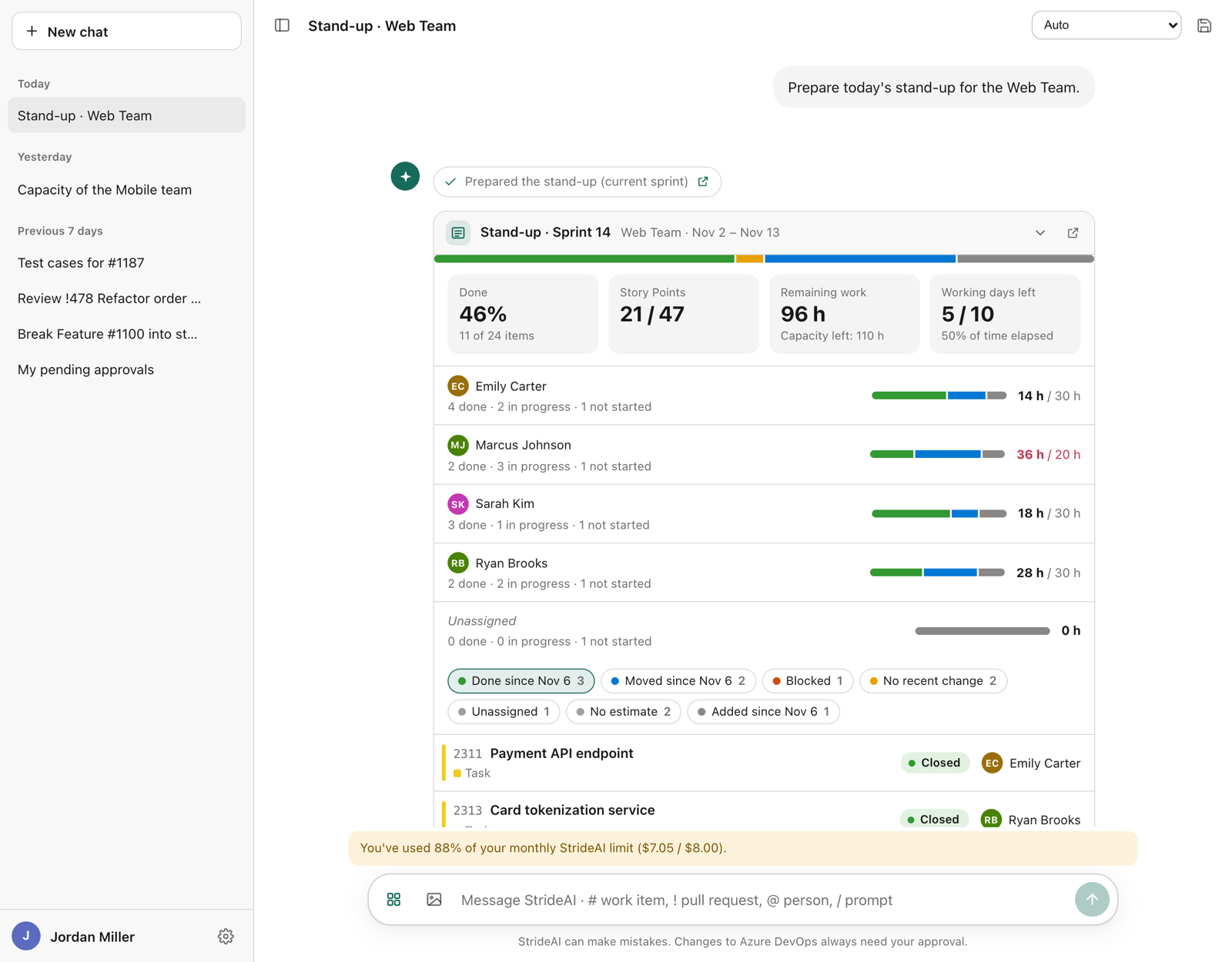
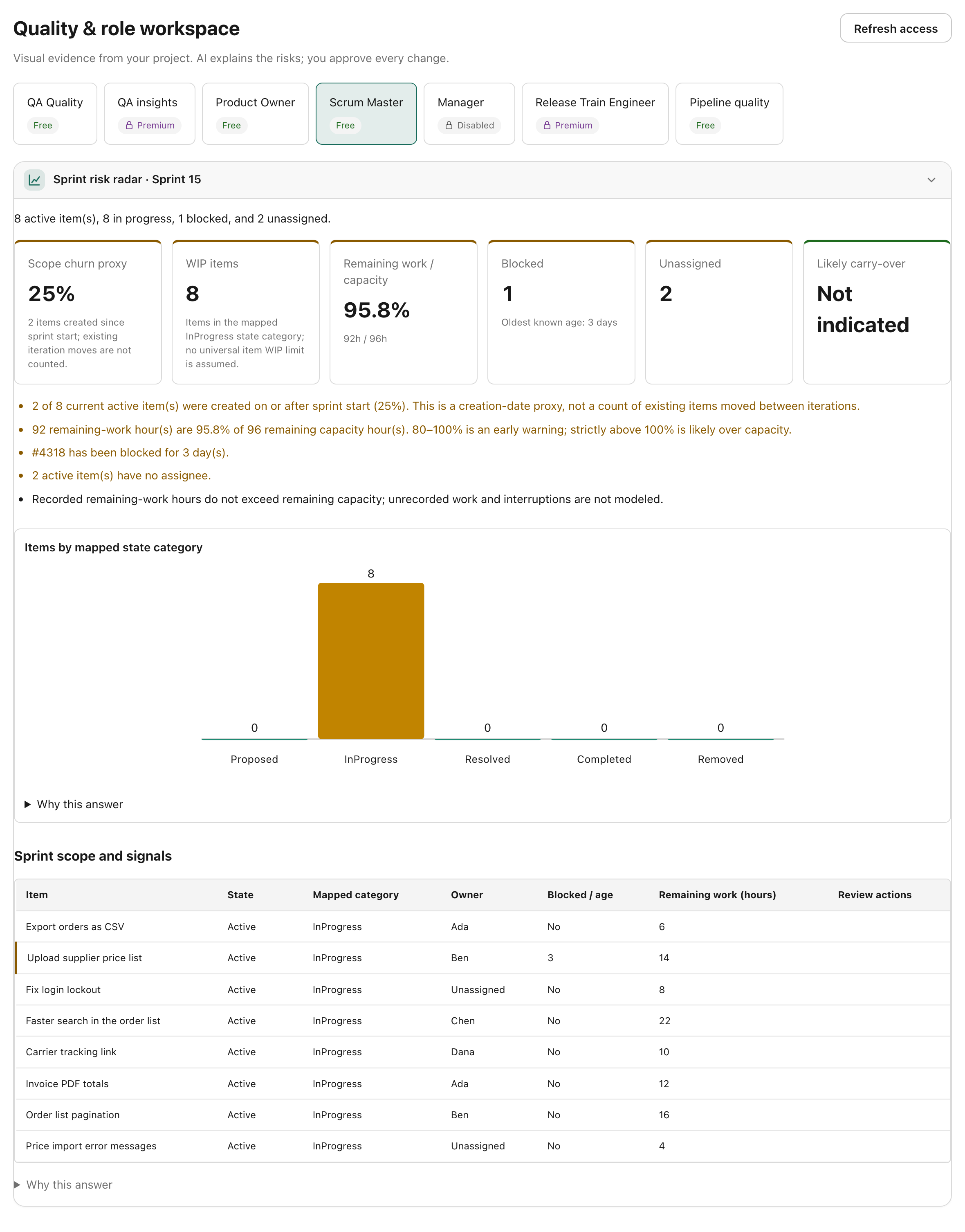
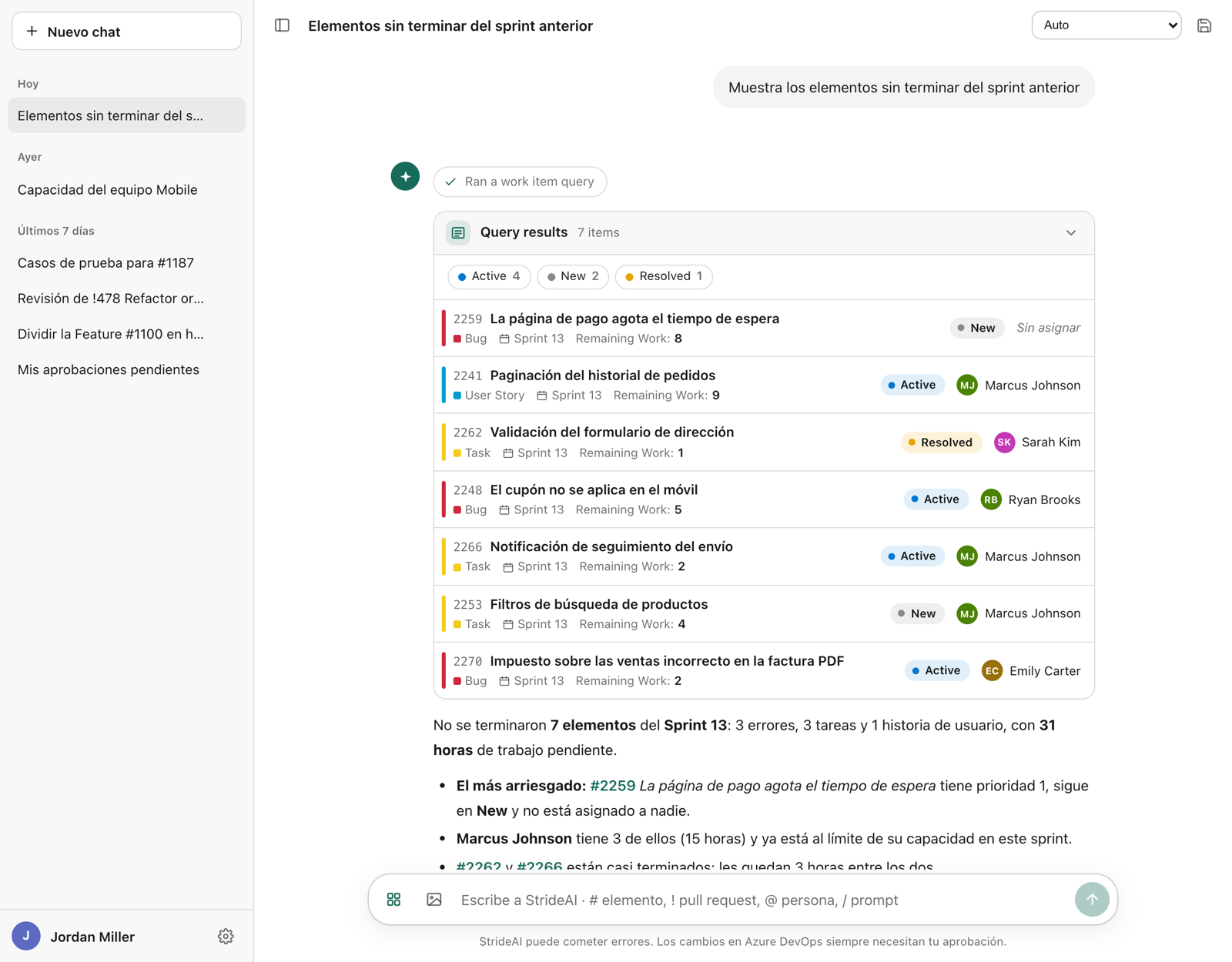
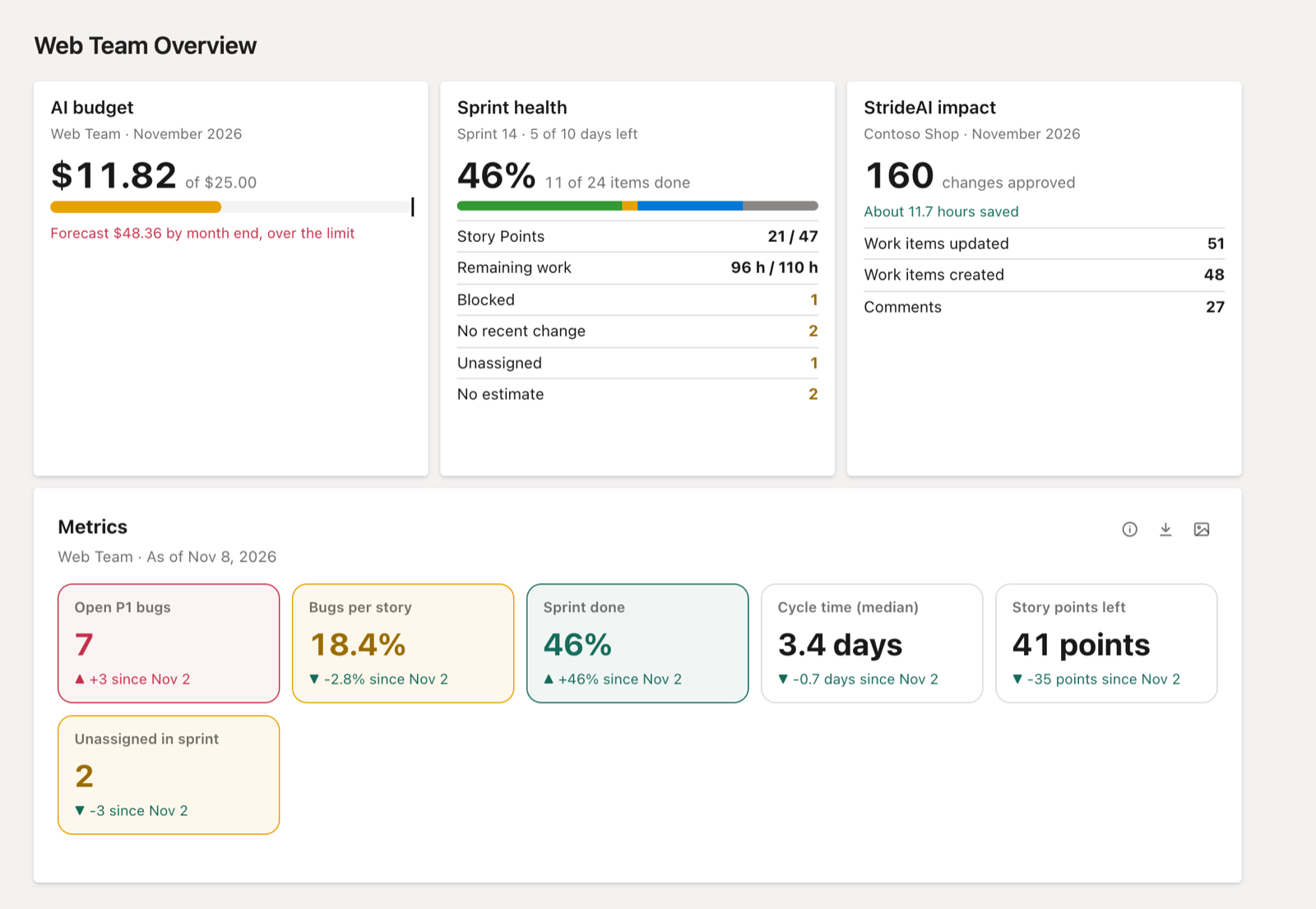
See it in actionDaily stand-up and sprint healthAsk "Prepare today's stand-up" or "How is the sprint going?". StrideAI shows progress, story points, remaining work against capacity for each person, and what needs attention: blocked, idle, unassigned, and unestimated items, plus everything done, moved, or added since the last working day.
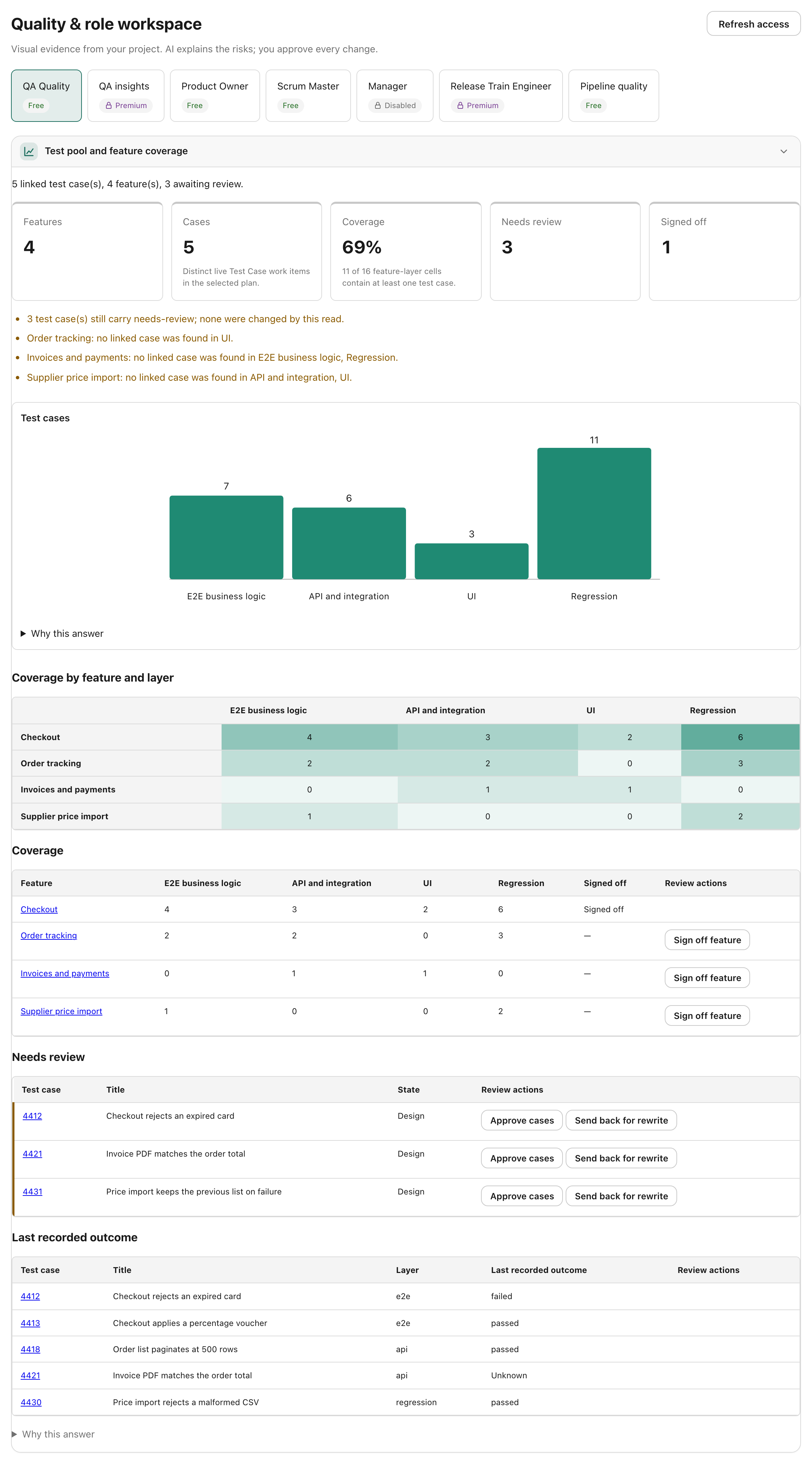
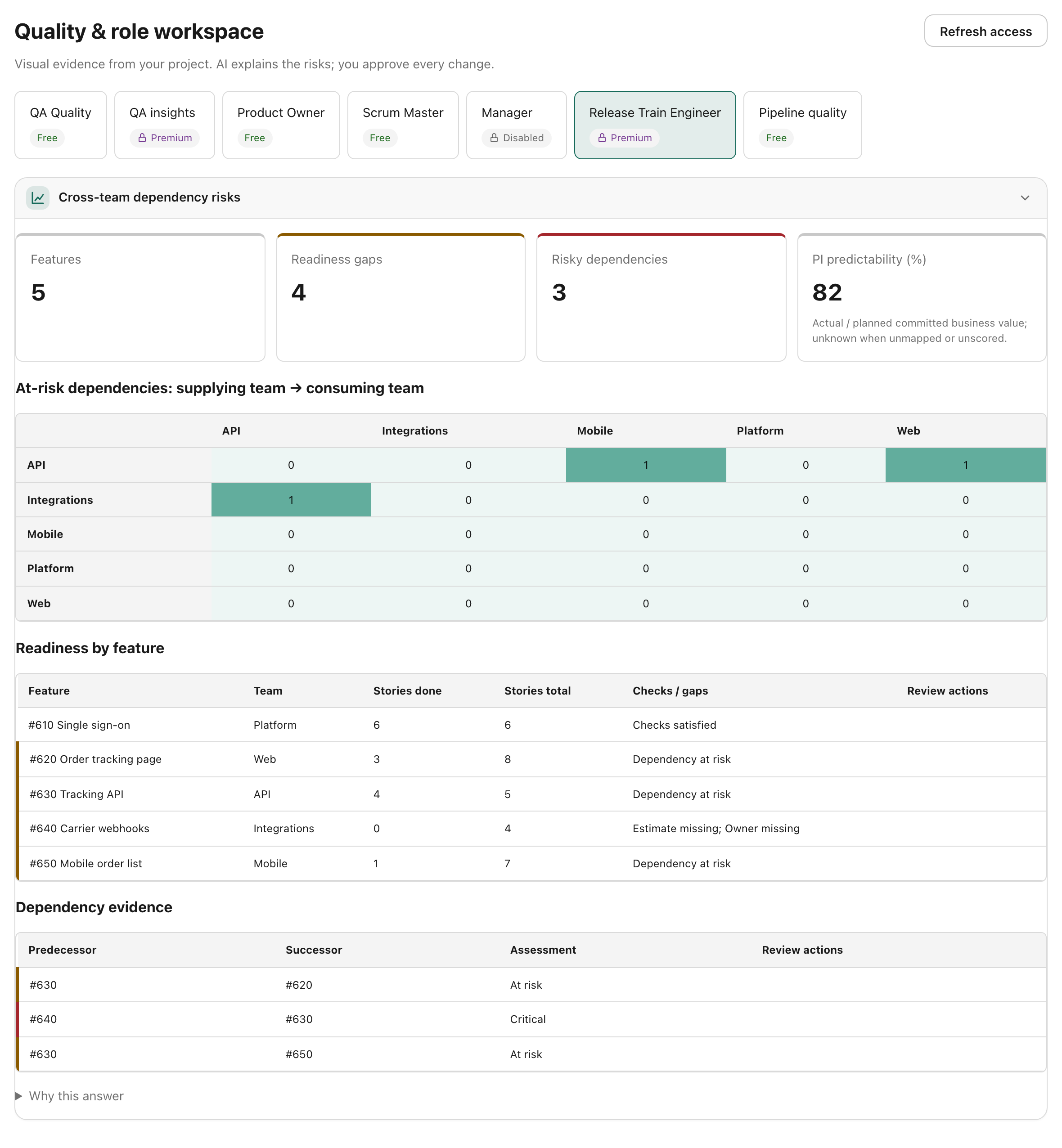
Quality & roles: visual dashboards for every roleOpen Quality & roles in the project navigation or from the chat sidebar. Seven tabs build visual reports straight from your project's evidence, with no model needed; the AI explains them when you ask:
Missing evidence stays unknown instead of becoming a guess, and every write a pack proposes, such as approving test cases or signing off a feature, opens the usual approval card with undo. Every pack is free, and Settings > Features turns each one off per project.
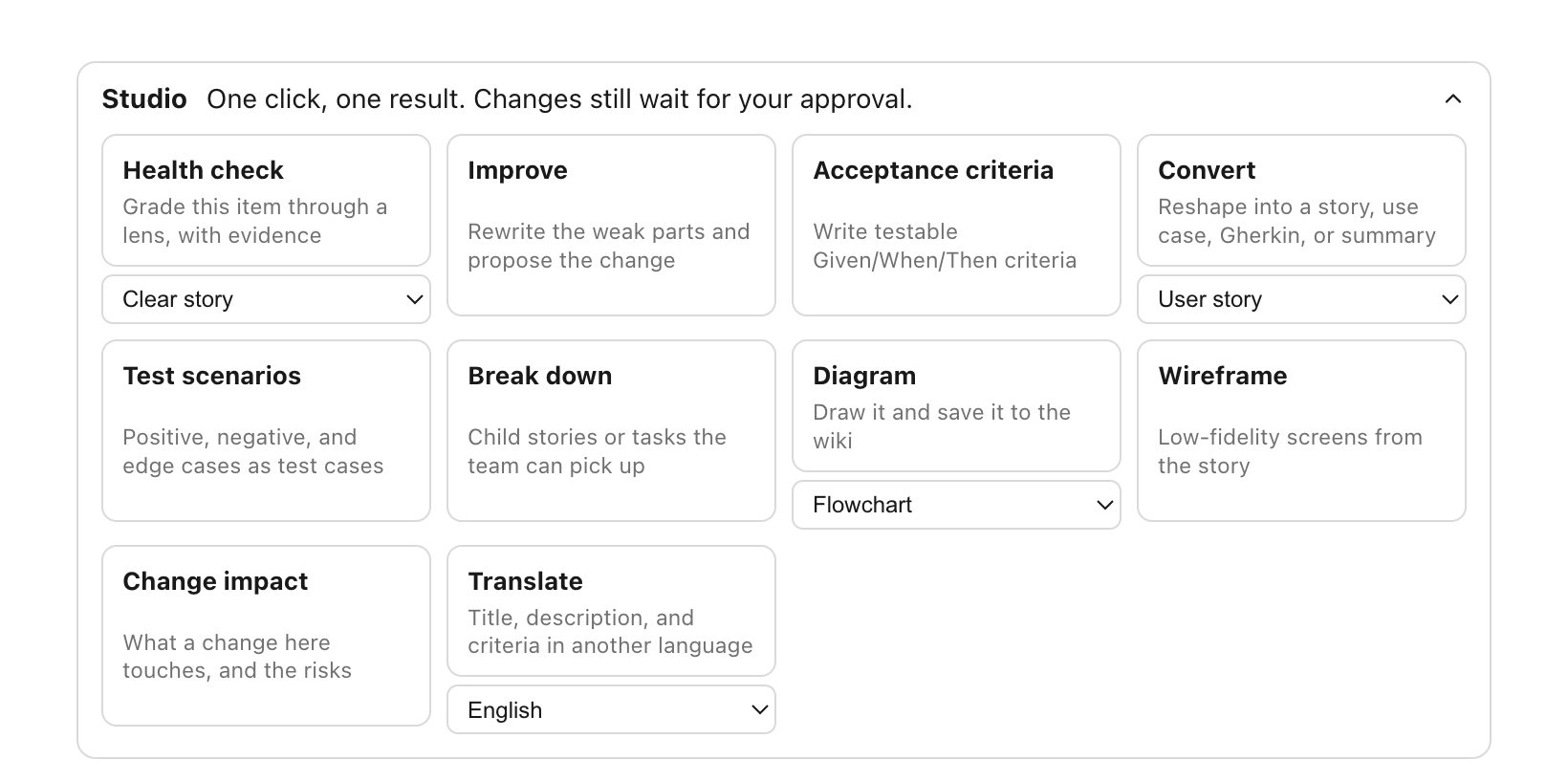
Studio: one click on the work itemOpen any work item and the StrideAI tab starts with Studio: tiles for the things people do most, one click each. Health check with the lens you pick, Improve, Acceptance criteria, Convert (user story, use case, Gherkin, stakeholder summary), Test scenarios, Break down, Diagram, Wireframe, Change impact, Translate. Each tile opens its own result with the same cards as the chat, and any change to the item still waits for your approval. No prompt to write, and the chat is right there when you want to refine.
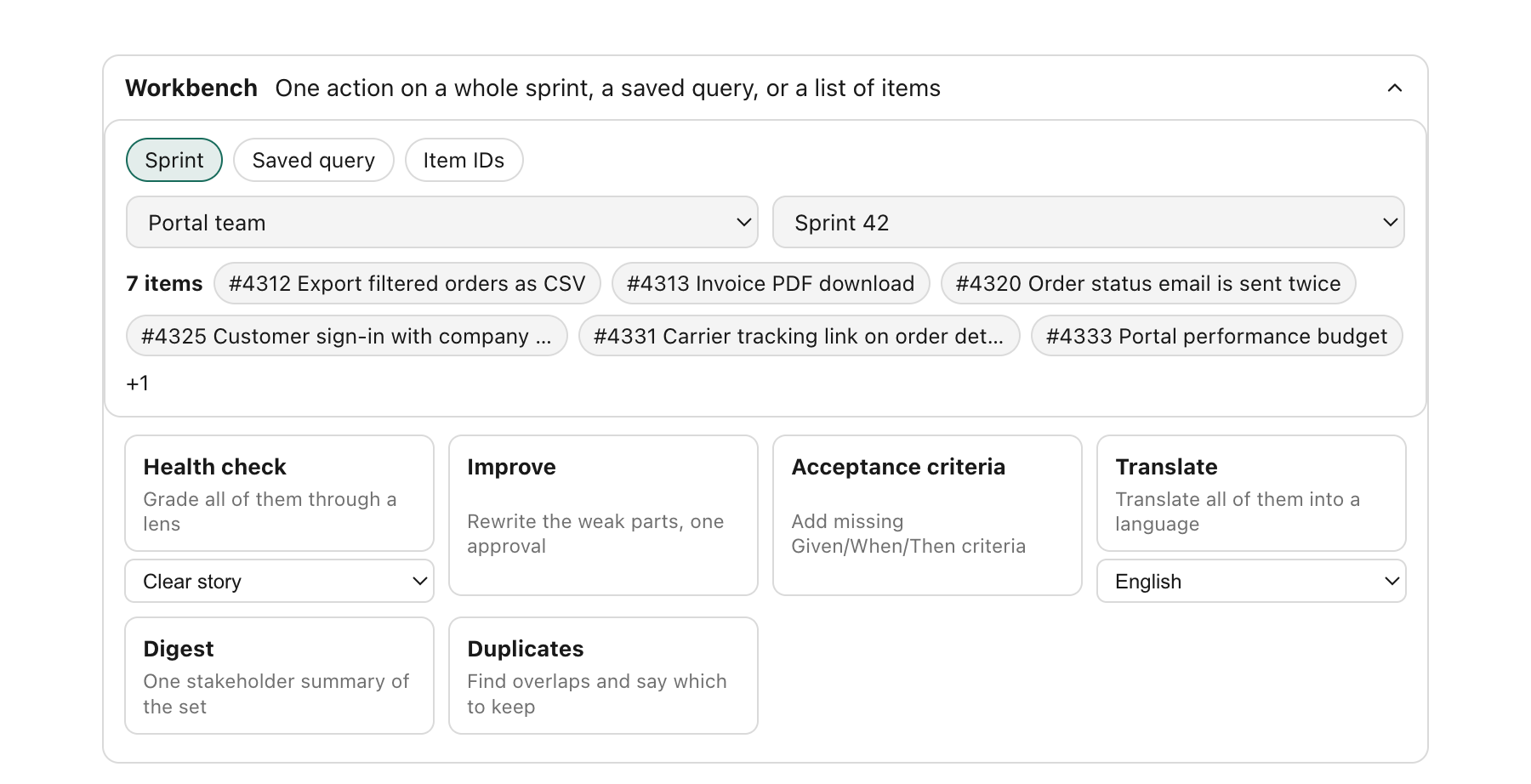
Right-click, doneYou don't have to open StrideAI first. Select items on a backlog, a board, or in query results, right-click, and the StrideAI menu runs a health check, improves them, adds acceptance criteria, translates, writes a digest, or finds duplicates. A saved query has Open in StrideAI Workbench in its menu. The hub opens with the items picked and the result on its way; changes still wait for your approval. Workbench: one action on a whole sprintIn the StrideAI hub, Workbench takes a sprint, a saved query, or a list of IDs and runs one action on all of them: a health check through a lens, improving the weak parts, adding missing acceptance criteria, translating, a stakeholder digest, or a duplicate sweep. Changes arrive as one bulk run you approve once.
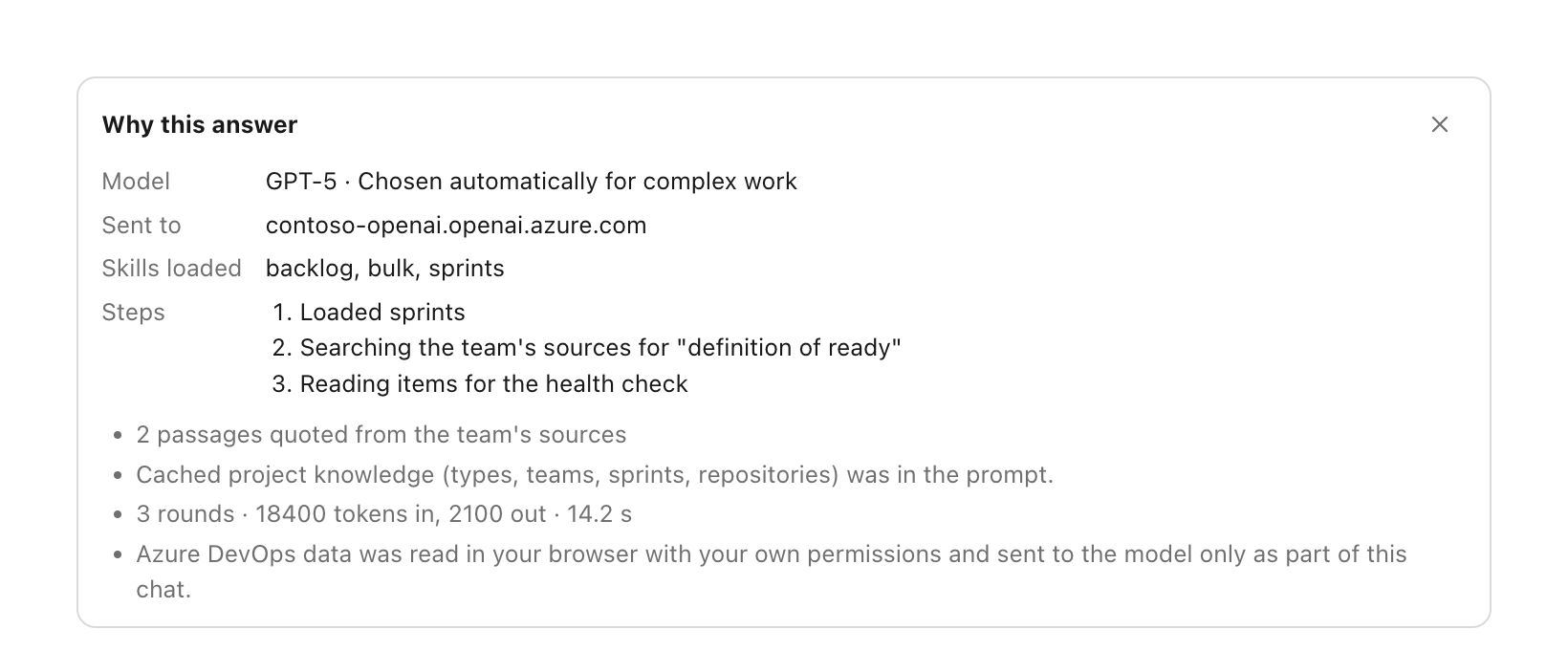
Why this answerEvery answer has a small Why this answer panel: which model answered and why it was chosen, where the request went, which skills were loaded, the steps StrideAI took, how many passages came from your sources, and what it cost in rounds, tokens, and seconds. Nothing in it leaves your browser.
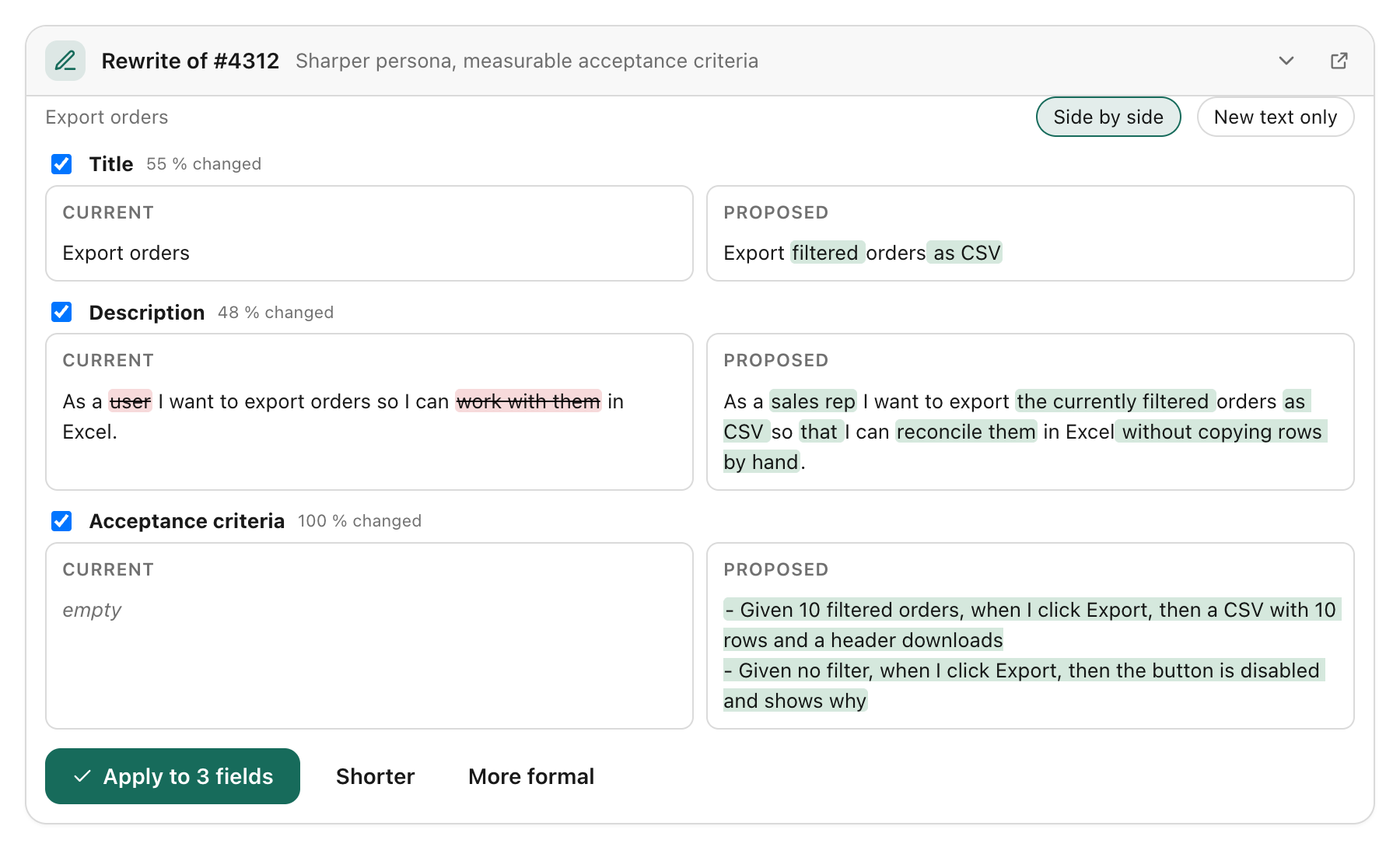
Rewrite with the differences markedImprove, Convert, Translate, or "make this description sharper": StrideAI shows the current text and the proposed text side by side, field by field, with what it removed and added marked and a percentage of how much changed. Untick a field to keep it, ask for a shorter or more formal version, then Apply; the update still waits for your approval.
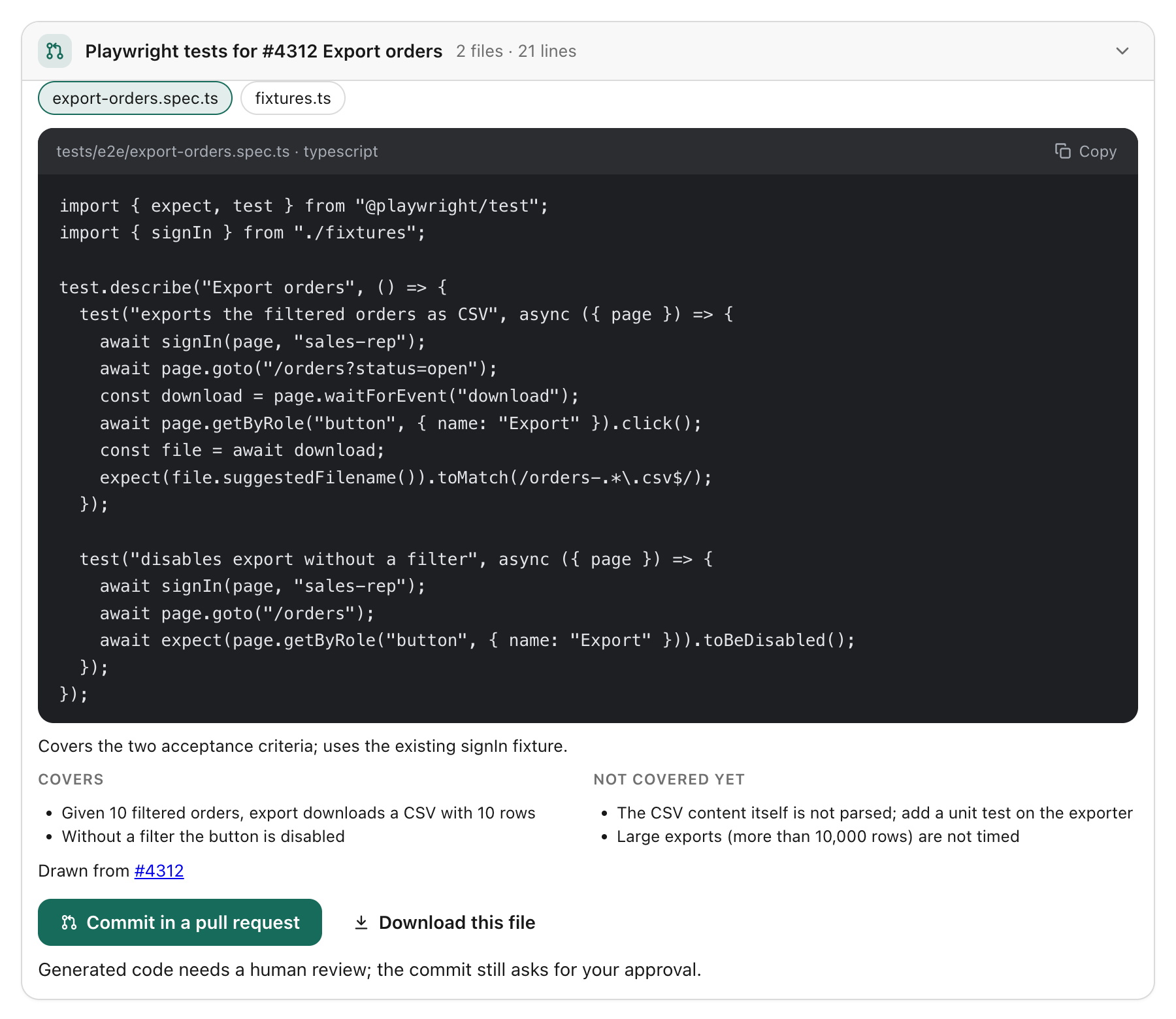
Tests and code, ready to commit"Generate Playwright tests for #4312" or "scaffold the exporter module": StrideAI reads how your repository does it, writes complete files, and shows them with their paths, what they cover, and what they don't cover yet. Copy a file, download it, or commit all of them in a new branch with a pull request, after your approval.
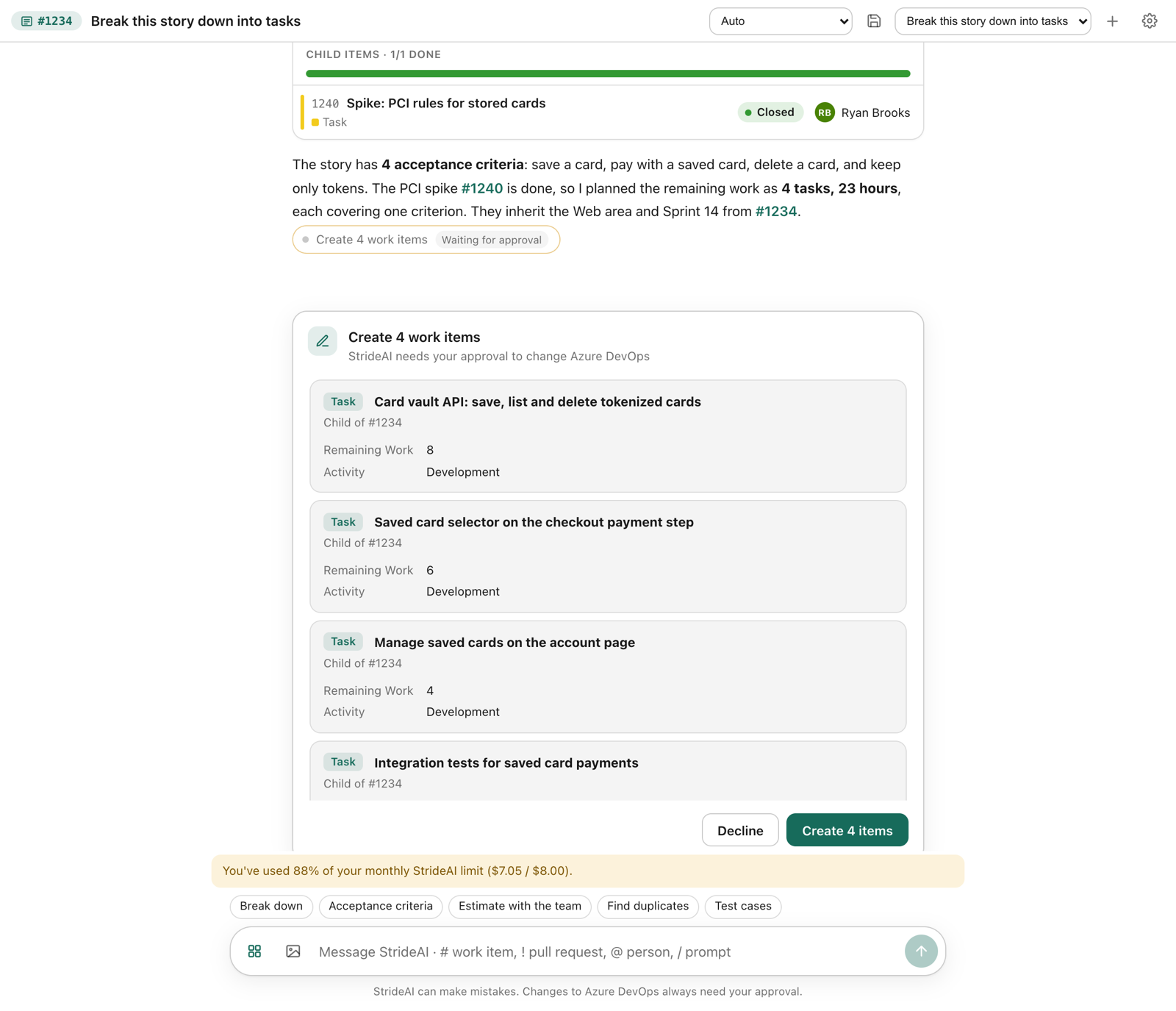
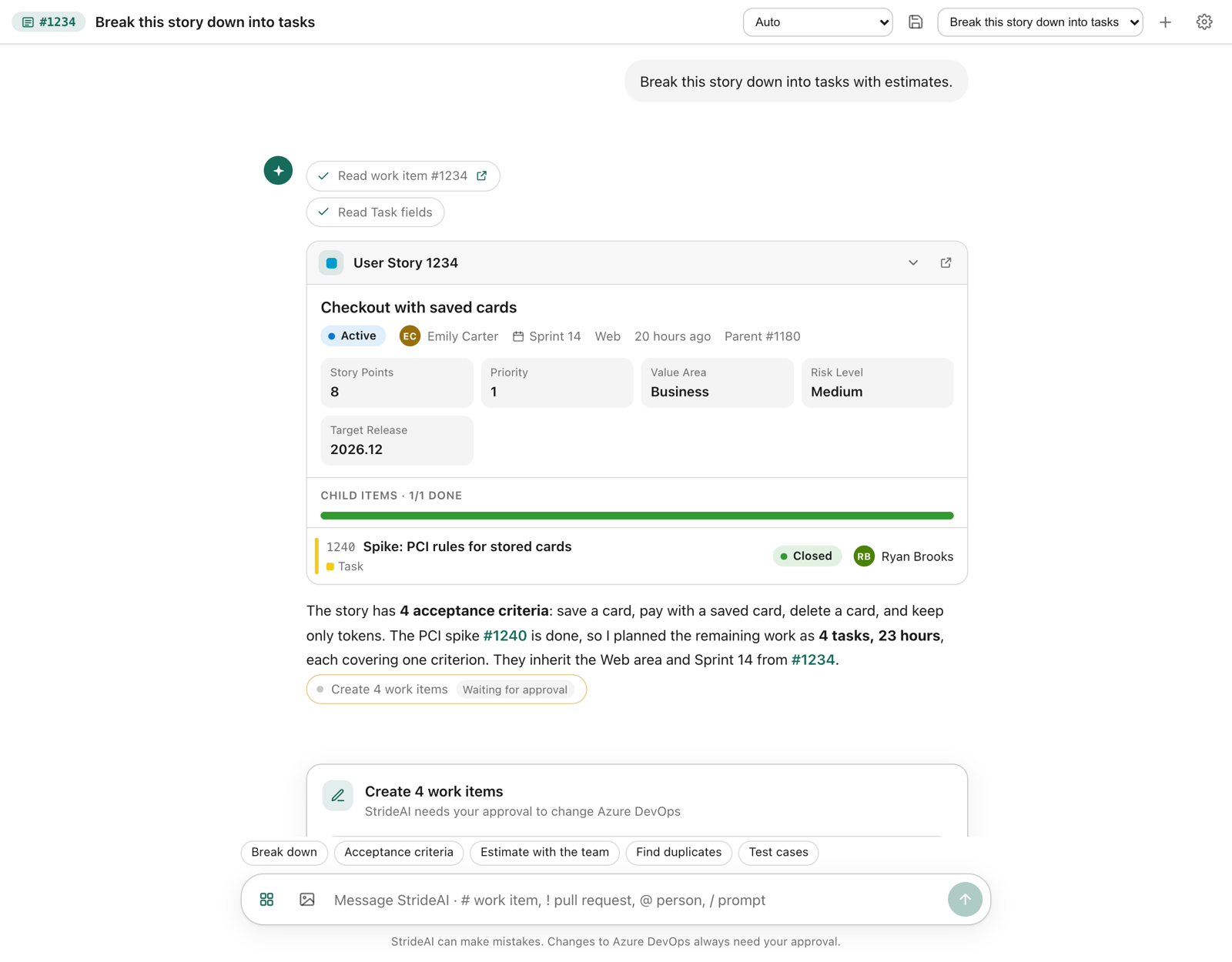
Plan the work right inside a work itemOpen the StrideAI tab on any work item. Ask it to explain the item, break it down, write test cases, or plan the implementation in your code. Changes appear as an approval card. Nothing is created until you click Create.
One-click actions above the message box work on the open item: Break down, Acceptance criteria (testable Given/When/Then scenarios), Estimate with the team (starts planning poker for it), Find duplicates, and Test cases (linked to the item, with an offer to add them to its test suite).
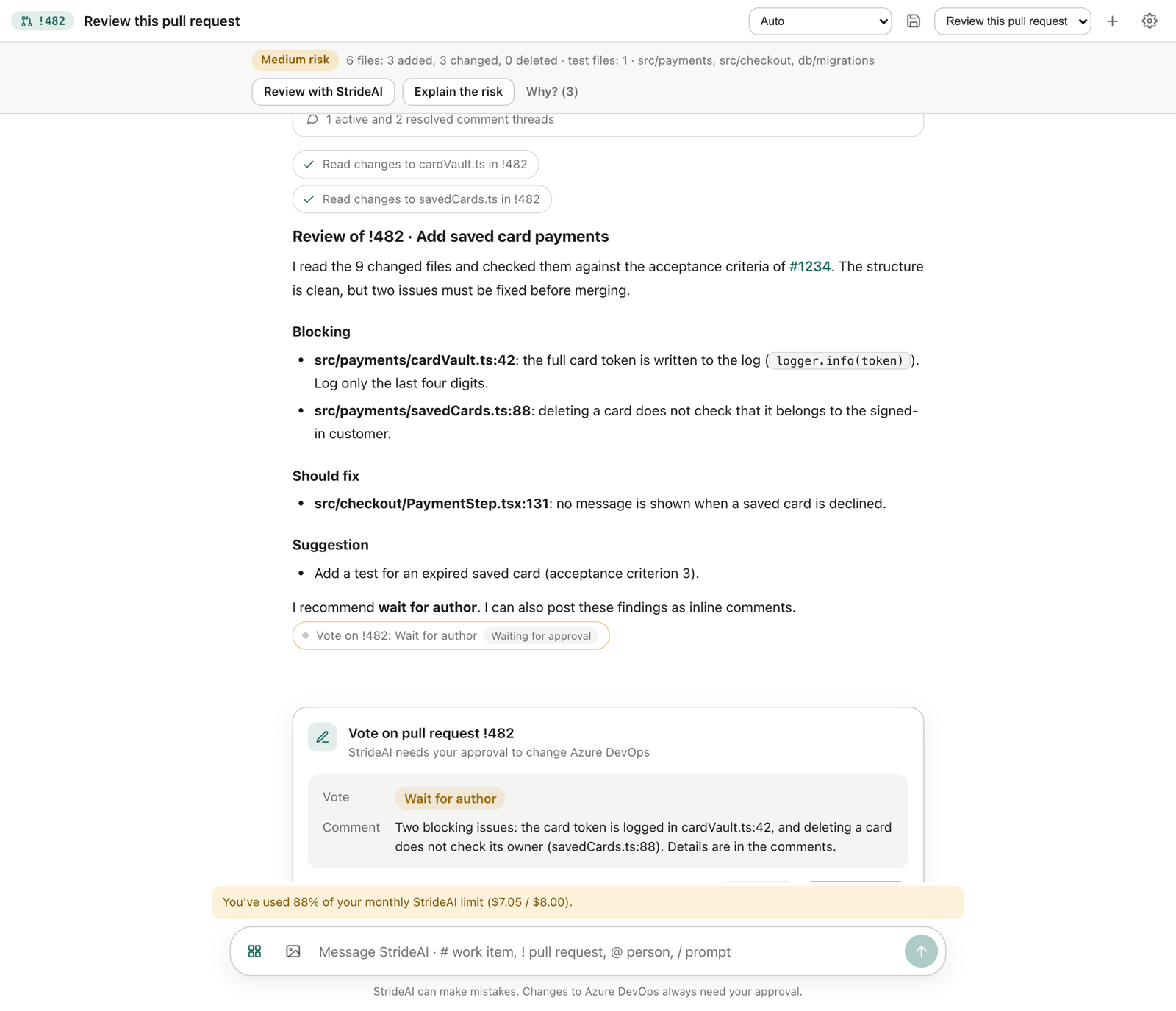
Review pull requestsOn the StrideAI tab of a pull request, ask for a review. It reads the diff, the policies, and the linked work items, then lists findings by severity. With your approval, it posts inline comments and votes.
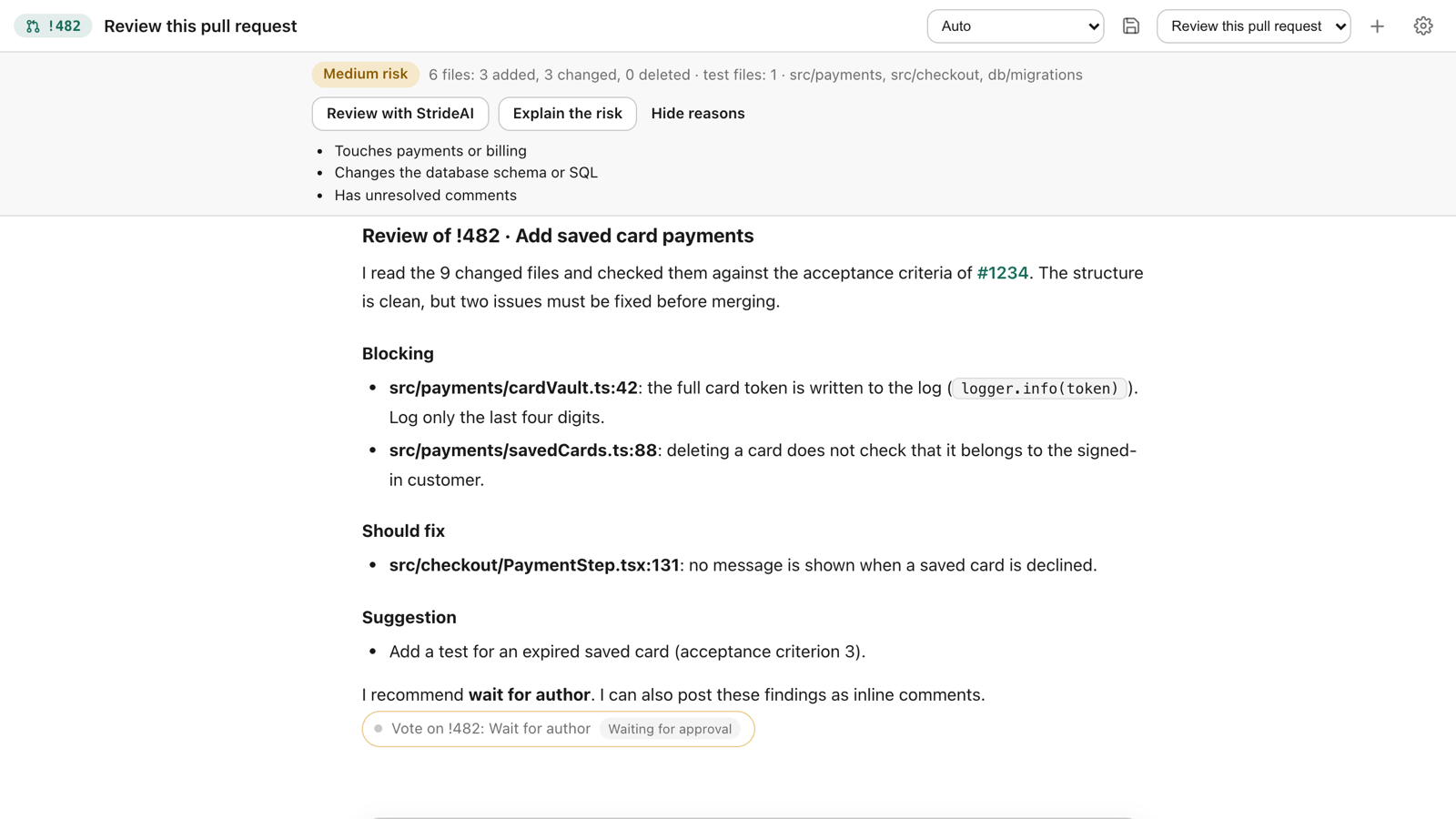
Every pull request also gets a risk level the moment you open the tab, at no AI cost: StrideAI looks at how many files changed, sensitive areas such as sign-in, payments, database migrations, pipelines, and dependencies, code changed without tests, linked work items, the description, failing checks, rejections, merge conflicts, and unresolved comments. Select Why? for the reasons, Explain the risk for what to test before merging, or Review with StrideAI for a full review.
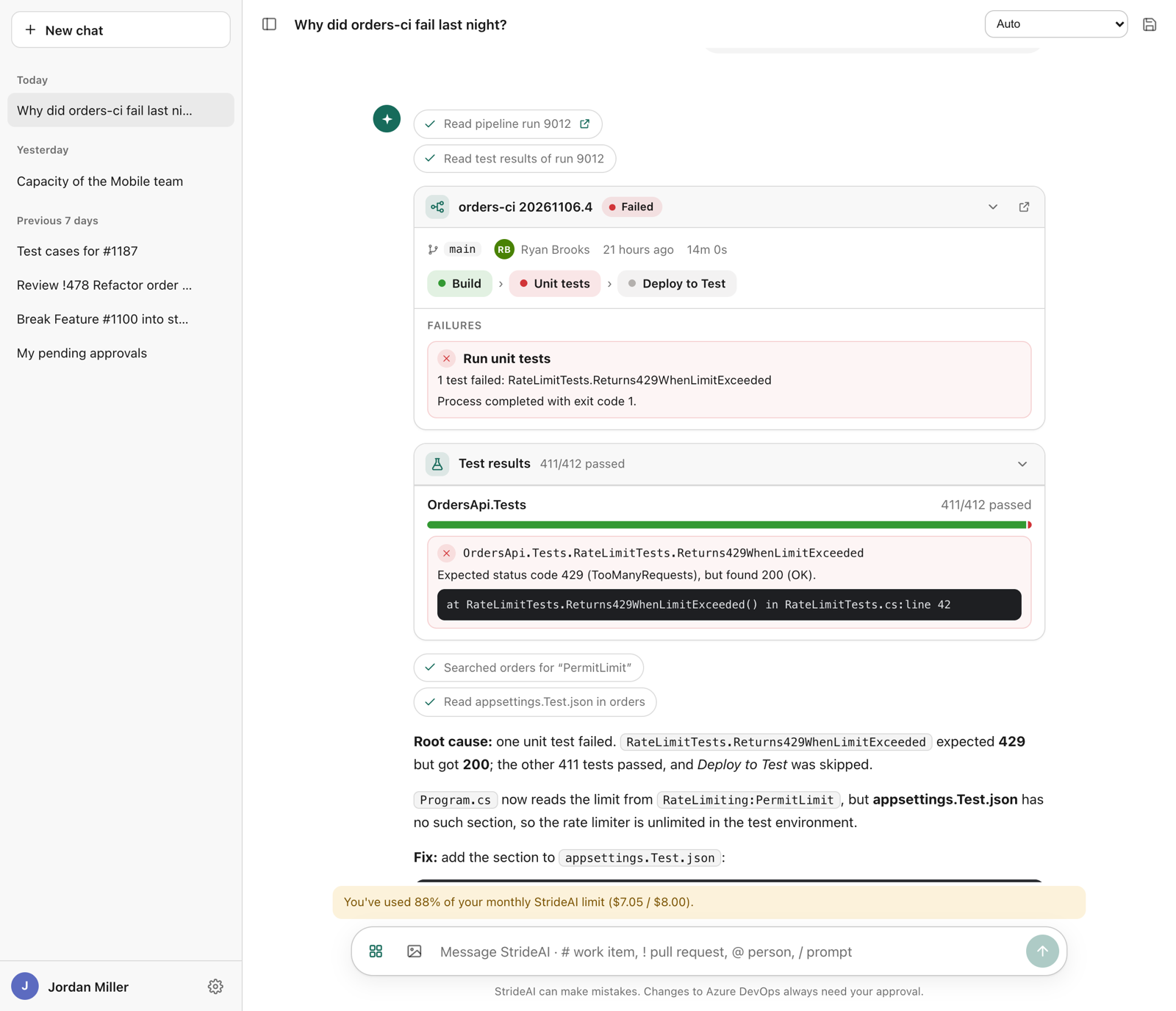
Find out why a pipeline failedIt reads the run timeline, failed tasks, logs, and test results, looks into your code, and explains the root cause with a concrete fix. It can also run, cancel, or retry pipelines and approve deployments when you ask.
Queries and reports in your languageAsk for any list or report. StrideAI writes the work item query (WIQL), runs it, and summarizes the result. It can also save the query: under Shared Queries, so your team can open it and add it to a dashboard, or under My Queries for yourself. The interface is available in English and Turkish, with the chat basics also in German, French, and Spanish, and answers follow the language you write in.
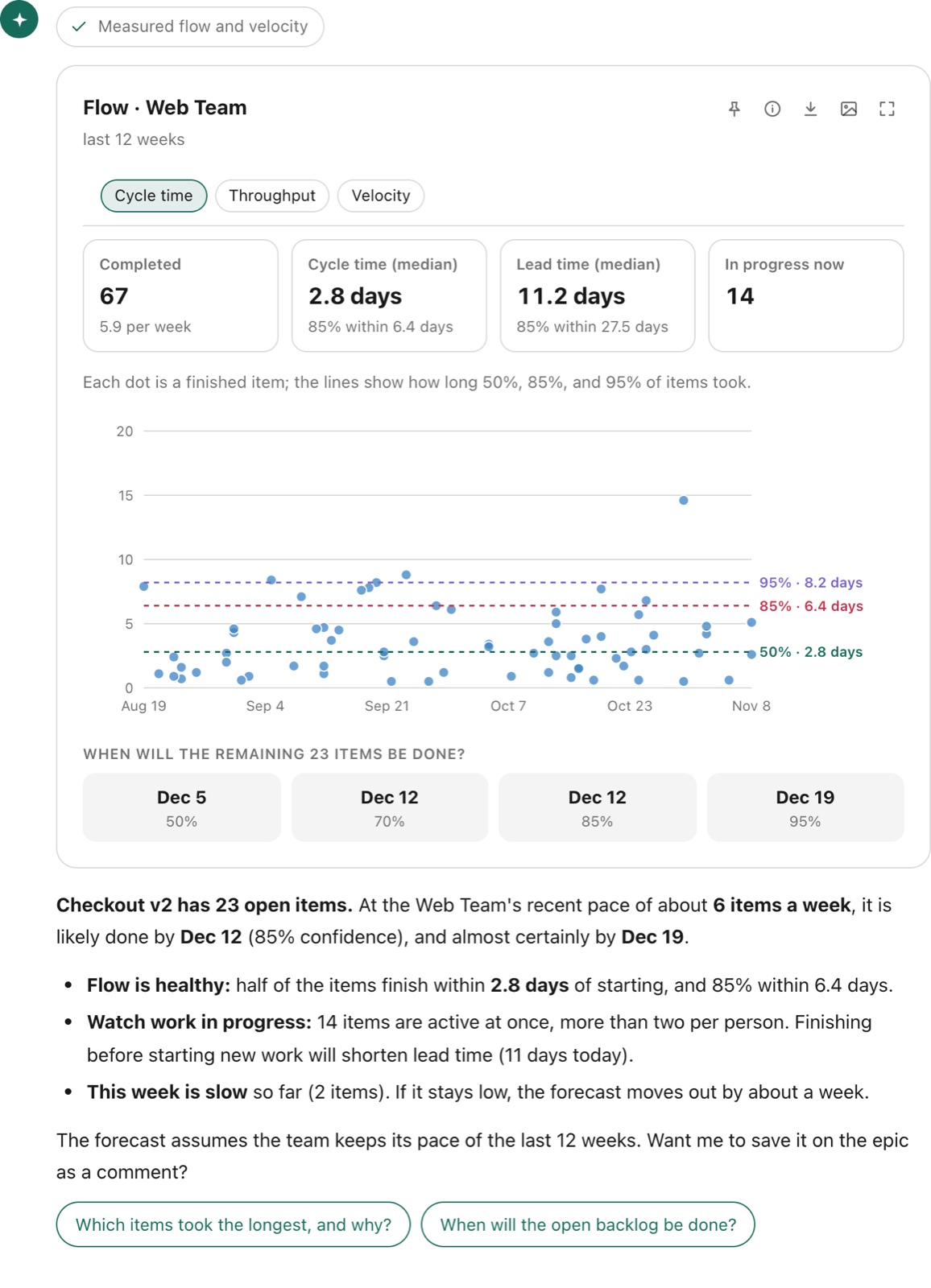
Forecast delivery with your team's real paceAsk "When will the Checkout epic be done?". StrideAI measures cycle time, lead time, throughput, and velocity from your completed work, then runs thousands of simulations to give a date range with confidence levels instead of a guess. Switch between a cycle time scatter with the 50%, 85%, and 95% lines, throughput per week, and velocity per sprint with its average and range. Each dot opens its work item.
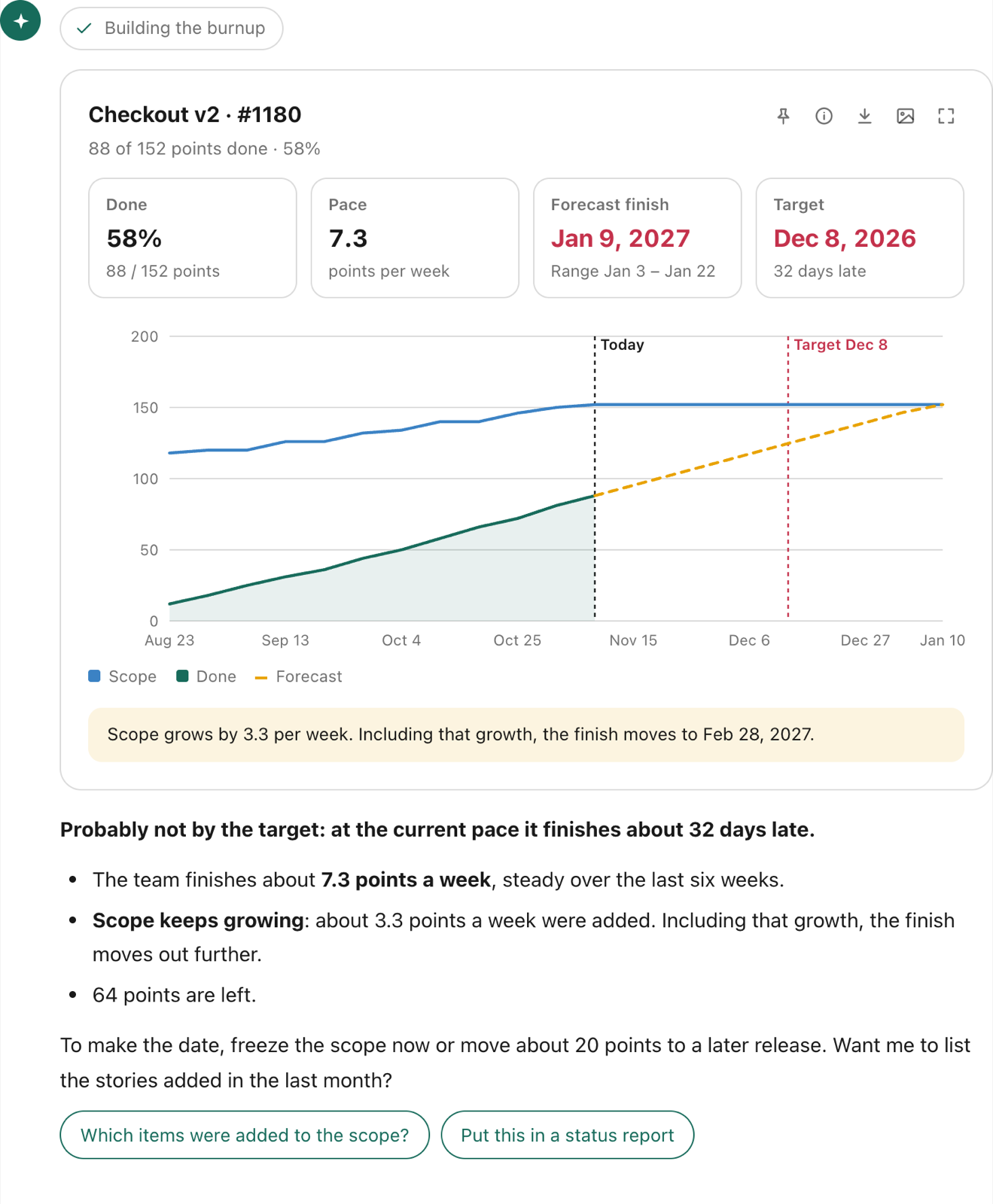
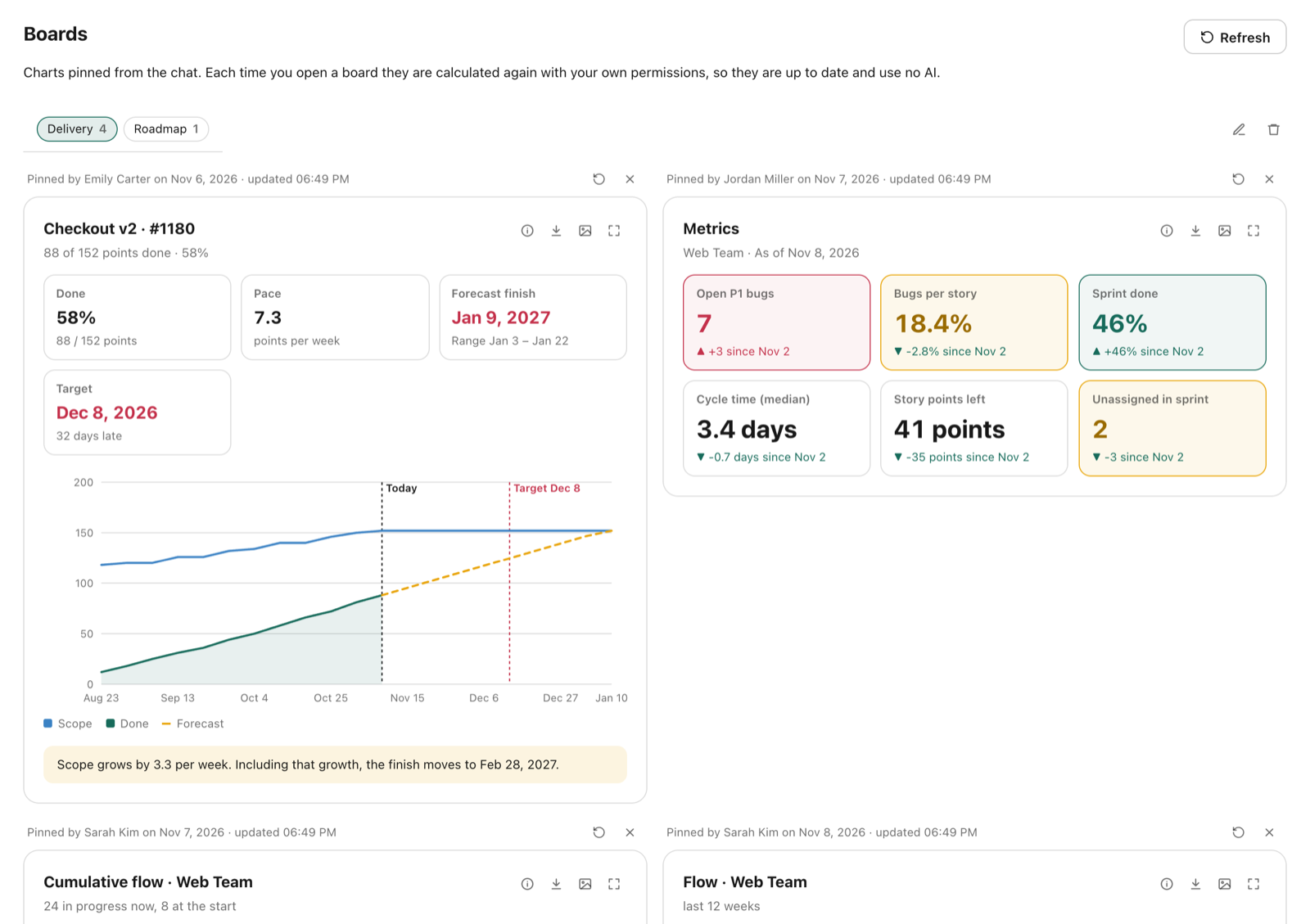
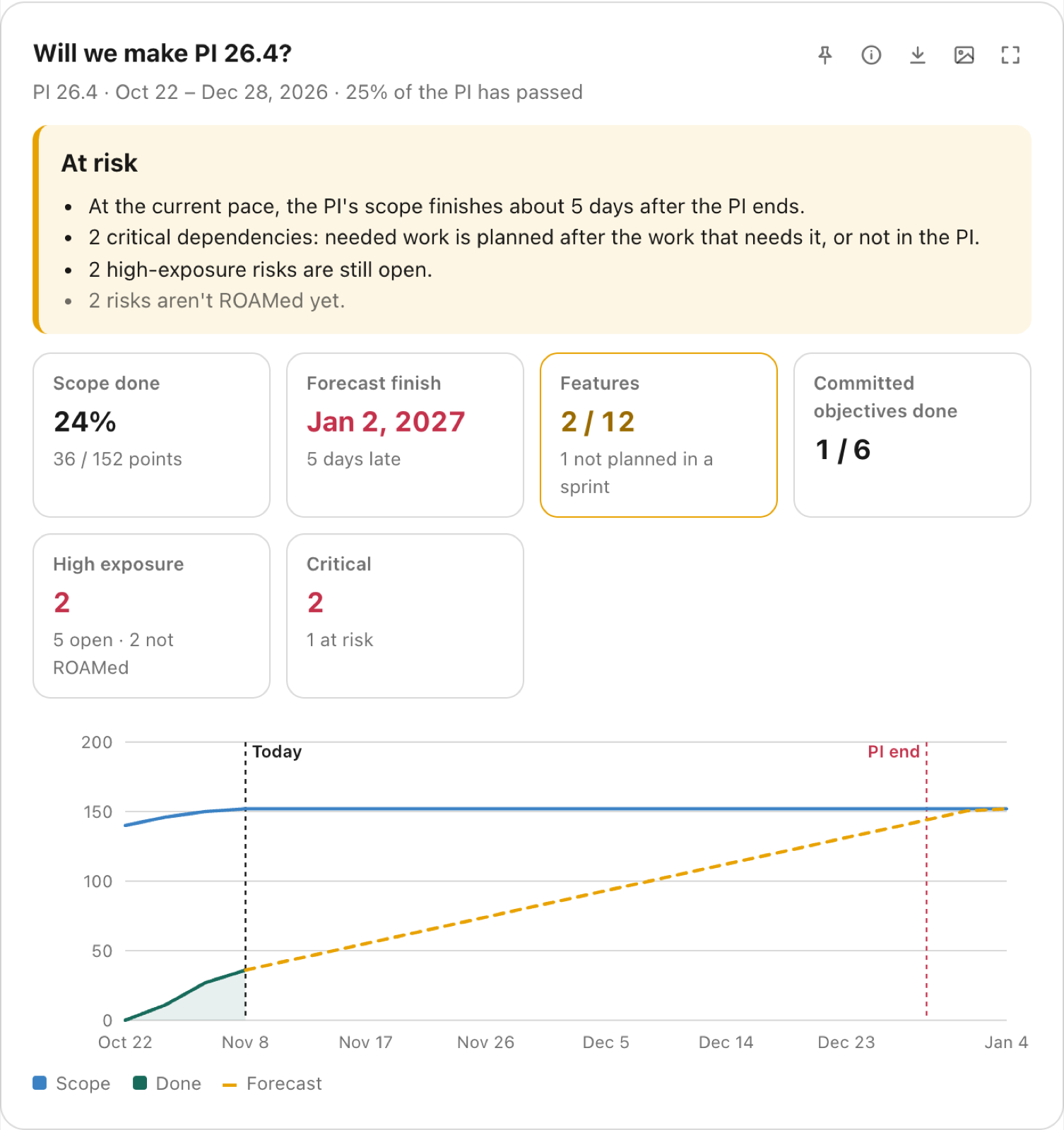
Burnup and cumulative flowAsk "Will Checkout v2 make it by December 8? Show the burnup in story points.". StrideAI draws the scope and the finished work over time, continues the recent pace to a forecast finish with a range, and shows how far it lands from your target date. When the scope keeps growing, it tells you by how much and what that does to the date.
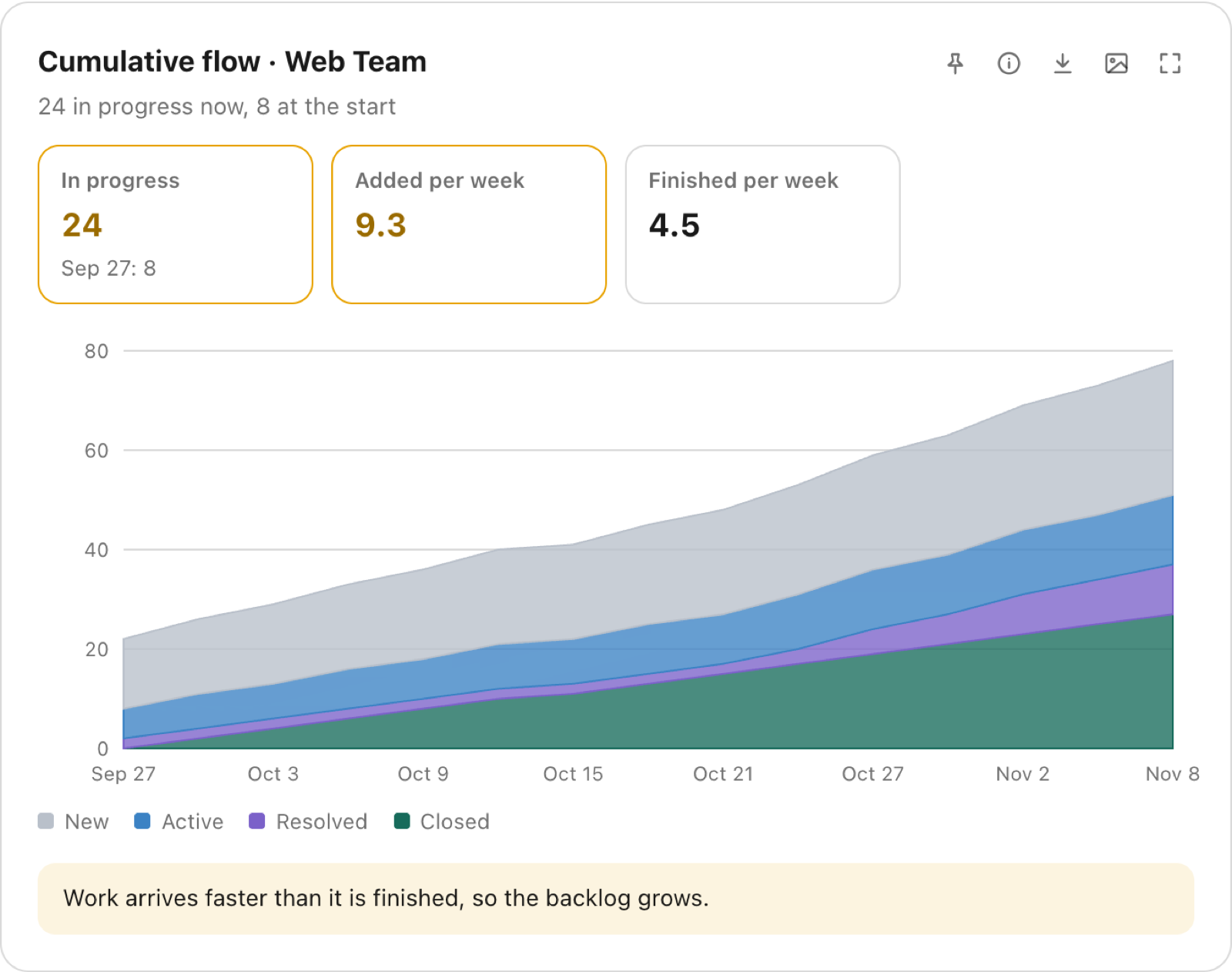
Ask "Show the cumulative flow for the Web Team. Where is work piling up?" to see how many items were in each state on each day, how work in progress changed, and whether work arrives faster than it is finished.
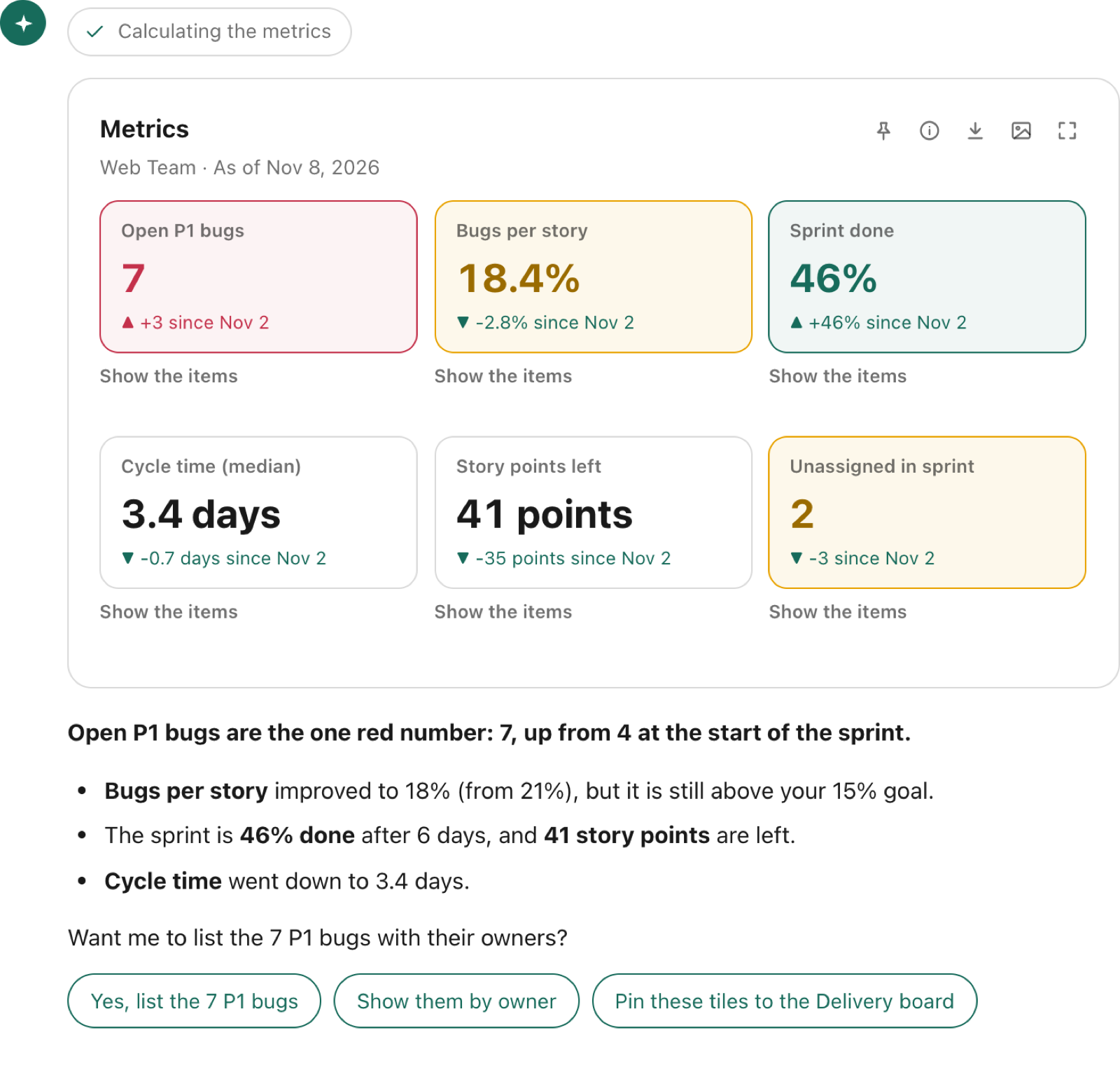
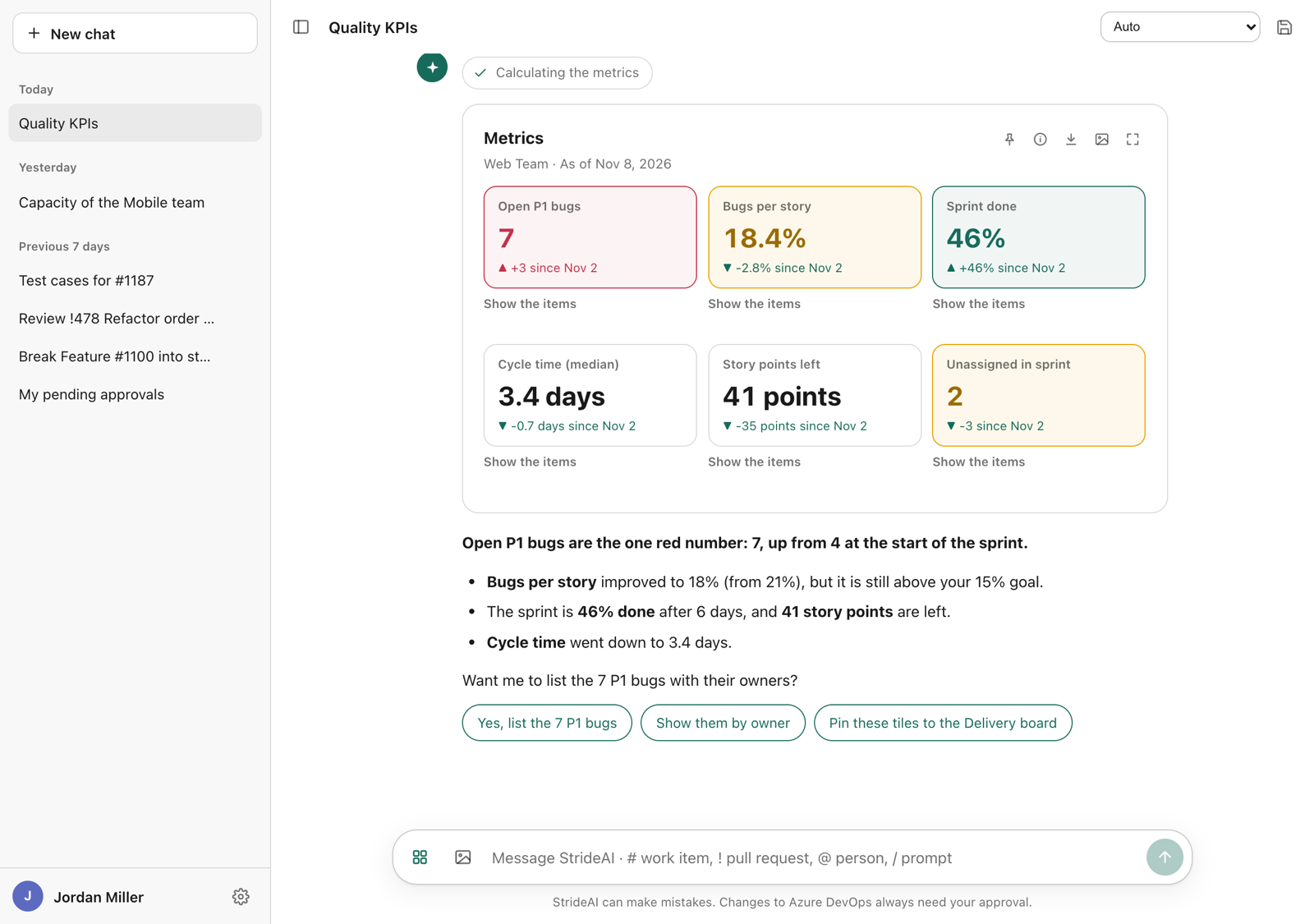
Both charts are built from your work items' history, so they need no extra permissions or Analytics setup. KPIs as tiles in one sentenceAsk "Show open P1 bugs (red above 5), bugs per story, and % of the sprint done as tiles, compared with the start of the sprint". StrideAI writes a query for each number, combines them with your formula, colors each tile by your rules, and shows the trend since last week, the start of the sprint, or last month. Point at a tile to see the formula and each query's result, or select Show the items to see what is behind it.
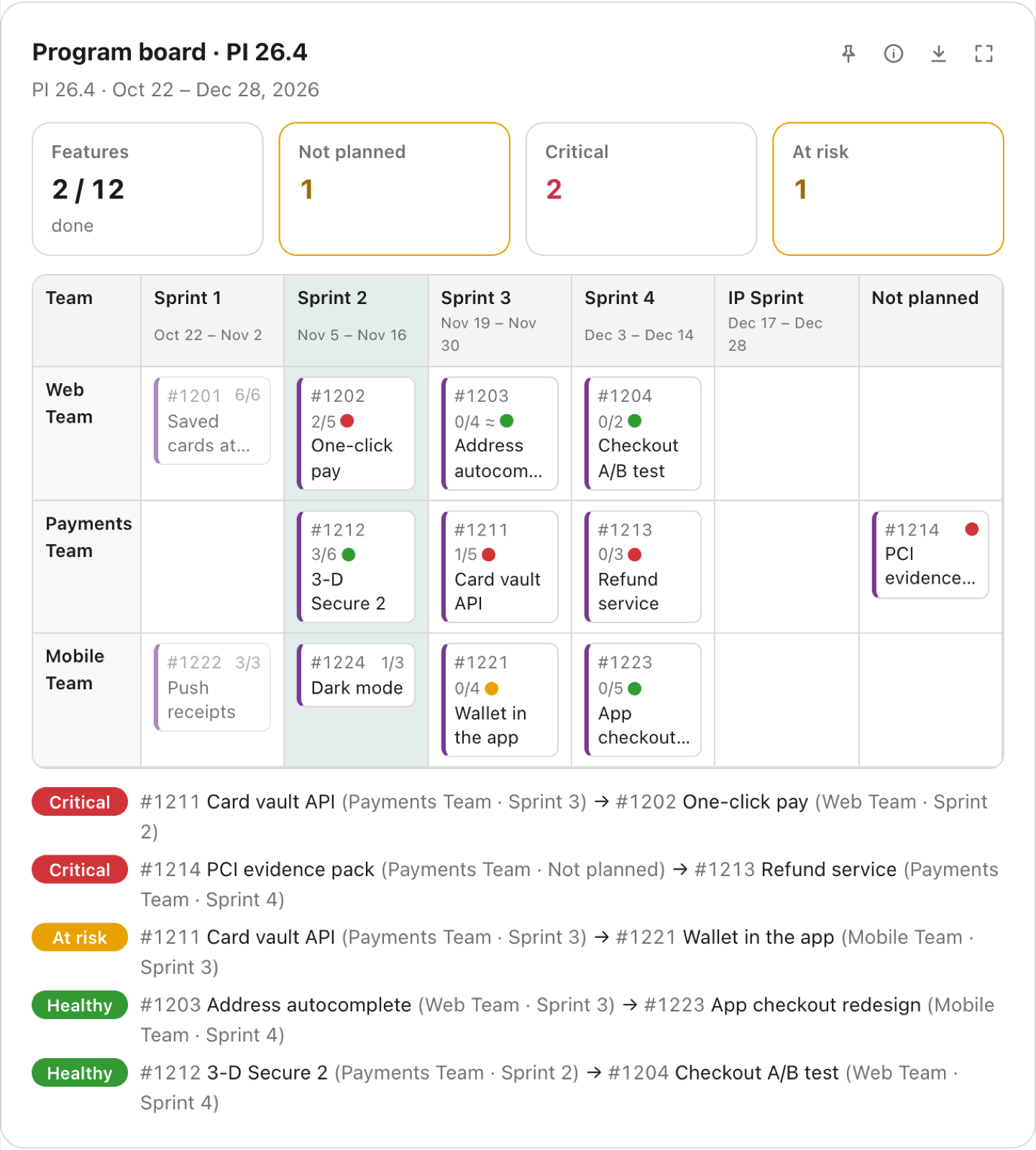
Pin charts to Boards and dashboardsSelect the pin icon on a timeline, burnup, cumulative flow, metric tiles, flow chart, or SAFe view such as the program board, and choose a board. StrideAI > Boards shows the project's boards to everyone. Each time someone opens a board, its charts are calculated again with that person's own permissions, so they are always current and use no AI.
Add StrideAI widgets to your Azure DevOps dashboards:
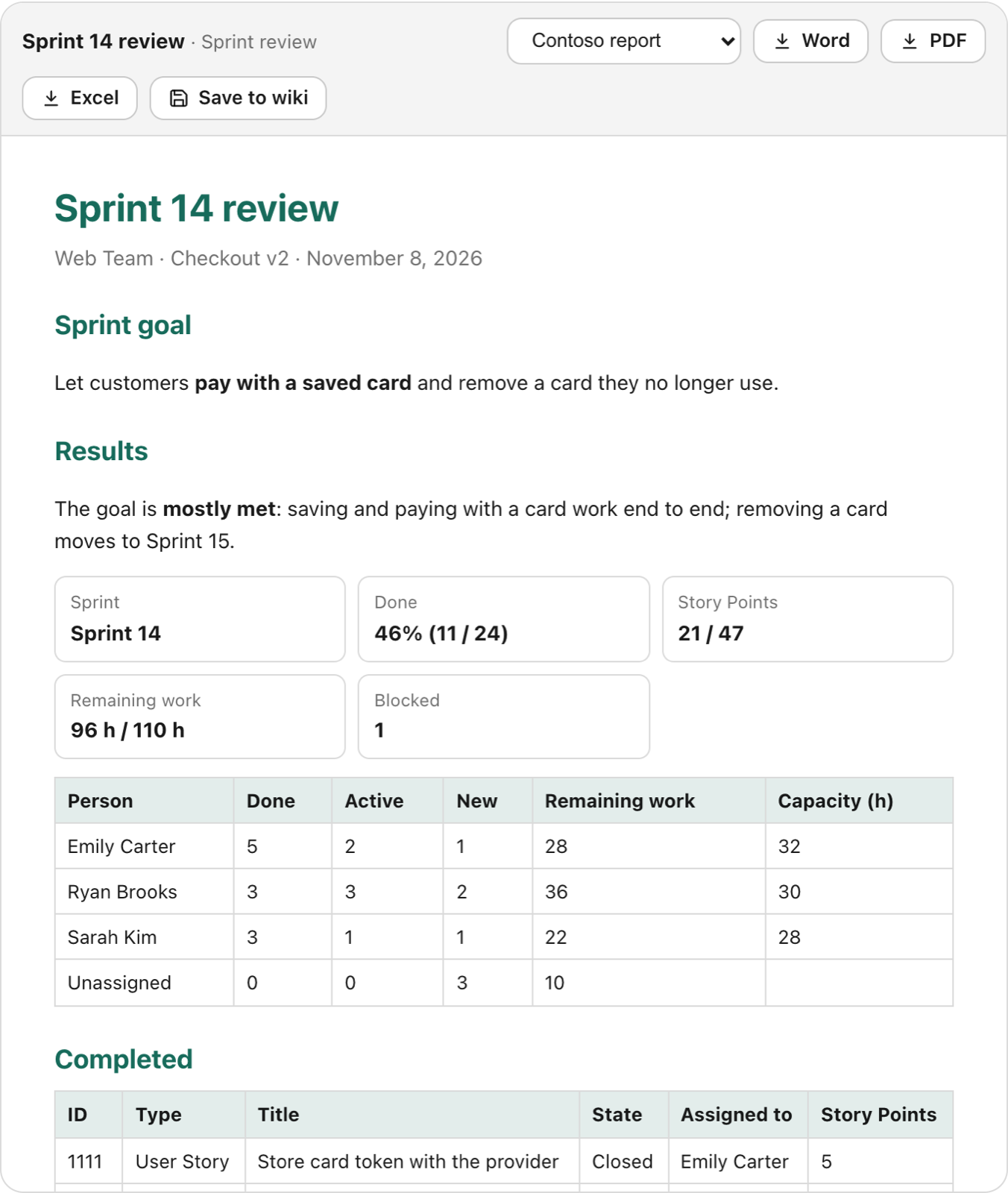
Reports and documents in your templateAsk "Prepare the Sprint 14 review as a document with the burnup" or "Write the monthly status report for the PMO". StrideAI writes the text, and the tables, key figures, and charts come straight from Azure DevOps: the sprint's results, any query, test results, a release's changes, or any chart from the chat. Preview the document in the chat, then:
Built-in templates cover status reports, sprint reviews, retrospective summaries, release notes, requirements specifications, traceability, and test execution reports.
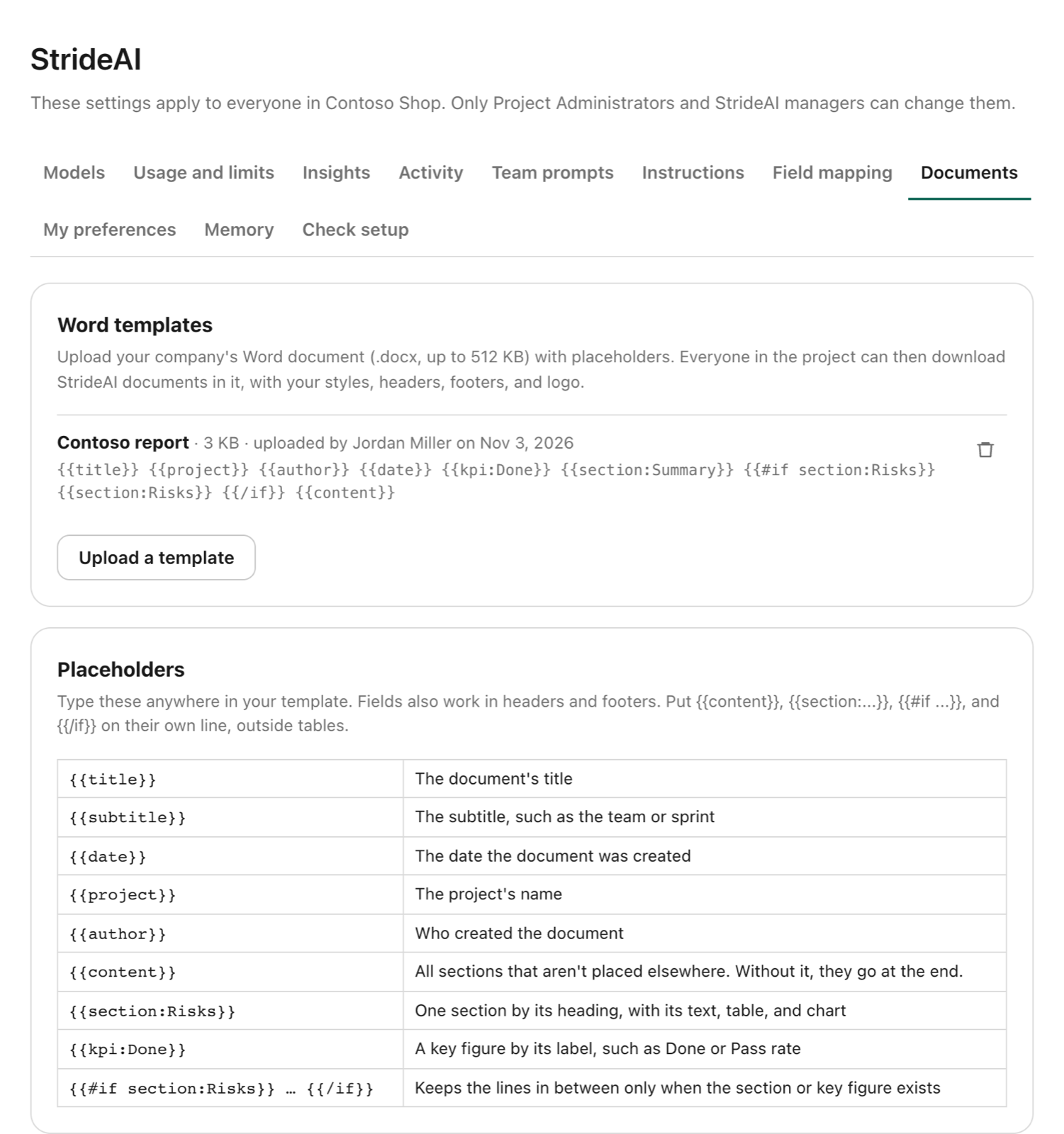
Administrators upload Word templates in Settings > Documents. Placeholders such as
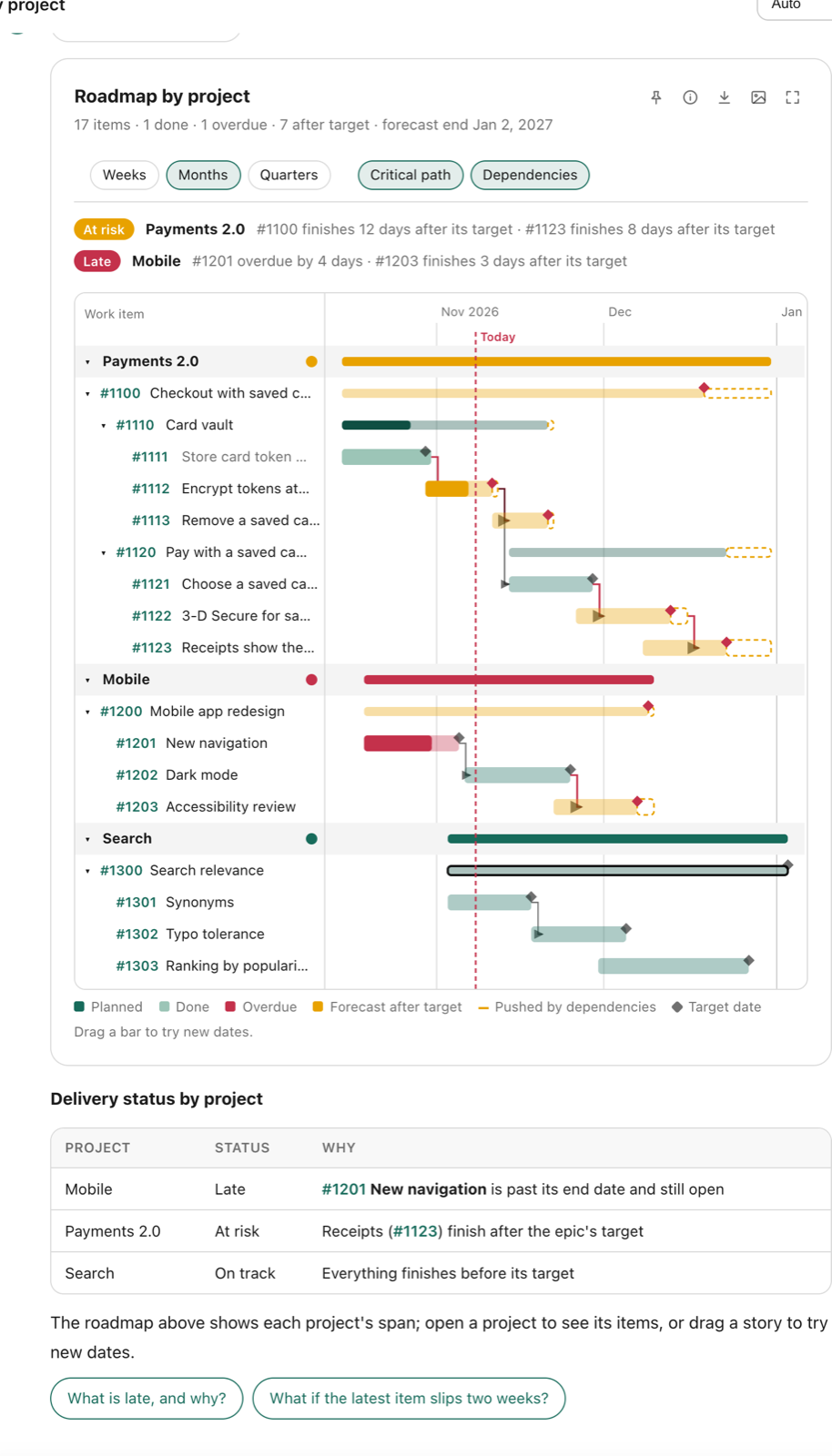
Timelines and roadmaps you can talk toAsk "Show the timeline for the Checkout epic" or "Roadmap by project for this quarter". StrideAI draws a timeline (Gantt chart) of the items and their children, with dependencies, the critical path, progress, target dates, and today's date. Group it by project, area, sprint, person, type, or tag, and switch between weeks, months, and quarters. It also forecasts: items that can't start until another one finishes are pushed out, and anything that will finish after its target date is marked. Each project or group gets a status, On track, At risk, or Late, with the reason.
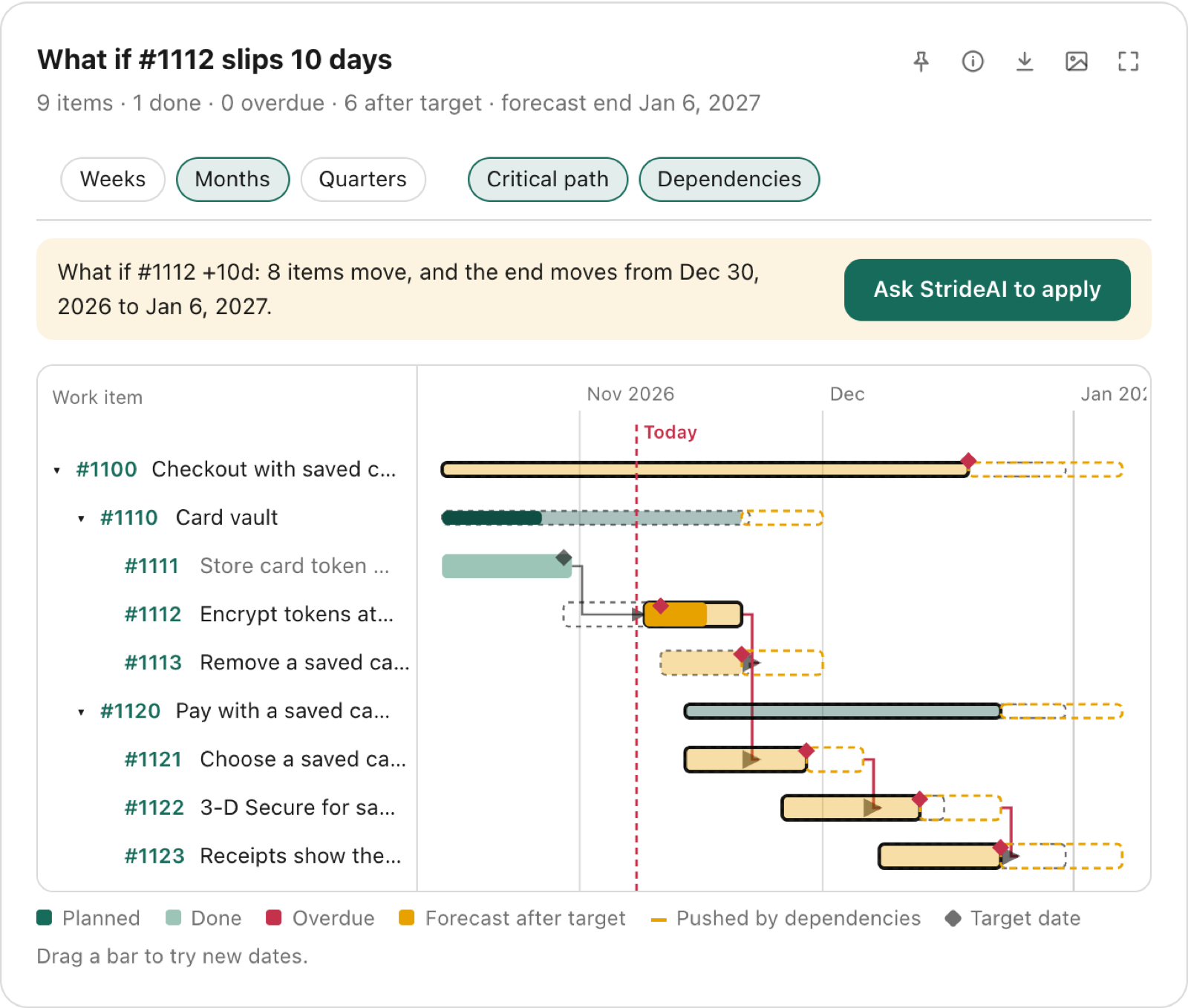
Ask "What if #1112 slips 10 days?" to see what moves and the new end date, with the old dates shown as outlines. You can also drag a bar to try new dates. Nothing changes until you select Ask StrideAI to apply and approve the new dates, and only the items you moved get new dates; epics and features keep the targets you set.
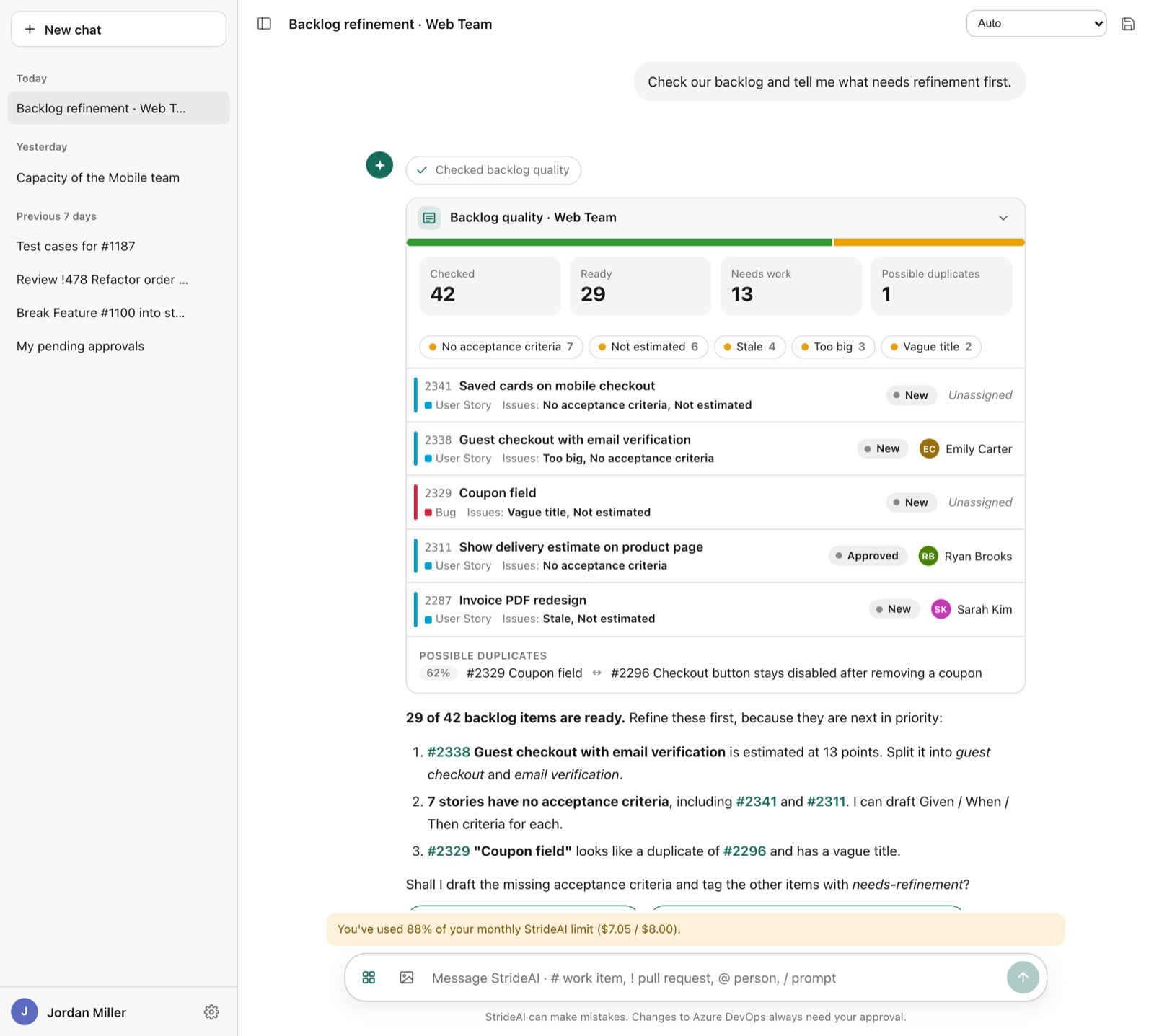
Timelines use the start and target date fields from Field mapping, then the item's sprint, then its children's dates. When only a start is known, StrideAI estimates the end from the remaining work. Every bar explains where its dates came from when you point at it. Refine the backlog in minutesAsk "What needs refinement first?". StrideAI finds items without acceptance criteria or estimates, items that are too big or stale, and likely duplicates, then drafts the missing parts for you to approve.
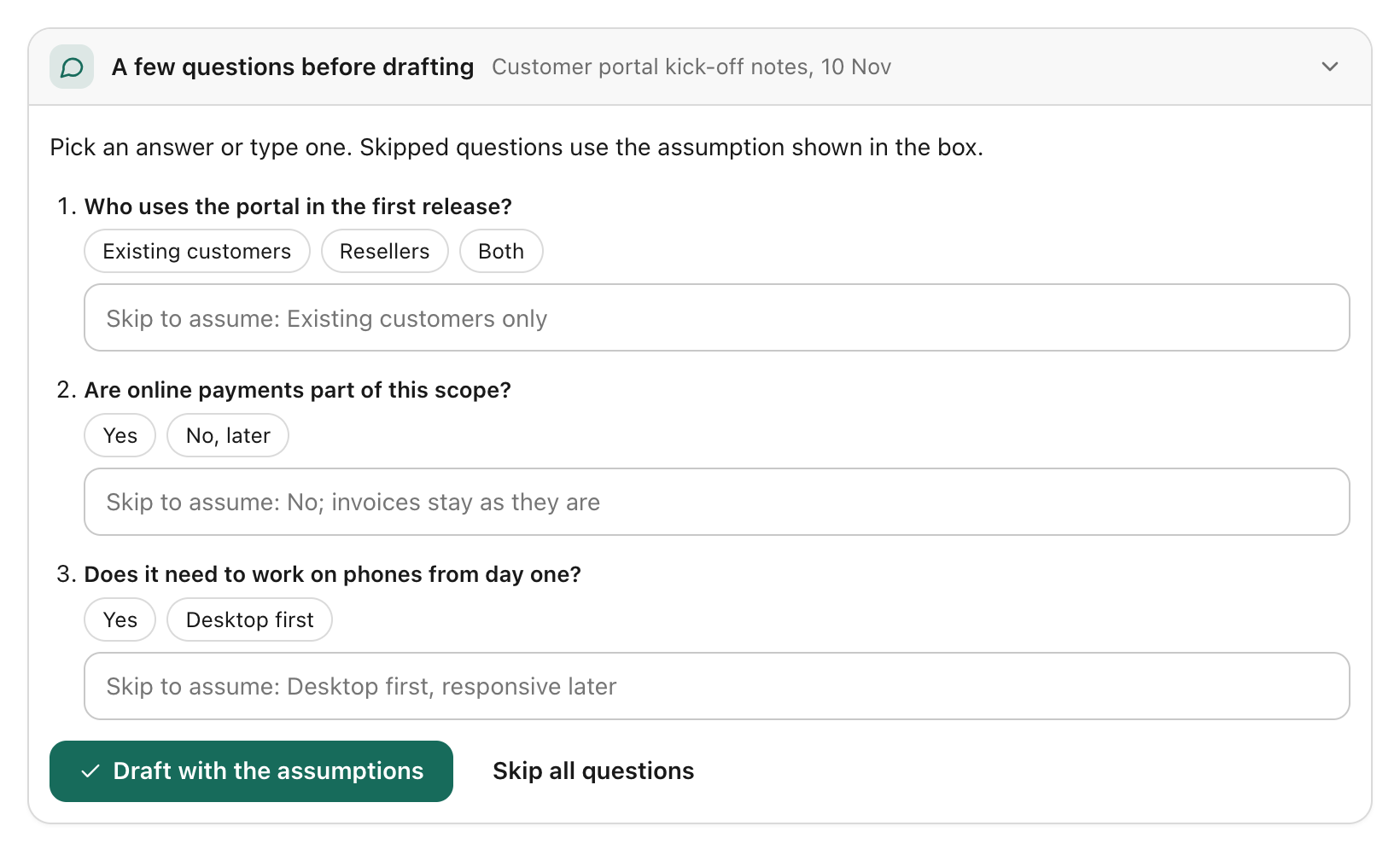
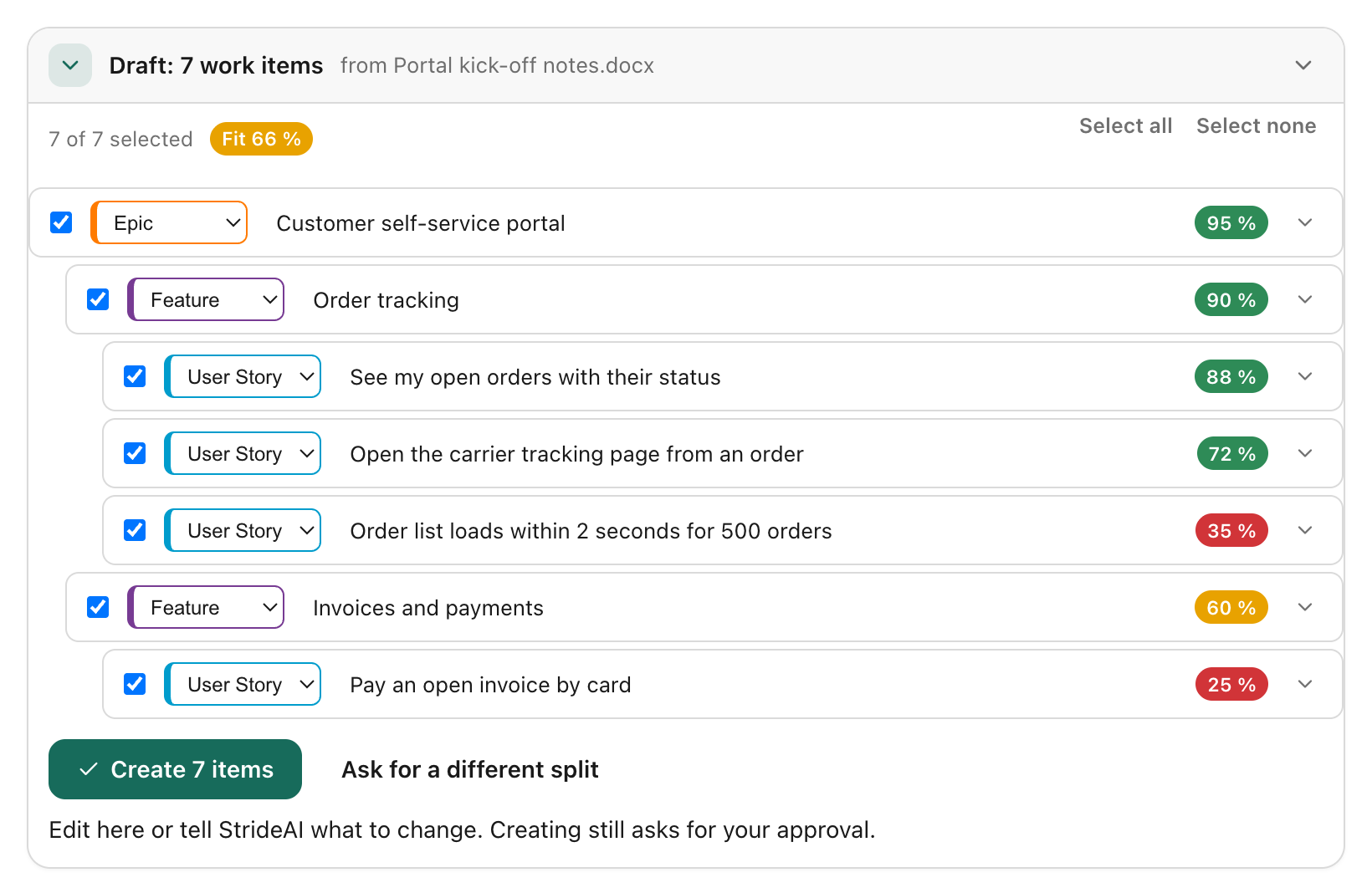
From notes to a backlog you reviewedPaste meeting notes, attach a Word, PDF or Markdown document or a Teams meeting transcript (.vtt), or point at a wiki page and ask for work items. StrideAI reads everything, then asks first: up to six questions whose answers change the draft (which users, what to leave out, priorities), each with the assumption it will make if you skip it. Then it drafts a hierarchy, Epic or Feature down to stories, bugs, and tasks, and shows it as a draft board: every item with its type, a fit score for how directly the source supports it, and the sentence it came from. Change titles, types, and parents, edit descriptions and acceptance criteria, untick what you don't want, then create everything with one approval. Anything StrideAI inferred rather than read is marked with a low fit, so you see where to look twice. Attached files are treated as untrusted data. Hidden and invisible text is removed before the model sees it, the file sits inside a boundary its own text can't fake, and passages that read like instructions to an AI are flagged on the attachment and on the draft board. While a file is in the conversation, the model can read and draft but can't change anything; every quoted source sentence is checked against the file, and items whose quote isn't there are marked and left unselected. Macros and embedded objects are never opened, and the text goes only to the model you configured.
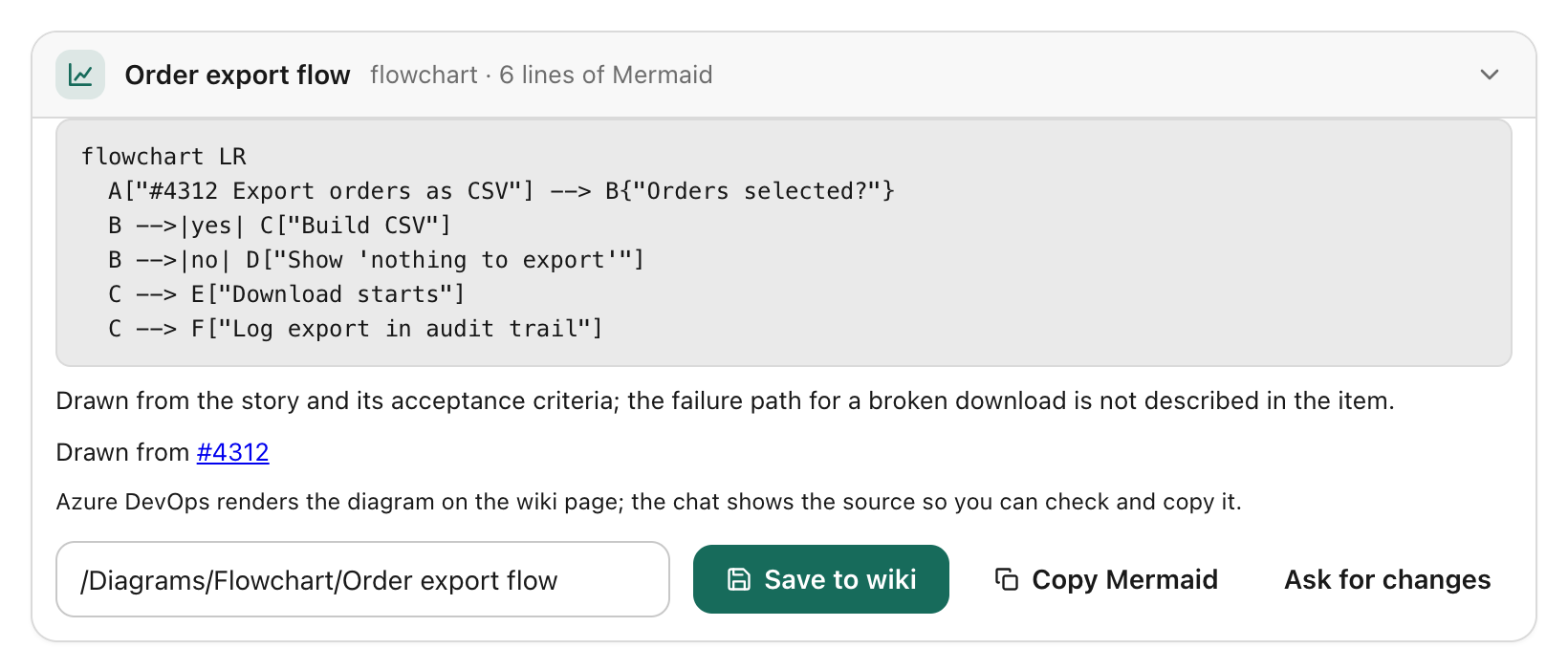
Diagrams from your work itemsAsk "Draw the checkout flow from #4312" or "Sequence diagram of the payment integration". StrideAI reads the items, code, or wiki pages and draws a flowchart, sequence, state, class, ER, Gantt, journey, mind map, or timeline diagram as Mermaid. The card checks the source (no HTML, no links, a diagram type the wiki renders), shows it with the items it was drawn from, and saves it to a wiki page under Diagrams, where Azure DevOps renders it, with your approval. Ask for changes in plain words and StrideAI redraws it.
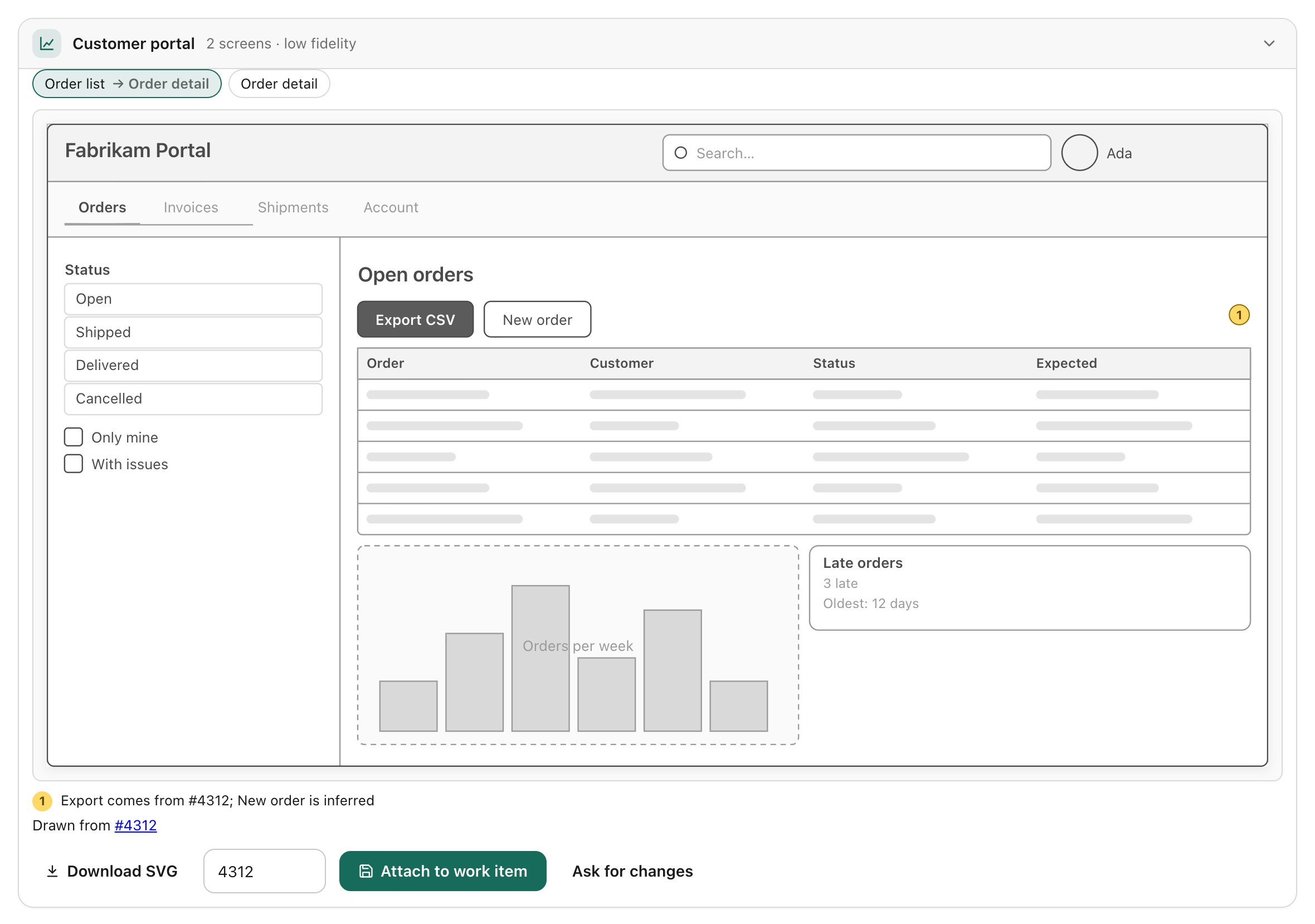
Wireframes from a storyAsk "Sketch the order list screen for #4312". StrideAI reads the story and draws a low-fidelity wireframe, grey boxes with real labels and no visual design, so the conversation stays about what goes on the screen, not how it looks. Several screens become tabs with the flow between them; numbered callouts say where an element comes from and what StrideAI inferred. Download the SVG or attach a screen to the work item with one approval. No image model is involved: the drawing is computed from a screen description, so it is instant, costs no tokens to render, and is the same every time.
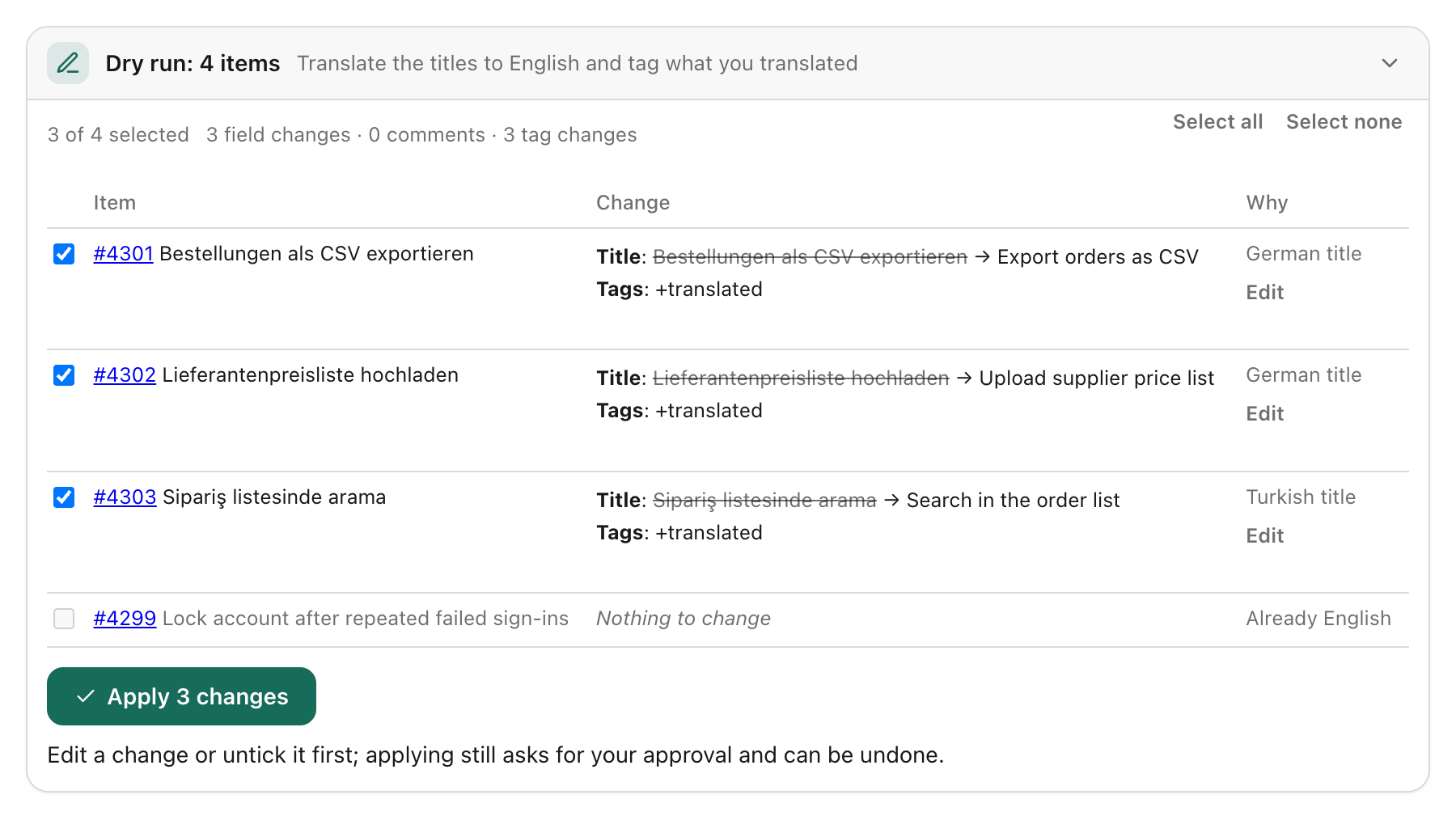
One instruction, many items, one approvalAsk "Translate the titles of all sprint stories to English and tag what you changed" or "Add acceptance criteria to every story that has none". StrideAI says which fields the run may touch, works out a change per item, and shows a dry run: before → after per field, comments, tags, and a one-line reason each. Untick what you don't want, edit a value, then apply everything with one approval; the run can be undone like any other change, and items that need nothing are left alone.
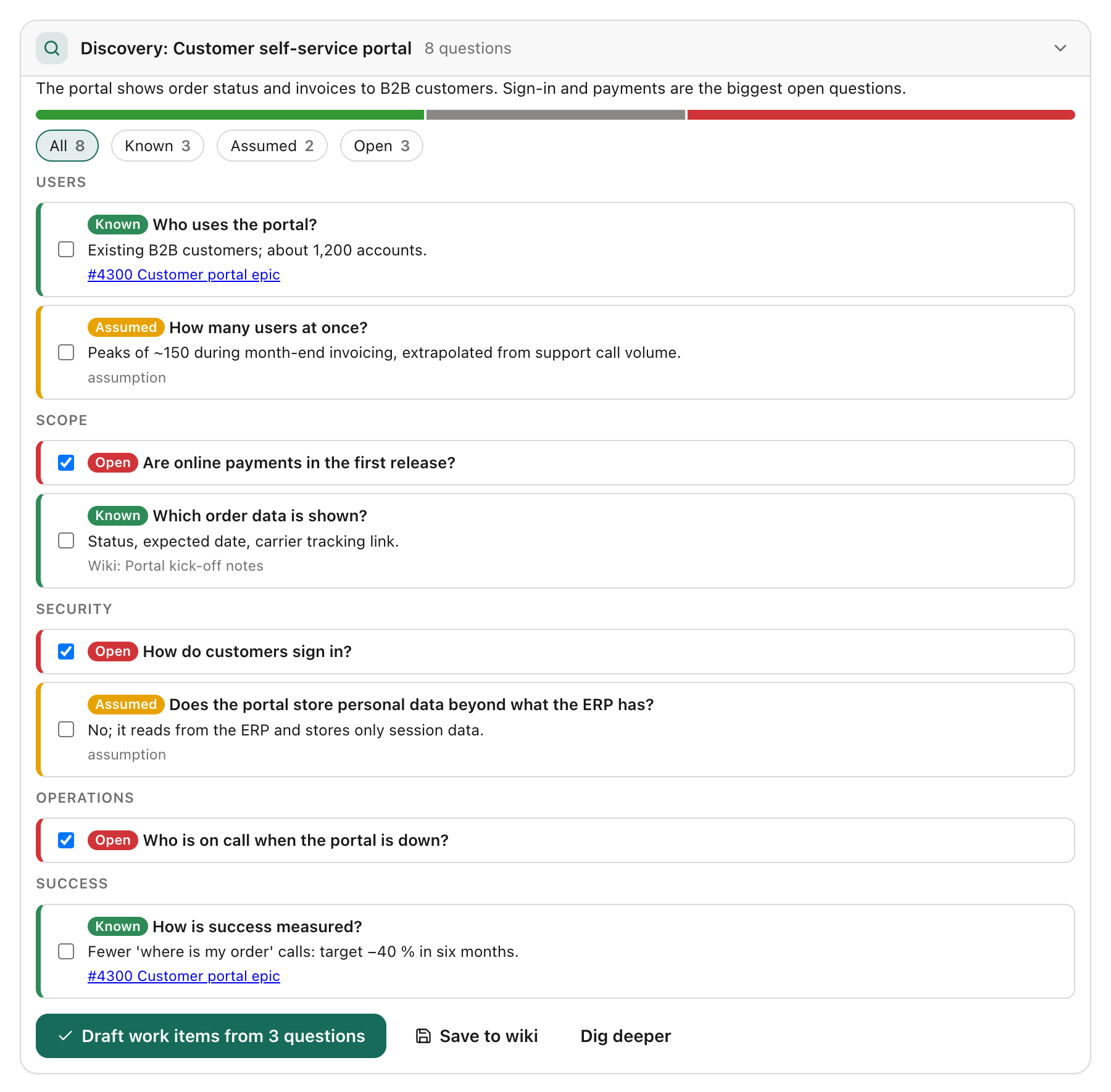
Explore a topic before you build itAsk "What do we know about the customer portal?". StrideAI searches the work items, wiki, and code and answers as a list of questions grouped by area, each marked known with its source, assumed when it inferred the answer, or open. Pick the open ones and send them to Intake as spikes and tasks, or save the whole list to the wiki as the starting point for the discovery.
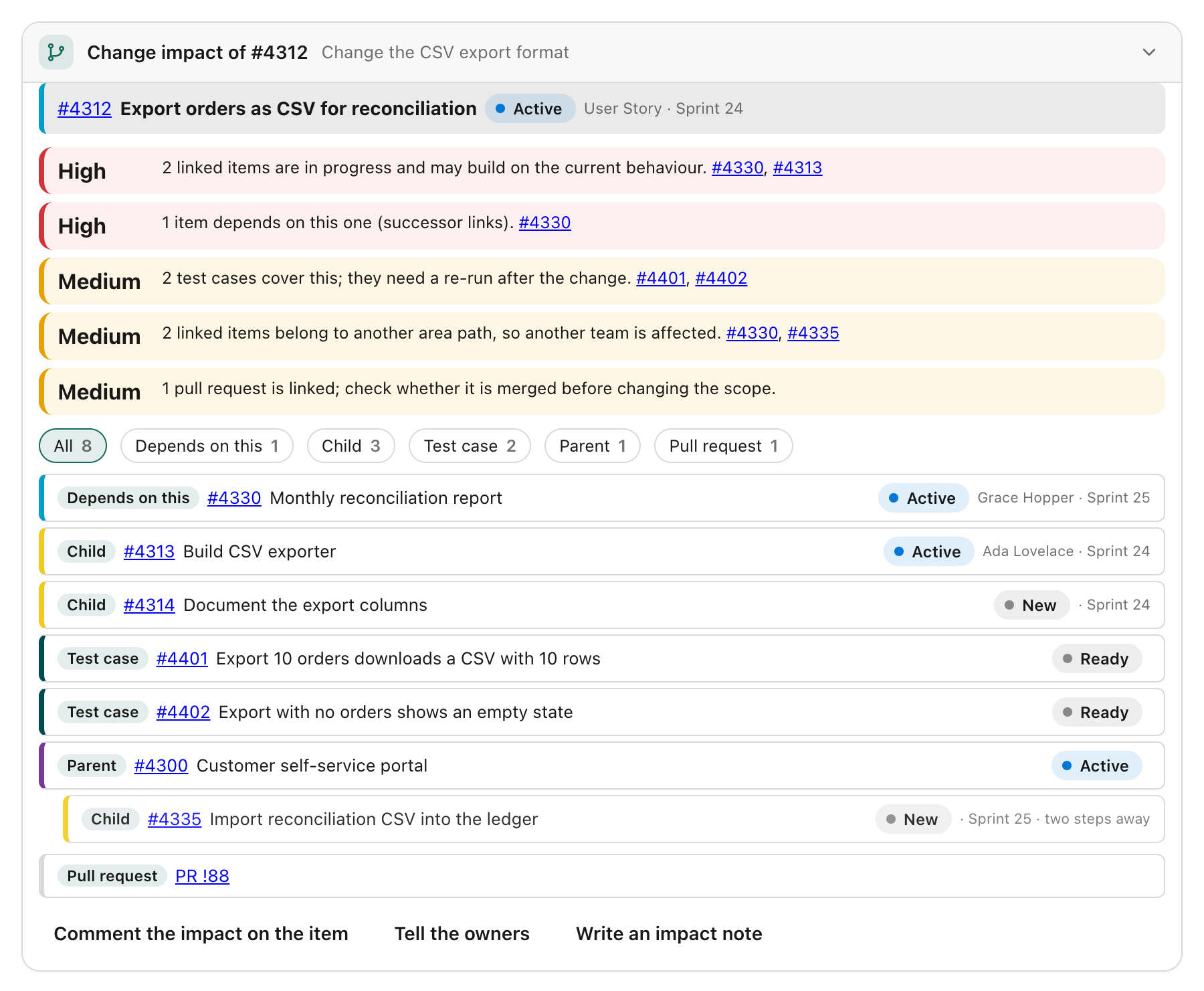
What does this change touch?Before you move, re-scope, or remove an item, ask "What does changing #4312 affect?". StrideAI follows the item's links two steps out, parents, children, related items, predecessors and successors, test cases, pull requests, commits, and builds, and shows them by kind with the risks that follow: items in progress that build on the current behaviour, items that depend on it, test cases to re-run, other teams' areas, other sprints, linked pull requests. From the card, comment the impact on the item, tell the owners of the affected items, or write an impact note to the wiki.
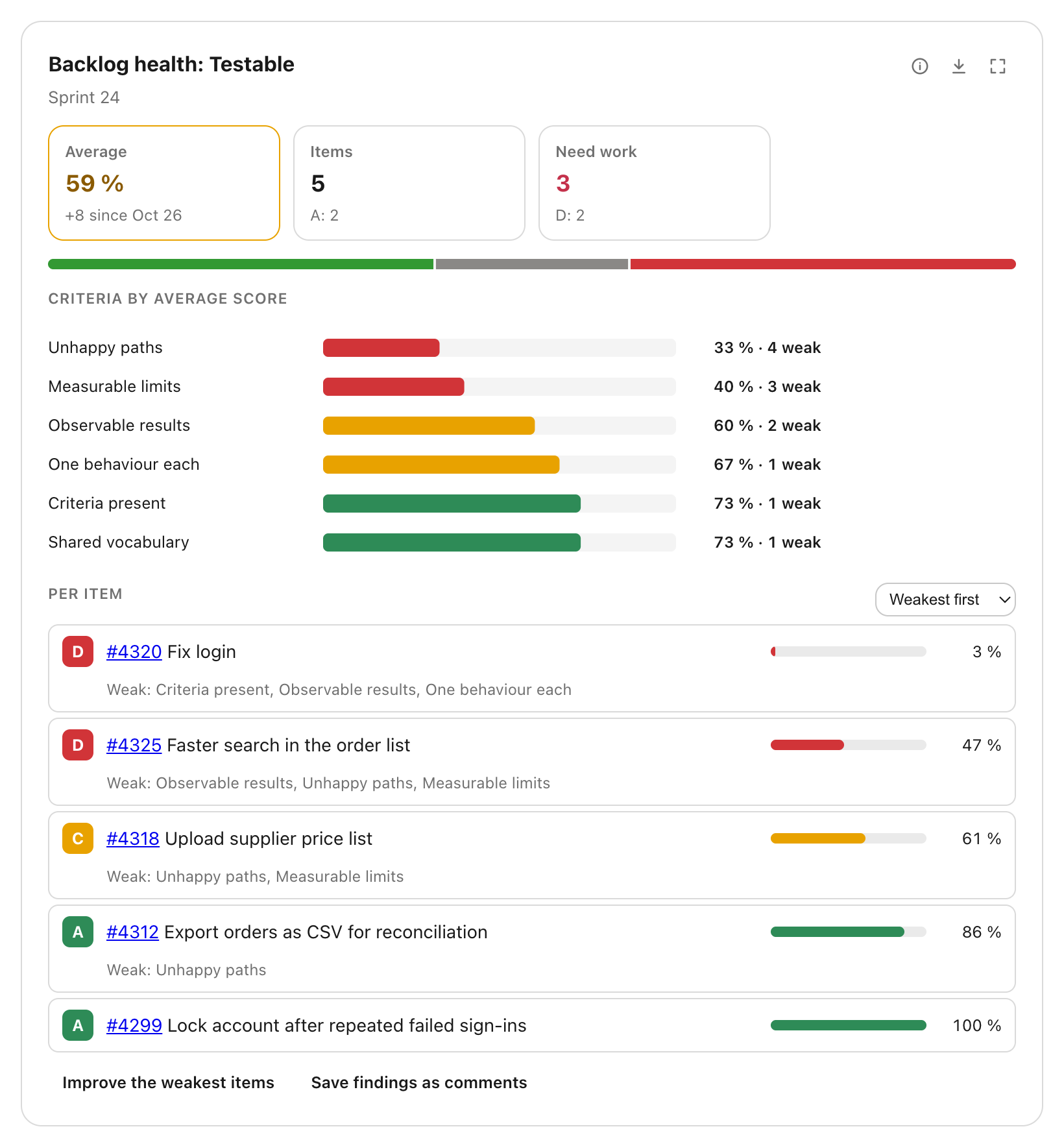
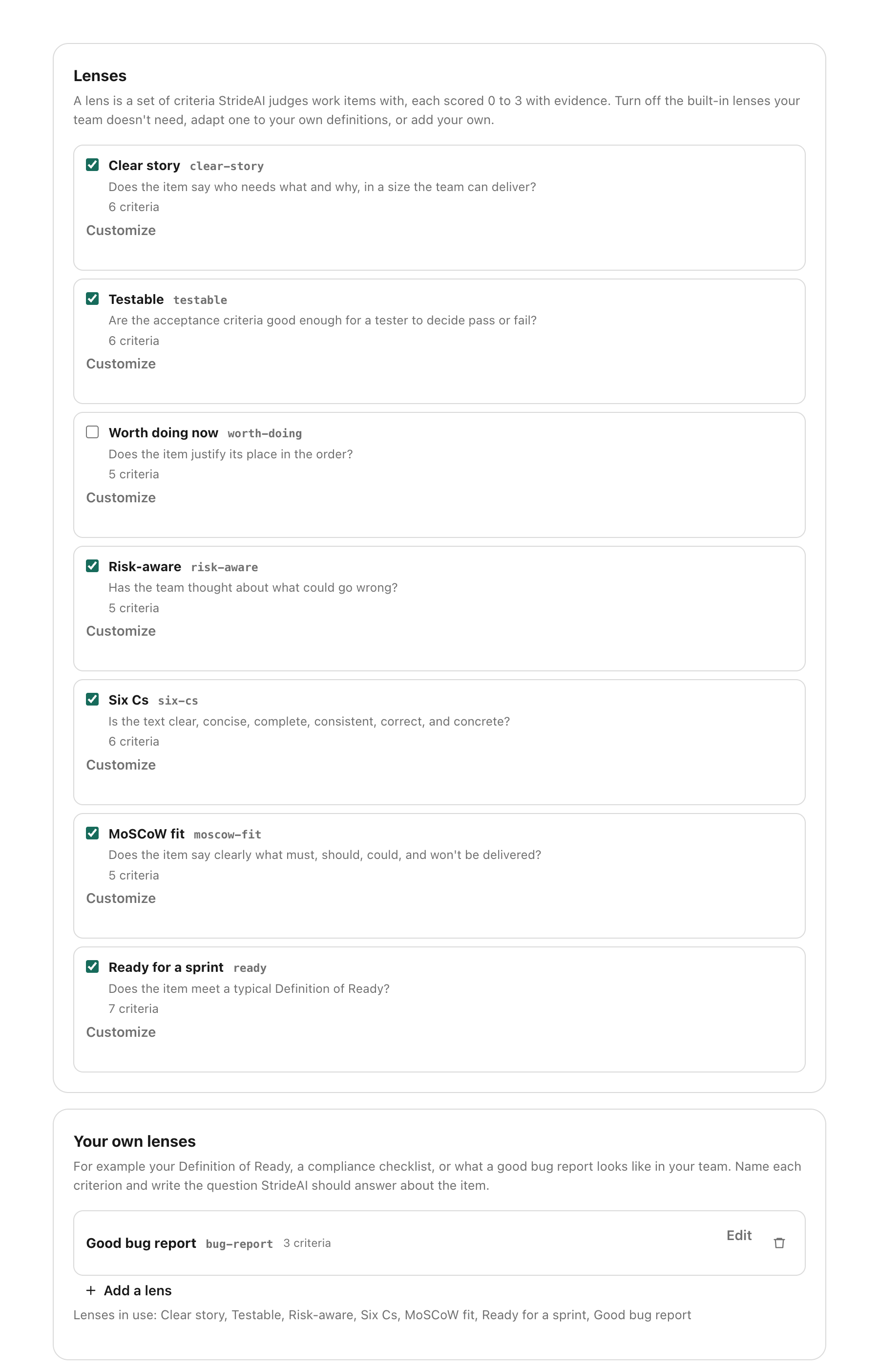
Tick the risks that need an owner and press Create mitigation tasks: one task per risk, under the item, with the risk and the items involved in its description, waiting for your approval. Backlog health: grade stories through a lensAsk "How ready are the sprint stories?" or "Score #123 for testability". StrideAI reads the items and judges each one against a lens, a set of criteria with weights: Clear story (who, outcome, scope, size, independence, verifiable), Testable (acceptance criteria a tester can decide on), Worth doing now, Risk-aware, Six Cs (clear, concise, complete, consistent, correct, concrete), MoSCoW fit, and Ready for a sprint. Every criterion gets a score from 0 to 3 with a sentence of evidence from the item, and the scorecard shows a grade from A to D per item, the weakest criteria across the whole set, and how the average moved since the last check of the same sprint or backlog. From the card, improve an item, ask why it scored as it did, or save the findings as comments, all with your approval.
In Settings → Backlog health, turn off the lenses your team doesn't need, adapt one, or write your own: a Definition of Ready, a compliance checklist, or what a good bug report looks like for you. Each criterion is a question StrideAI answers about the item.
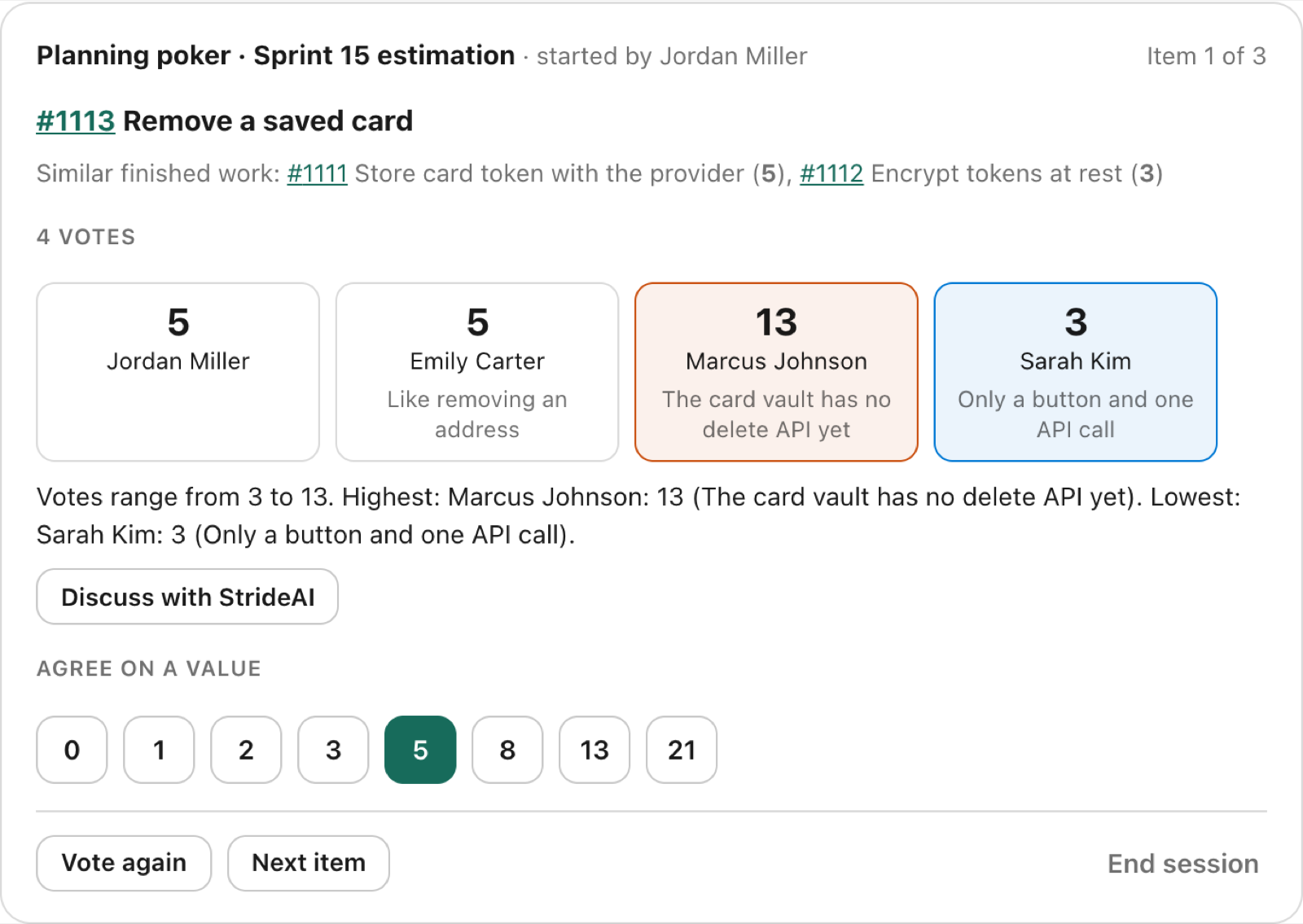
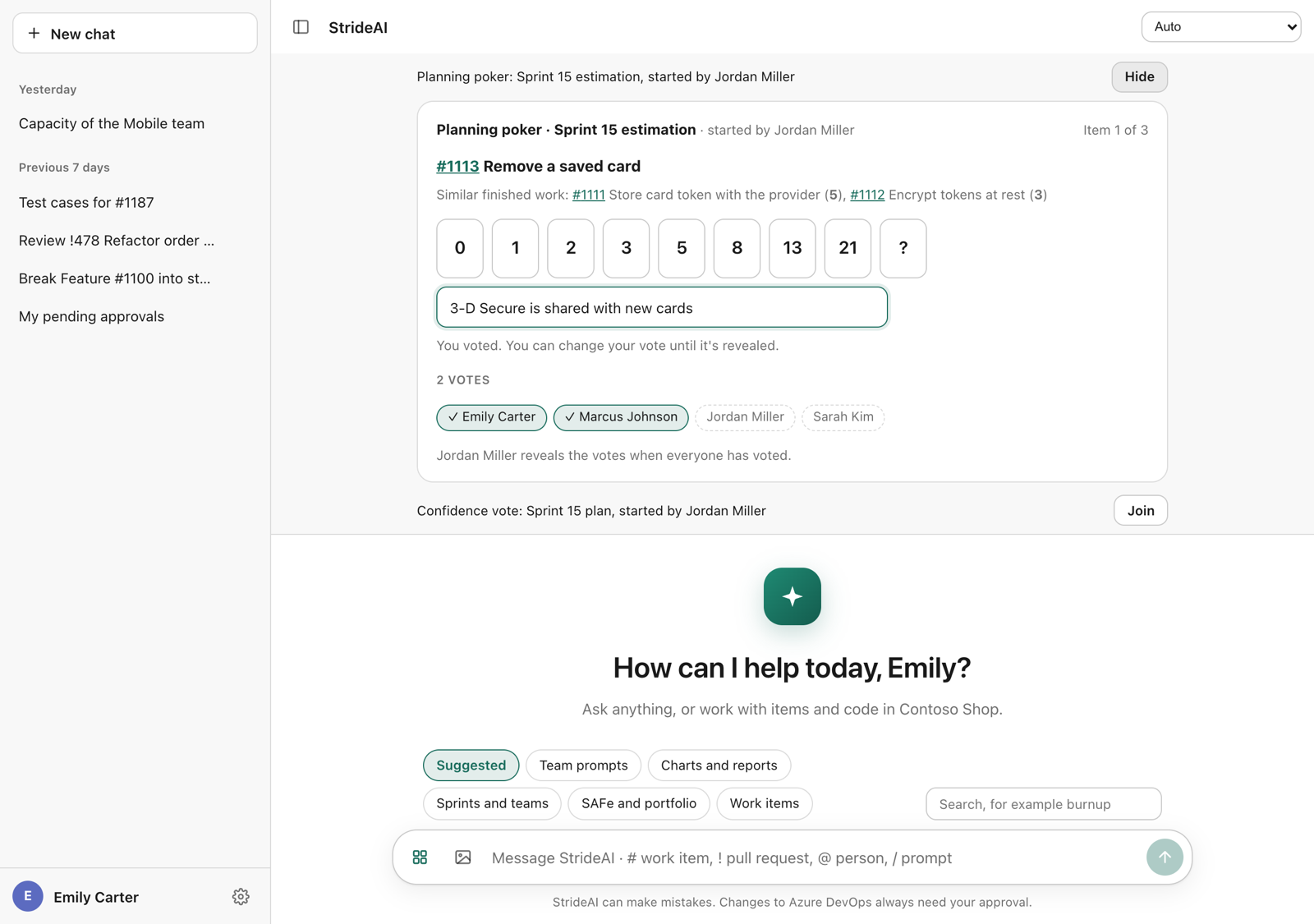
Planning poker and confidence votesAsk "Let's estimate the Sprint 15 candidates with the Web Team". StrideAI starts a planning poker session, flags items that aren't ready (no description or acceptance criteria, too big, or a vague title), and shows similar finished stories with their estimates as a reference. Everyone in the project sees the session at the top of their StrideAI page and joins with one click, so it works for live meetings and for people who vote later.
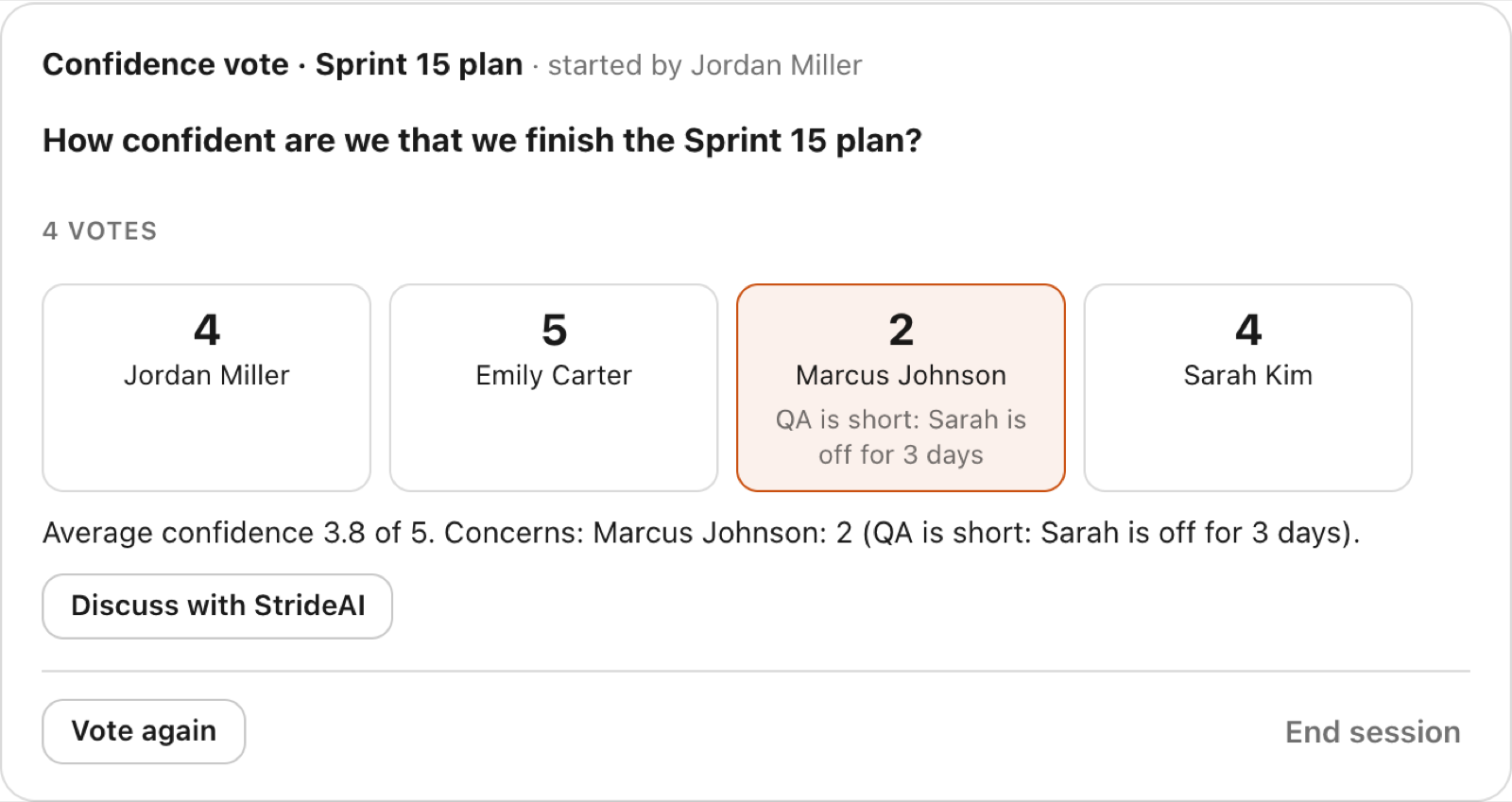
Ask "Run a fist of five on the Sprint 15 plan" for a confidence vote from 1 to 5. After the reveal you see the average and the concerns behind every 1 or 2.
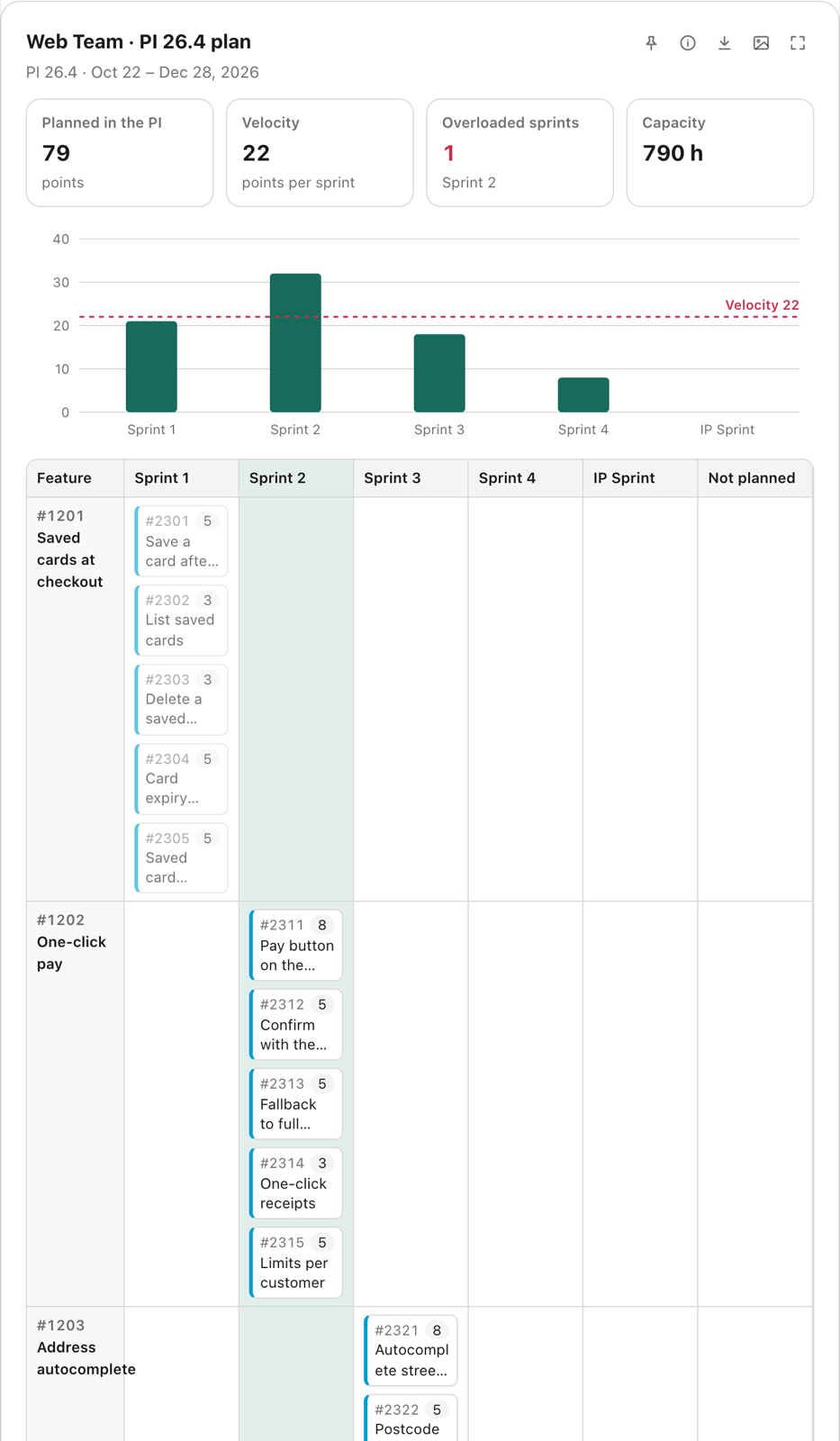
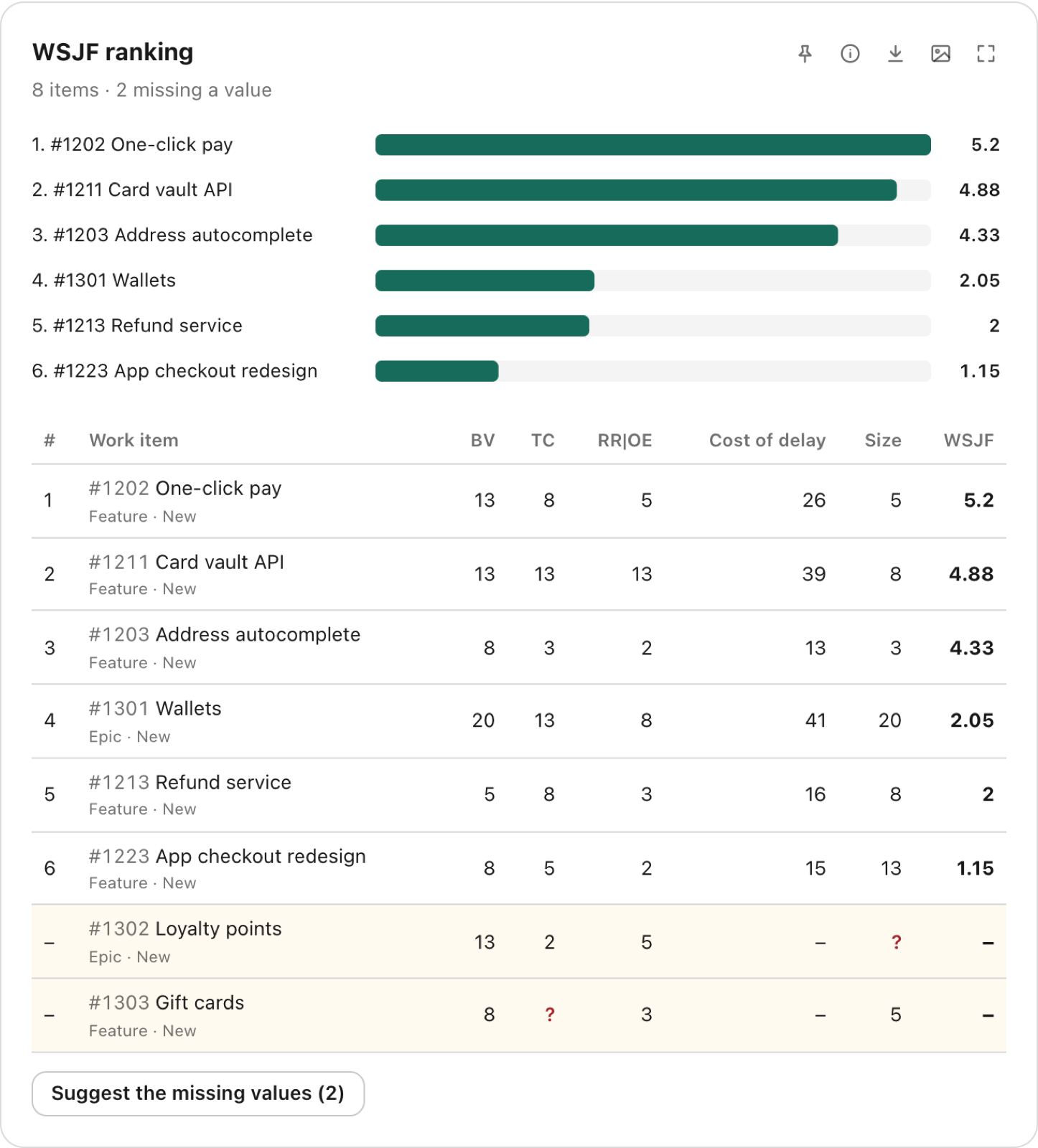
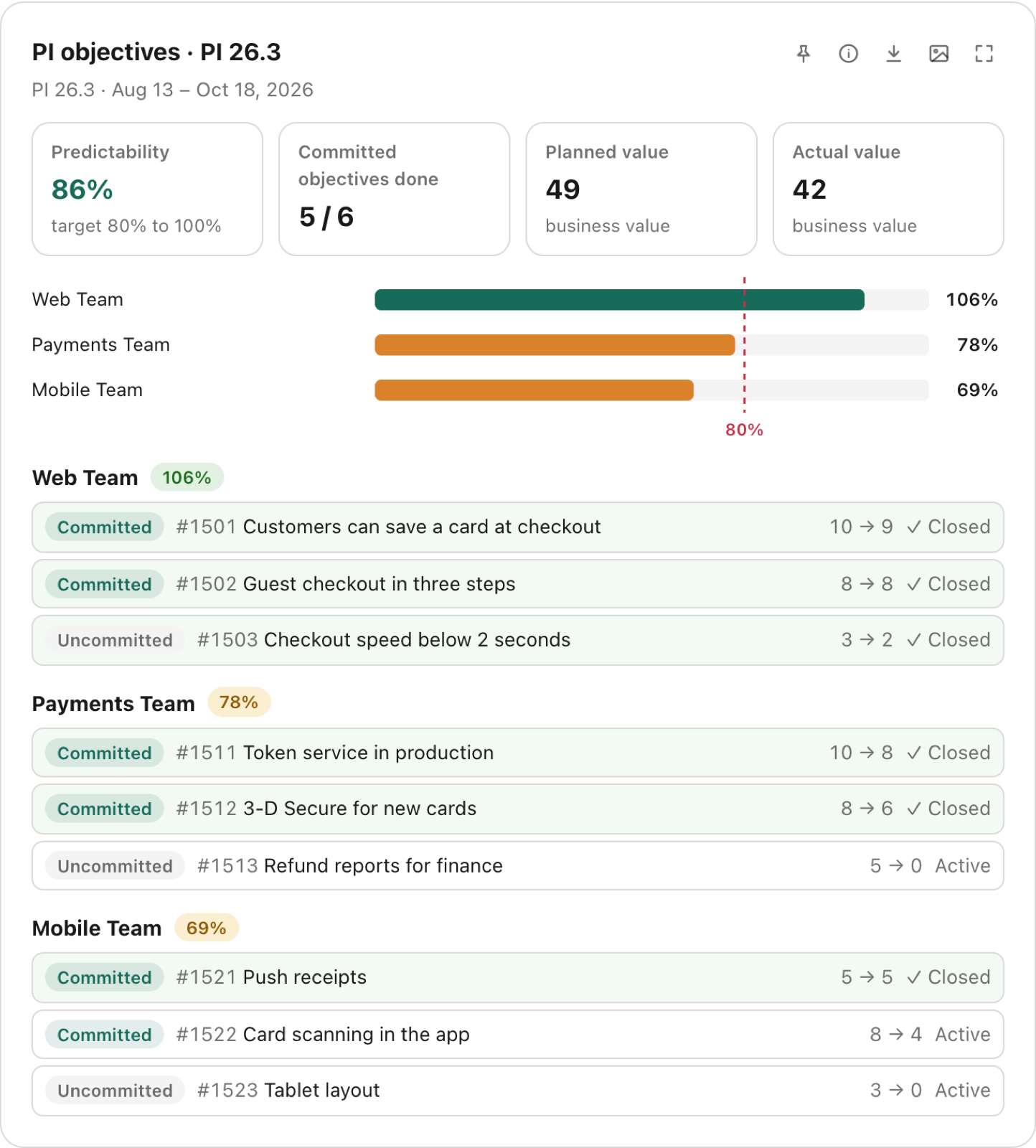
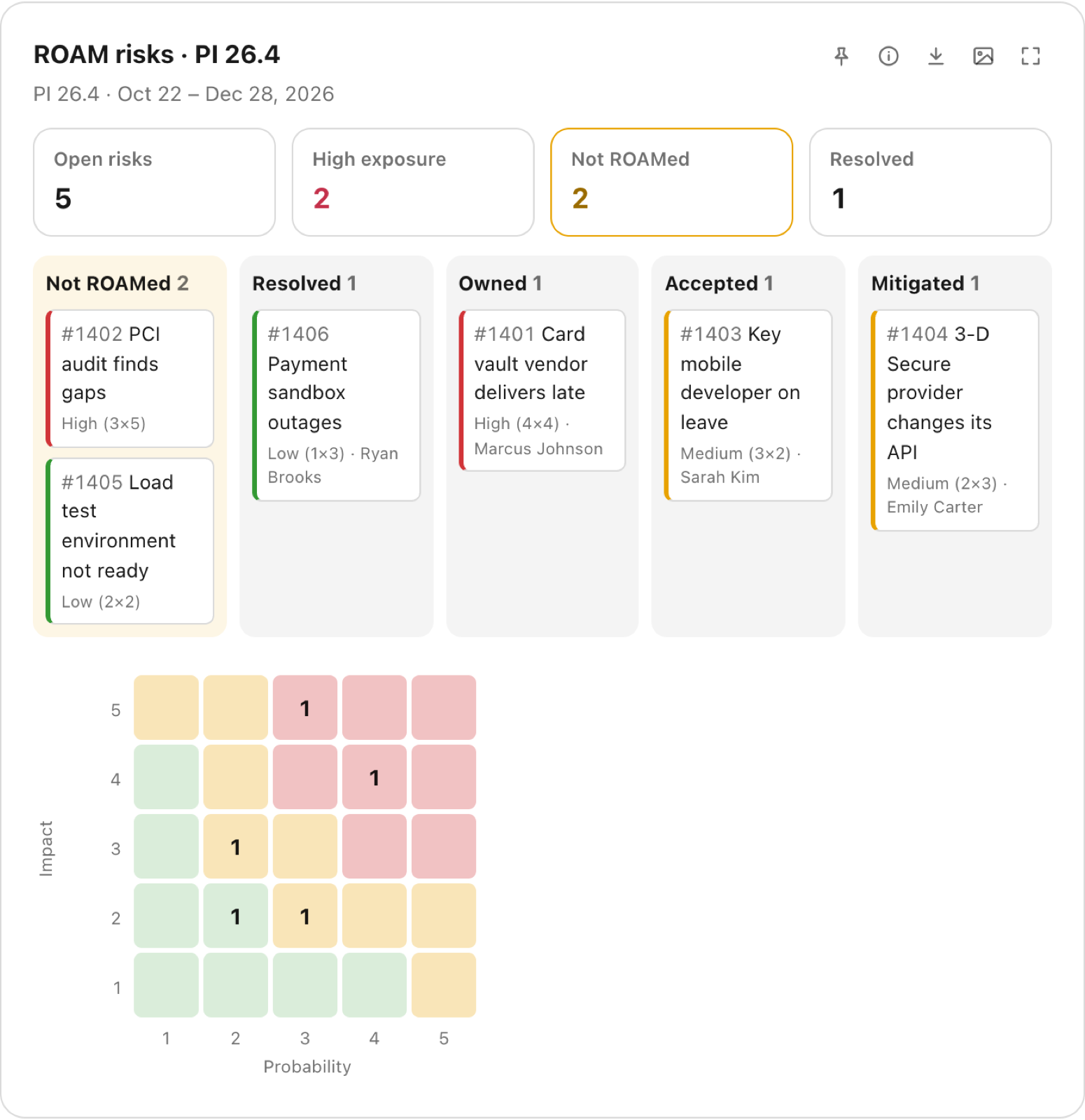
SAFe: will we make the PI?Ask "Will we make PI 26.4?". StrideAI answers On track, At risk, or Off track with the reasons: the PI's burnup and forecast against its end date, features done, committed objectives, high-exposure risks, and critical dependencies. A Planning Interval (PI) is a parent iteration with its sprints below it; the teams of the train are the teams that follow those sprints, and each team's work comes from its area paths, so there is nothing extra to set up.
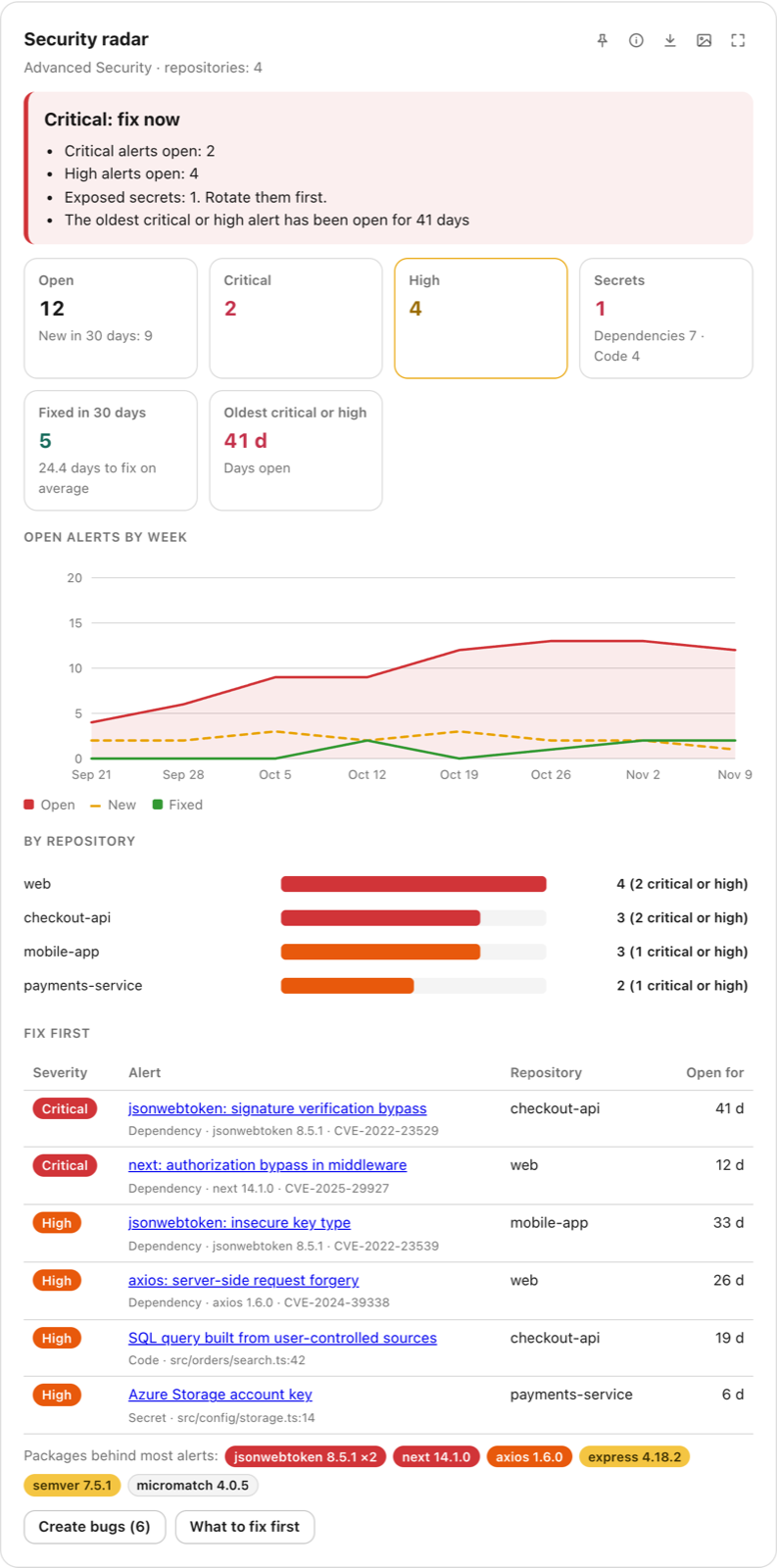
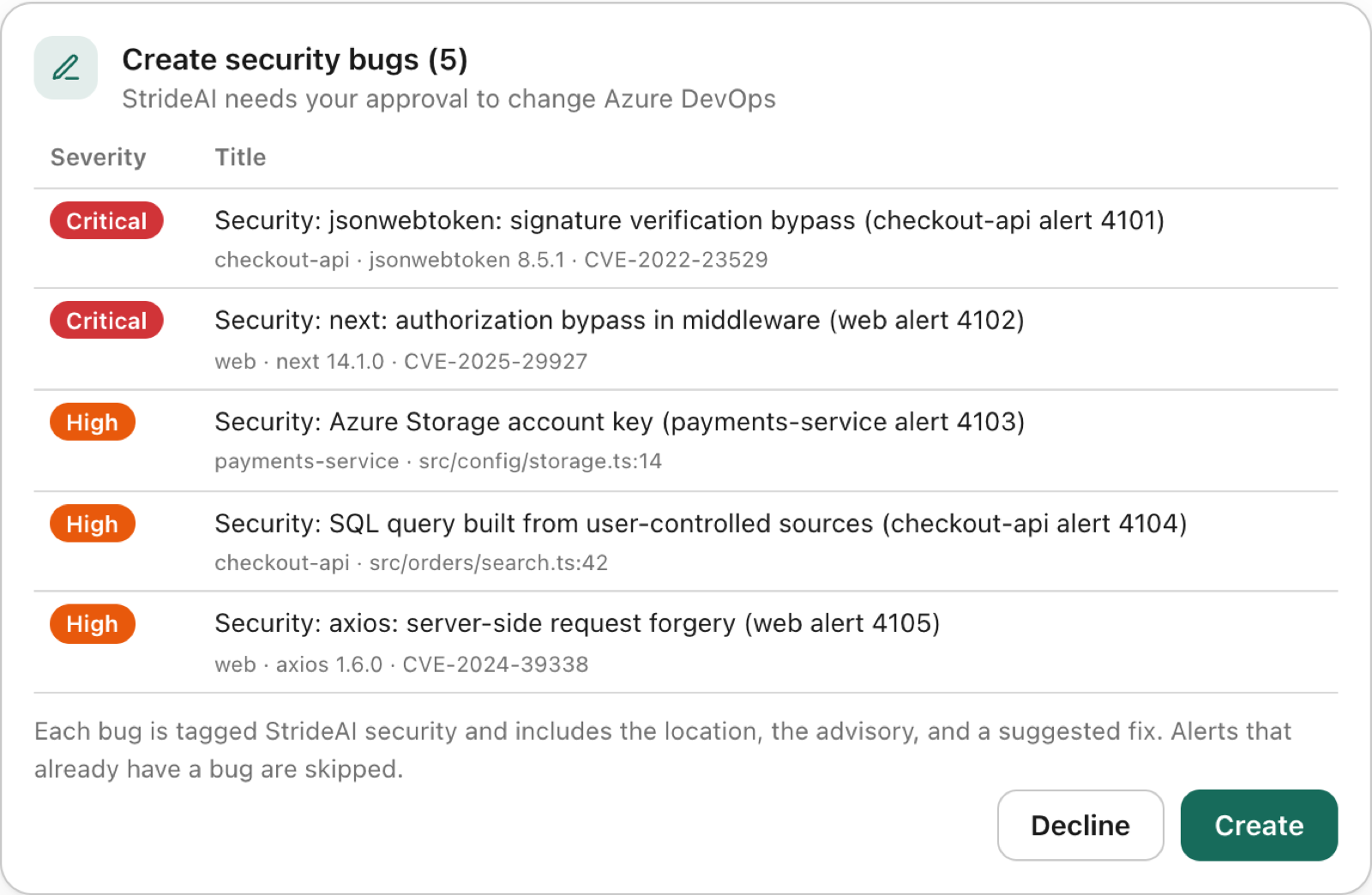
All of these can be pinned to Boards and shown on dashboards with the StrideAI Visual widget, so the train sees the latest state without asking. Security radarWorks with or without GitHub Advanced Security: the StrideAI checks task's built-in scan finds vulnerable dependencies (npm, NuGet, PyPI, Go) through the open OSV database and exposed secrets or risky patterns in your code, and the radar shows them like any other alert. Ask "Show our security alerts: what's critical and what should we fix first?". StrideAI reads the open alerts your pipelines report across your repositories and answers All clear, Needs attention, or Critical: fix now, with the reasons. You see the open alerts by severity, exposed secrets, how many were fixed in the last 30 days and how fast, a weekly trend, the repositories with the most critical alerts, the alerts to fix first with links to each one, and the packages behind most alerts.
The radar reads the newest pipeline run that published security results:
Without either, the radar says what to add instead of failing. The radar can be pinned to a board and shown on a dashboard.
Automate it in your pipelinesStrideAI adds five tasks to Azure Pipelines. They run on your agents with the pipeline's own identity and, when you want AI, with your own model.
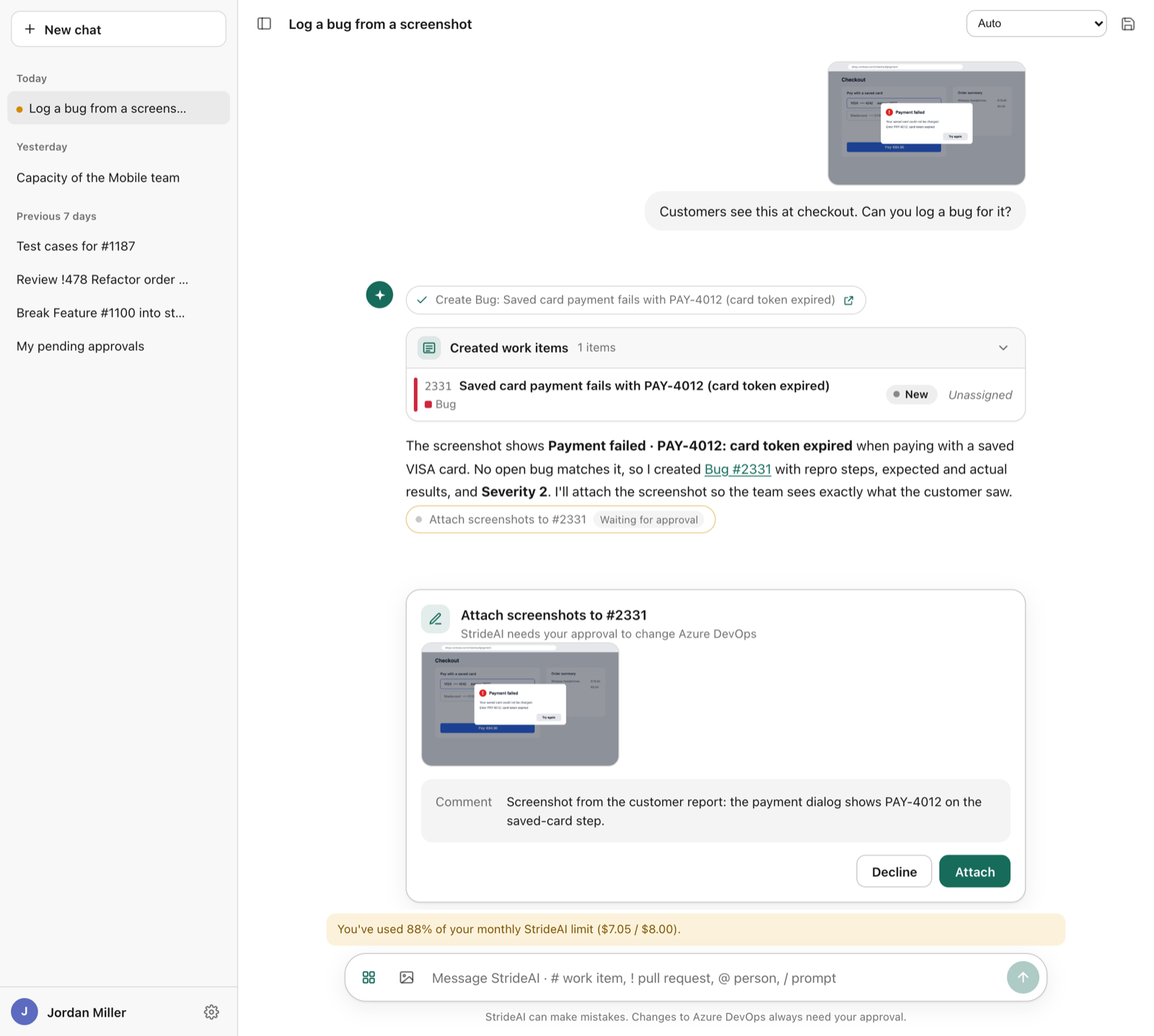
The model is optional for every task: without one, the review uses its fixed rules and the release notes and reports are written without AI. Secrets found in a pull request are masked before anything is sent to the model or posted. A ready-made pipeline that runs all four tasks against a project, for a demo or a smoke test after installing, is in the repository as Log a bug from a screenshotPaste a screenshot of the problem and ask "Log a bug for this". StrideAI reads the error on the screen, checks for duplicates, writes the bug with repro steps, and, after your approval, attaches the screenshot to it.
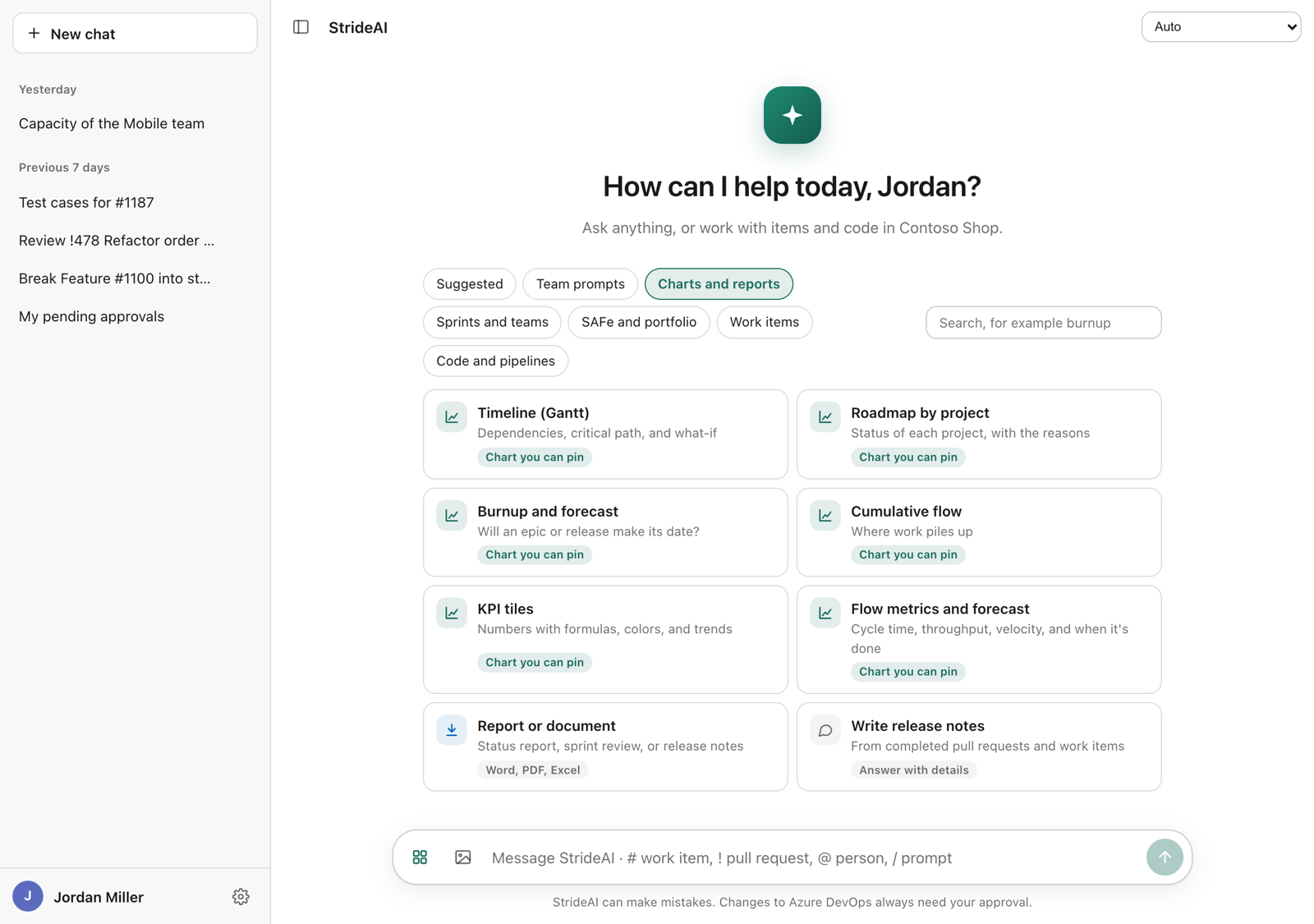
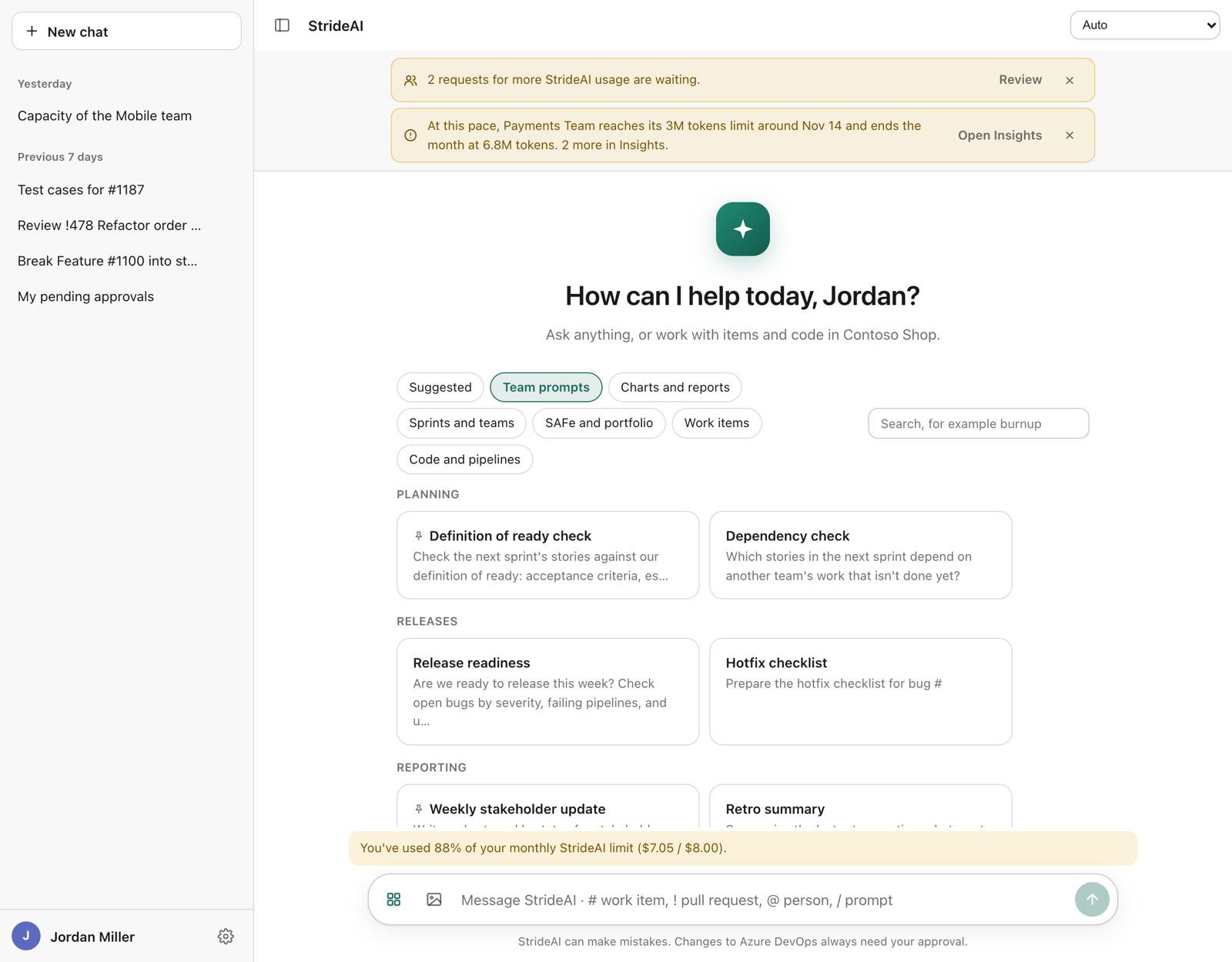
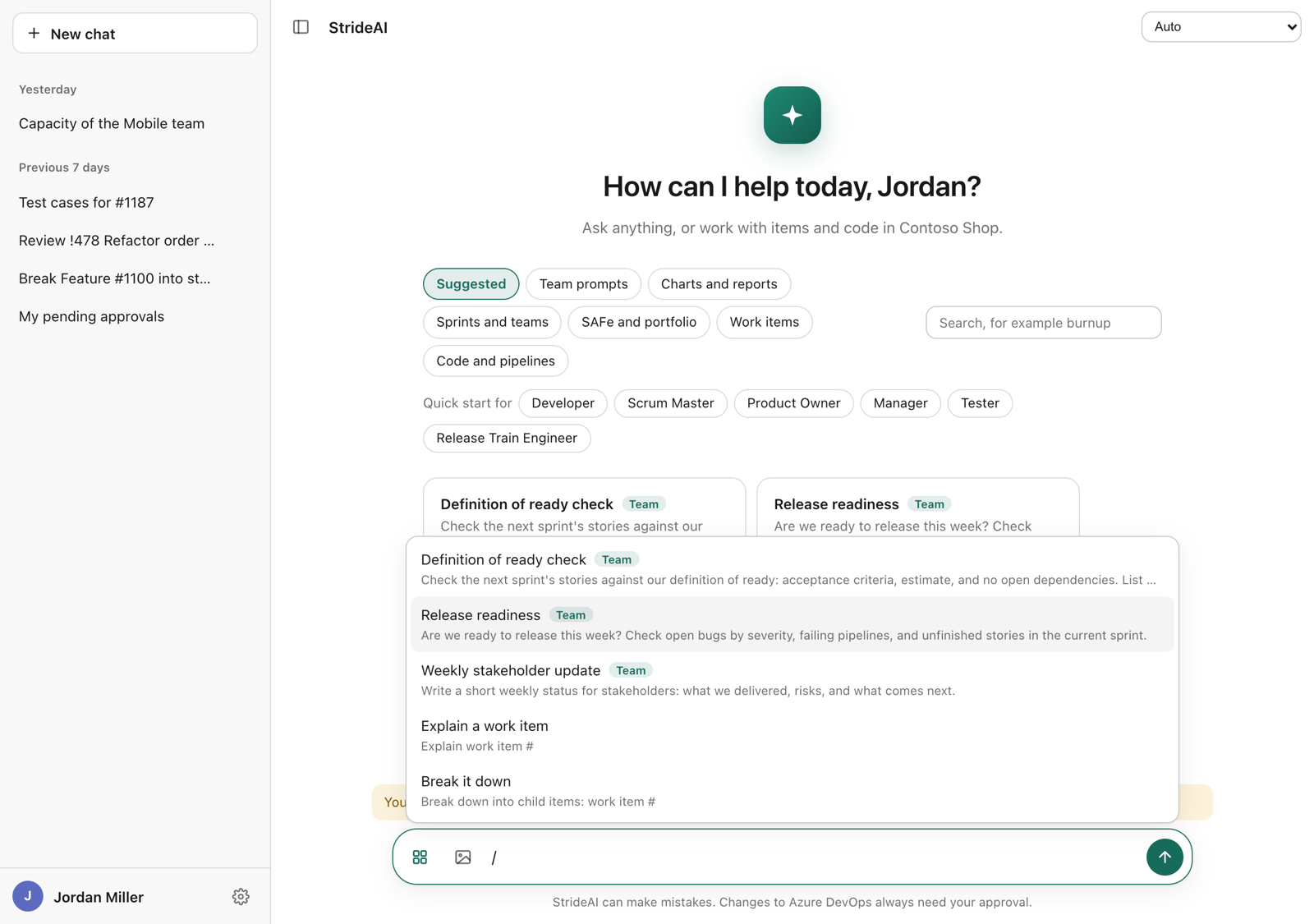
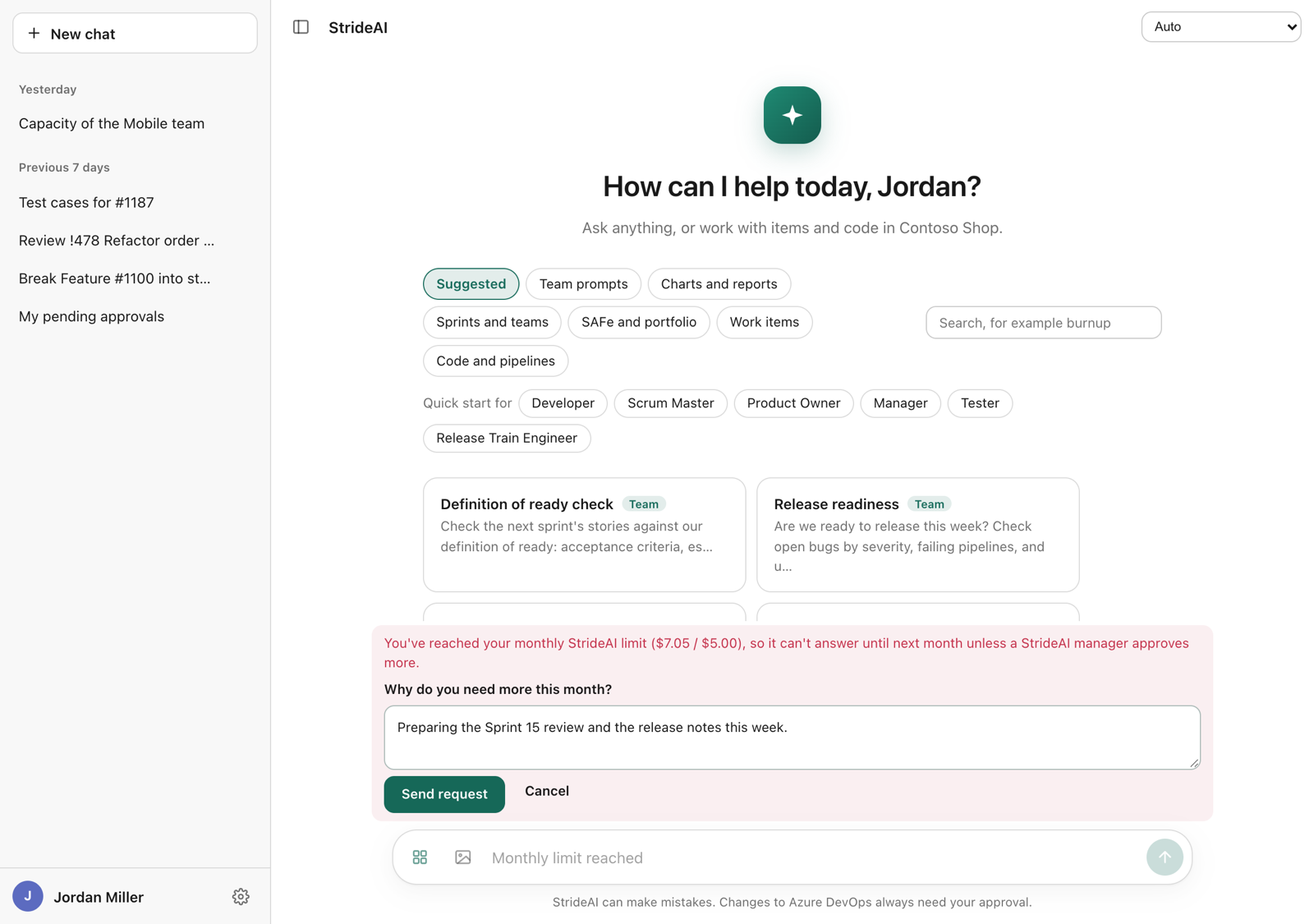
Explore what it can do, and click to continueA new chat shows Suggested prompts and everything StrideAI can do, grouped into Charts and reports, Sprints and teams, SAFe and portfolio, Work items, and Code and pipelines. Each one says what you get back: a chart or board you can pin, a document for Word, PDF, and Excel, a session live with your team such as planning poker, changes after you approve, or an answer with details. Search for a word such as burnup, or select the grid button next to the message box to open the same list in any chat. Prompts you need to finish, such as with a work item number or a date, go to the message box; the rest are asked right away.
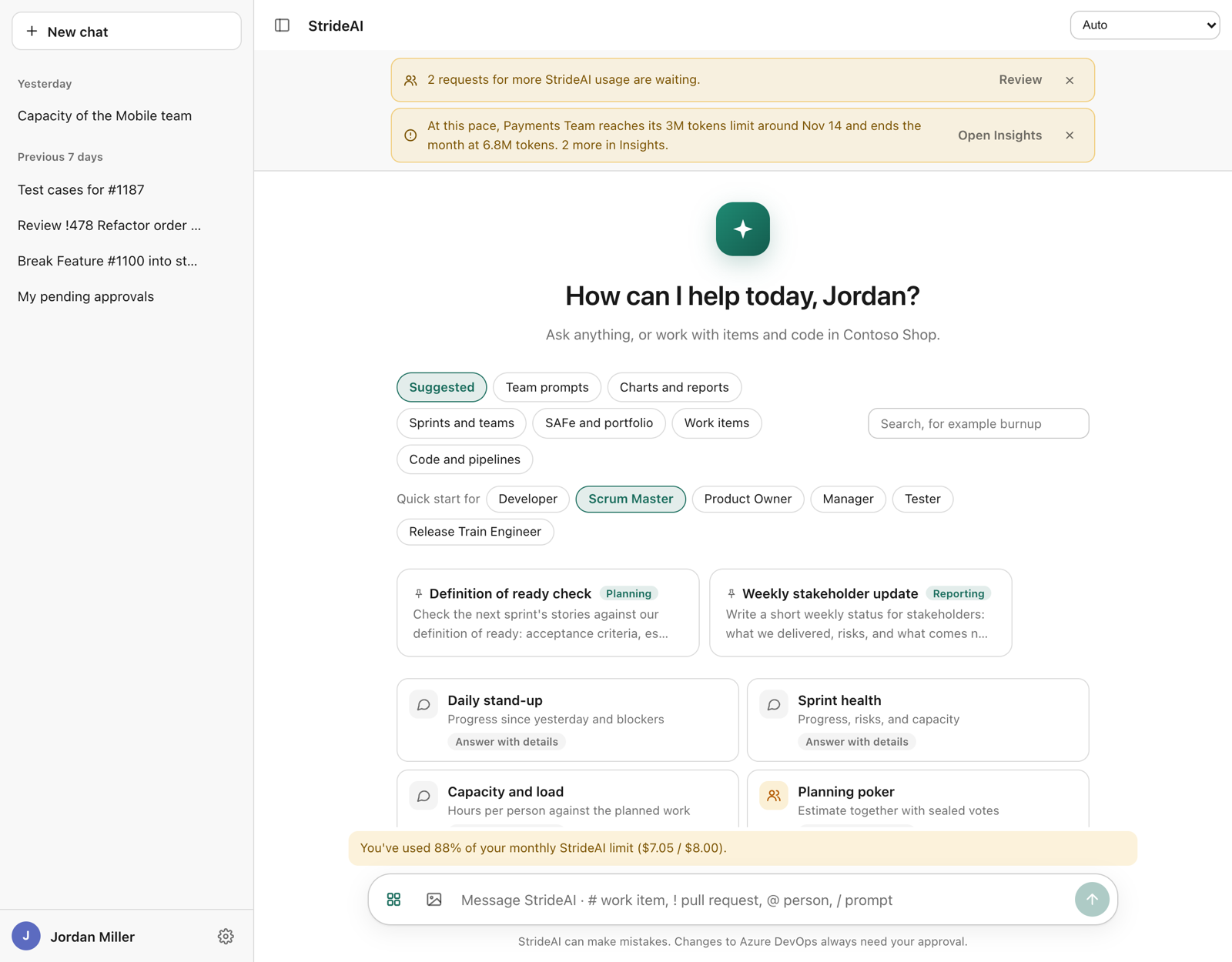
Pick your role, Developer, Scrum Master, Product Owner, Manager, Tester, or Release Train Engineer, to see the six things people in that role ask most, with your team's pinned prompts first. StrideAI remembers your role; select it again to go back to the suggestions.
When StrideAI offers options, such as "Want me to list the 7 P1 bugs?", they appear as buttons under the answer, so you continue with one click. After a chart or board, useful next questions appear the same way, such as what is late on a timeline or the risks of a PI. Want a different answer? Point at it and select Answer again. To change your last question, point at it, select the pencil, edit it, and send; the new answer replaces the old one.
Team prompt library and quick referencesYour StrideAI managers can add ready-made prompts, such as a definition of ready check or a weekly stakeholder update, group them in categories such as Planning or Releases, and pin the most important ones to the top. Everyone sees the pinned prompts first in a new chat and the whole library under Team prompts, and typing / opens them in the message box with their category, together with everything from Explore. Settings shows how often each prompt was used this month and by how many people. Type #, !, or @ to pick a work item, pull request, or person without leaving the chat.
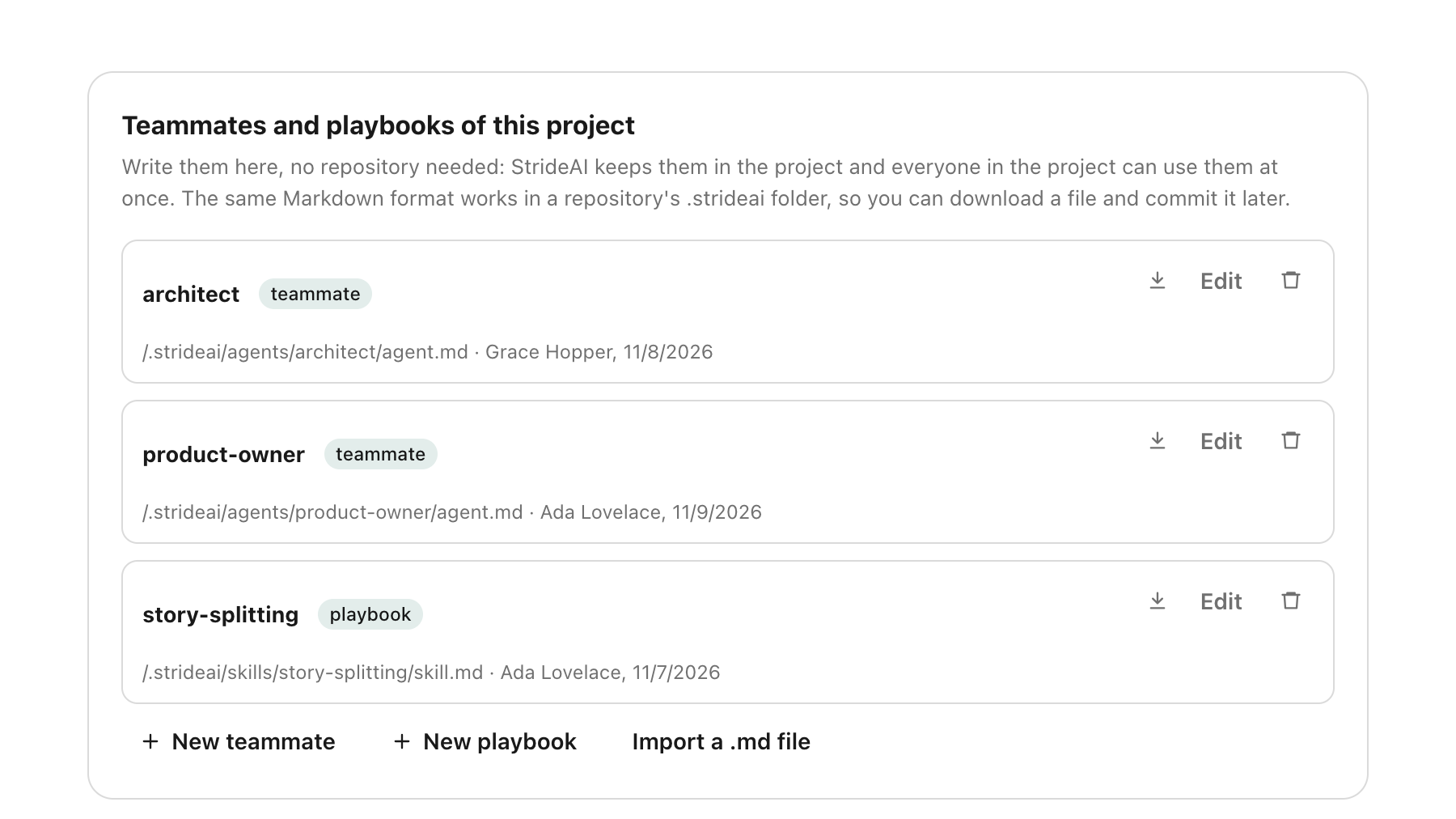
Teammates your team definesThree places, in the order that wins on duplicates: the Settings library (administrators), the project wiki under Give StrideAI a role written by your own team. A teammate has a name, a description, the instructions it follows, and optionally the tools it may use ( Write them in Settings → Teammates: a project administrator adds a teammate or playbook, sees the same checks the chat applies while typing (unknown tool names, missing instructions), saves, and everyone in the project can use it right away. No repository needed, and it works the same in Azure DevOps Services and on Azure DevOps Server. Teams that prefer Git keep the files in a repository's
Pick a teammate on the chips above the message box; the chat remembers it and each answer shows who answered. A teammate can also take on StrideAI Watch findings: give it
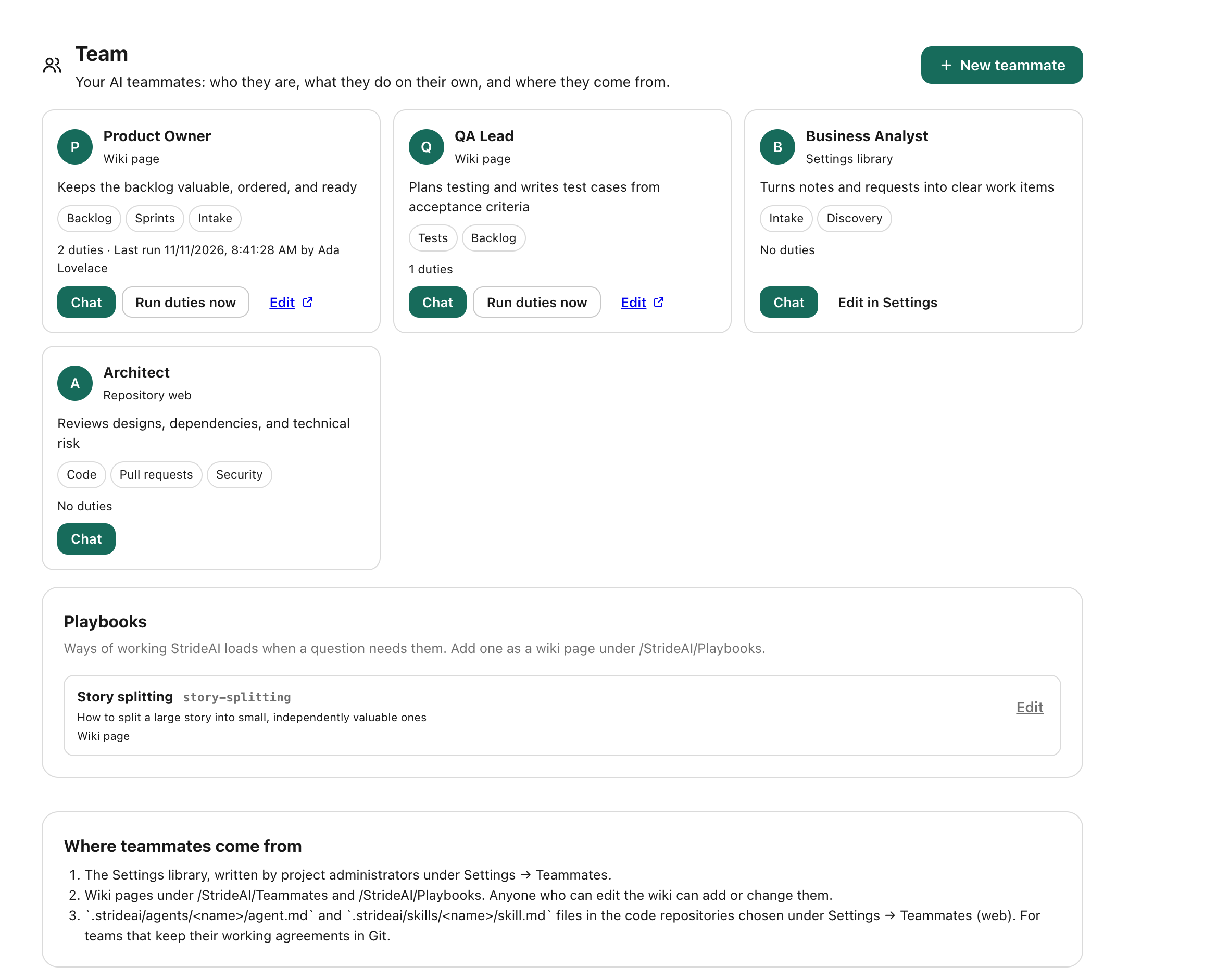
The Team page: your AI teammates in one placeThe Team tab in the StrideAI hub shows every teammate as a card: who it is, which areas it has, what it does on its own, and where it comes from. Chat starts a conversation with it, Run duties now runs its jobs, Edit opens its page. New teammate creates one from a role (Product Owner, Scrum Master, QA Lead, Business Analyst, Release Manager, or blank) and saves it as a page in the project wiki, so anyone who can edit the wiki can add or change teammates; no repository, no administrator. Teams that keep their working agreements in Git still can:
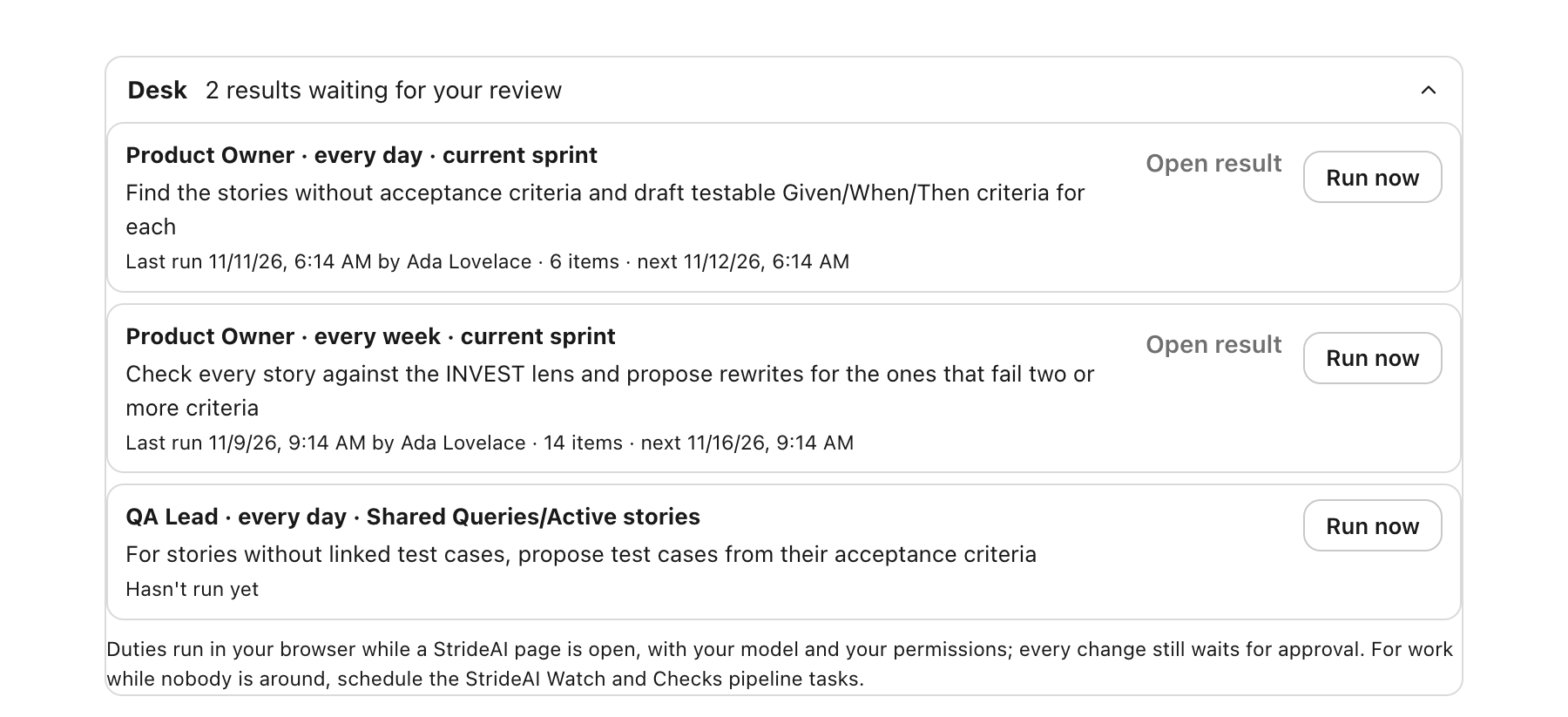
Teammates that do jobs for youGive a teammate duties and it works while you do something else: every day, in the current sprint, find the stories without acceptance criteria and draft them; every week, check every story against INVEST and propose rewrites; every day, propose test cases for stories without any. The Desk panel in the hub shows each duty, when it last ran, what it found, and Run now. Results arrive as chats with changes waiting for your approval; nothing is applied on its own. Duties run in the browser of whoever has StrideAI open, with that person's model and permissions.
Share a chat with your teamSelect the people button in the chat header and choose who to share the chat with. They see the whole chat, including the answers and what StrideAI found with your access, and can ask their own questions in it, with their own model and limits. Each question shows who asked it, and new questions appear for everyone within a few seconds. People who are added see a notice the next time they open StrideAI. Everything in a shared chat, including its title, is encrypted in your browser before it is saved in Azure DevOps, so only the people in the chat can read it, not project administrators or StrideAI. There is no server: the chat is kept in the project's extension data and each browser keeps it in sync. The person who shared the chat can add people, or select End sharing to end it for everyone: the shared messages are deleted, and members keep a copy they can read but not continue. Members can select Leave at any time. Questions in a shared chat can't be edited or answered again. You can share with up to 24 people who have opened StrideAI in the project at least once, because that creates their keys. Everything it can do
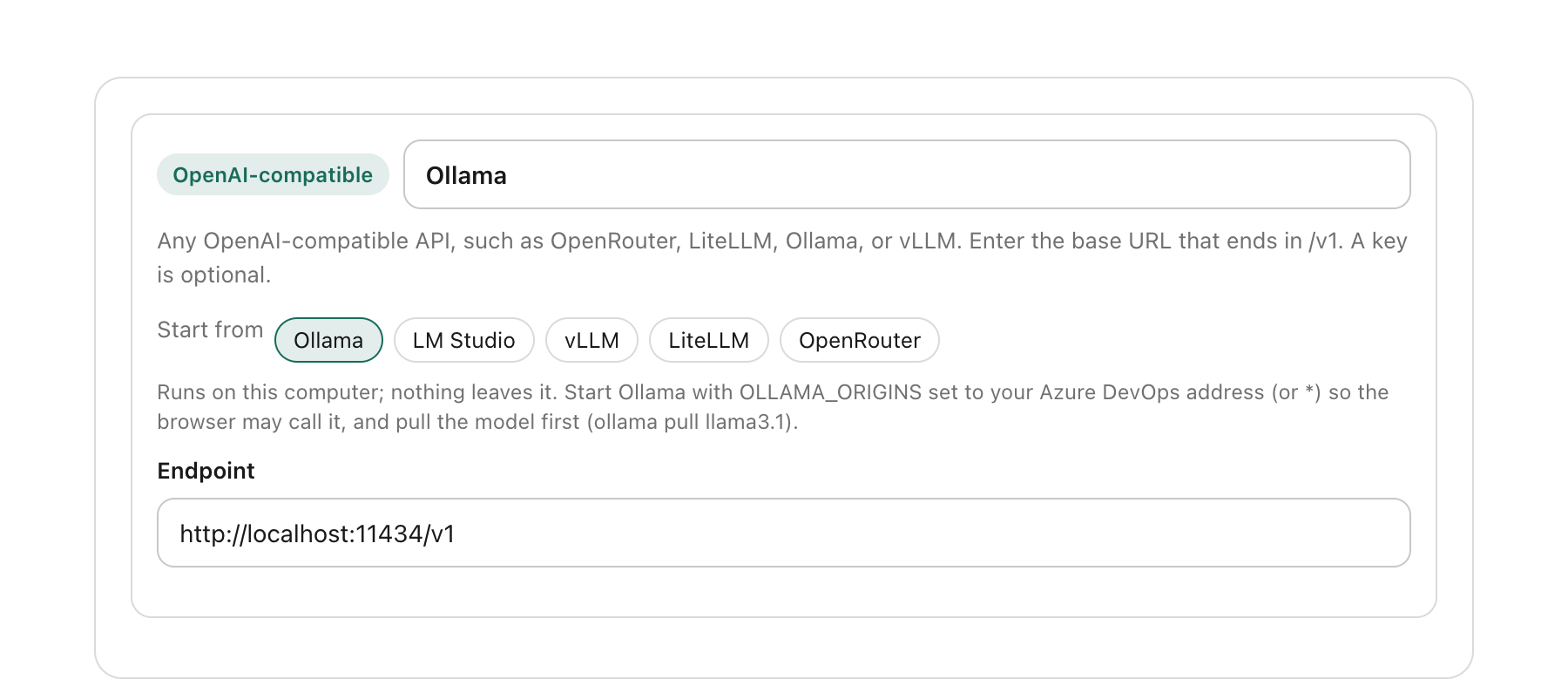
A model on your own machinePick OpenAI-compatible API and press Ollama, LM Studio, vLLM, or LiteLLM: the endpoint and a starter model are filled in, and the note tells you the one switch each runtime needs so the browser may call it. Nothing leaves your computer but the Azure DevOps calls you already make, and the Why this answer panel says so under every answer. Details in docs/local-models.md.
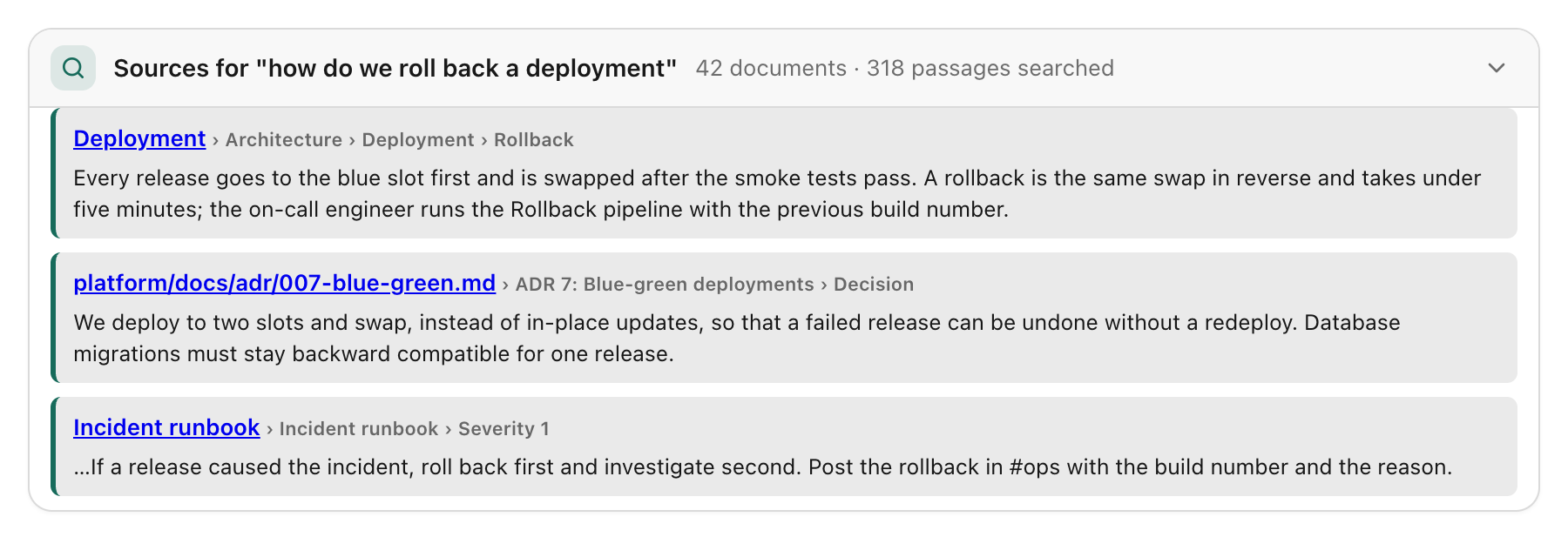
Answers grounded in your own documentationTell StrideAI which wiki pages and repository folders are the team's reference, your architecture pages, process guides, decision records, runbooks, under Settings → Knowledge. For questions about how the team works, its standards, or what was decided, StrideAI searches those sources first, right in the browser, and answers with quoted passages and links to the pages. Nothing is sent anywhere to be indexed, it works with every model connection, and when the sources don't cover a question StrideAI says so instead of guessing. For documents whose content isn't in the project yet, such as an SOP or runbook, it interviews you first and then writes the document from your answers and the sources. Wiki search reads every page of the project wiki by content, not just by title: the wiki is read from its Git repository once, kept in the browser, and only changed pages are read again, so a search takes milliseconds. Pick an embedding model under Settings → Knowledge (any OpenAI-compatible connection) and passages are ranked by meaning as well as keywords, so a paraphrase still finds the page; nothing is sent anywhere but your own model.
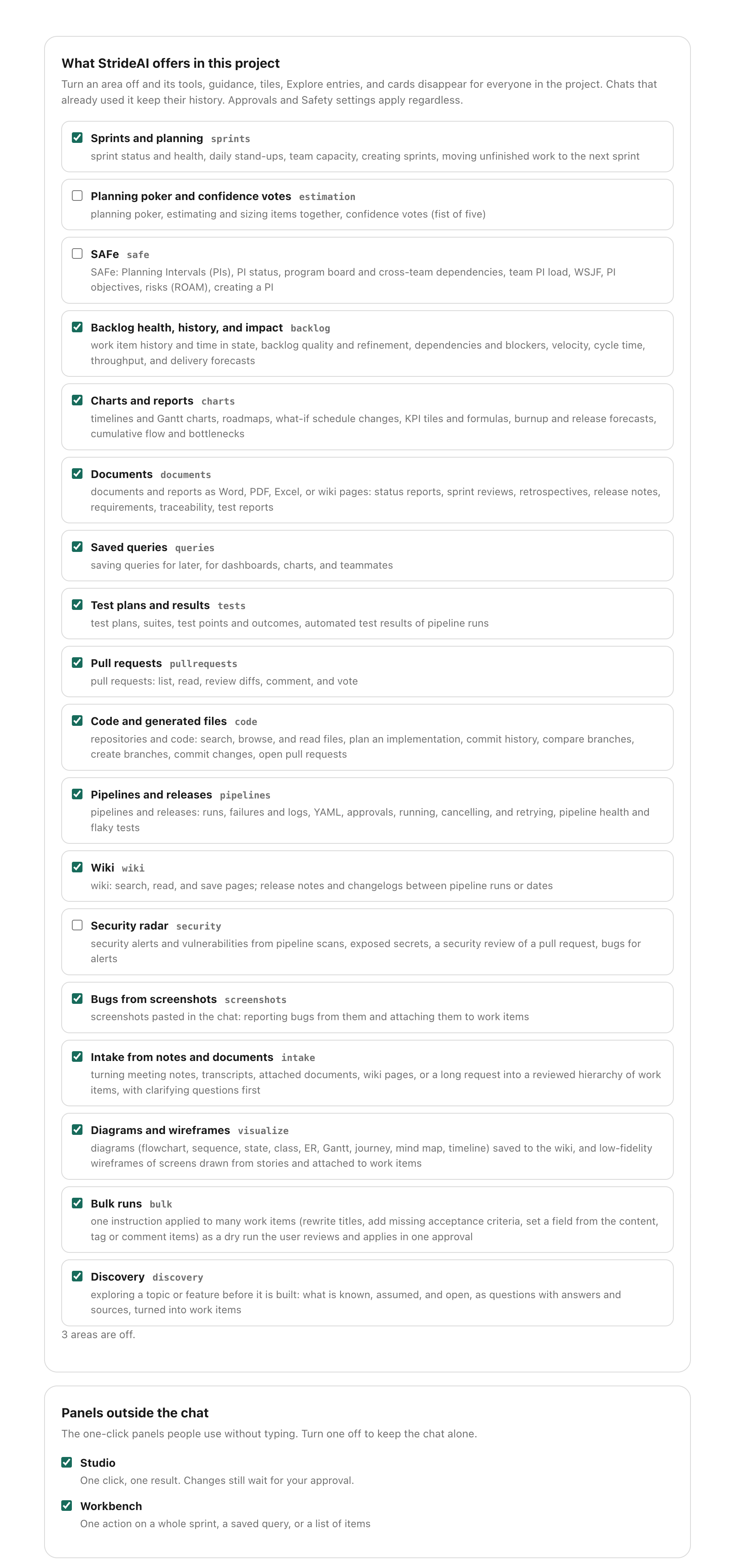
Turn off what your project doesn't useToo many features? Settings → Features lists every area with a switch. Turn SAFe, planning poker, or the security radar off and their tools, tiles, Explore entries, and cards disappear for everyone in the project; the Studio and Workbench panels have switches too. Chats that already used an area keep their history.
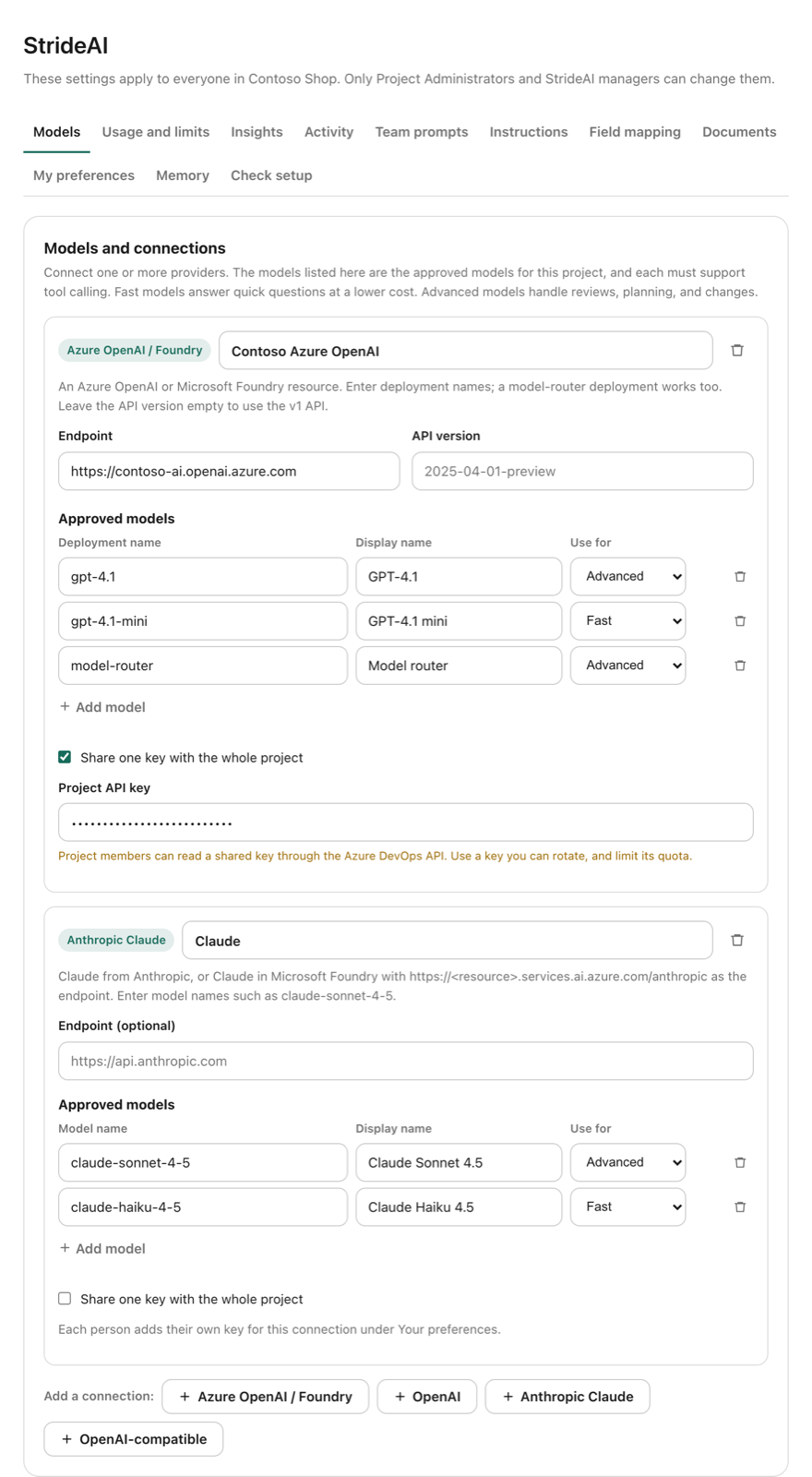
Documents keep their versionsEvery generated document is kept as a version in the project. Ask for this week's status report and the card says Version 4 · 3 earlier; open last week's or see what changed with the differences marked. Nothing to save first, nothing to find later. Your favouritesStar anything in Explore and it moves to Mine, together with the questions you asked recently. One click brings it back. Set it up once for the whole projectA Project Administrator or StrideAI manager connects the models in Project settings > StrideAI:
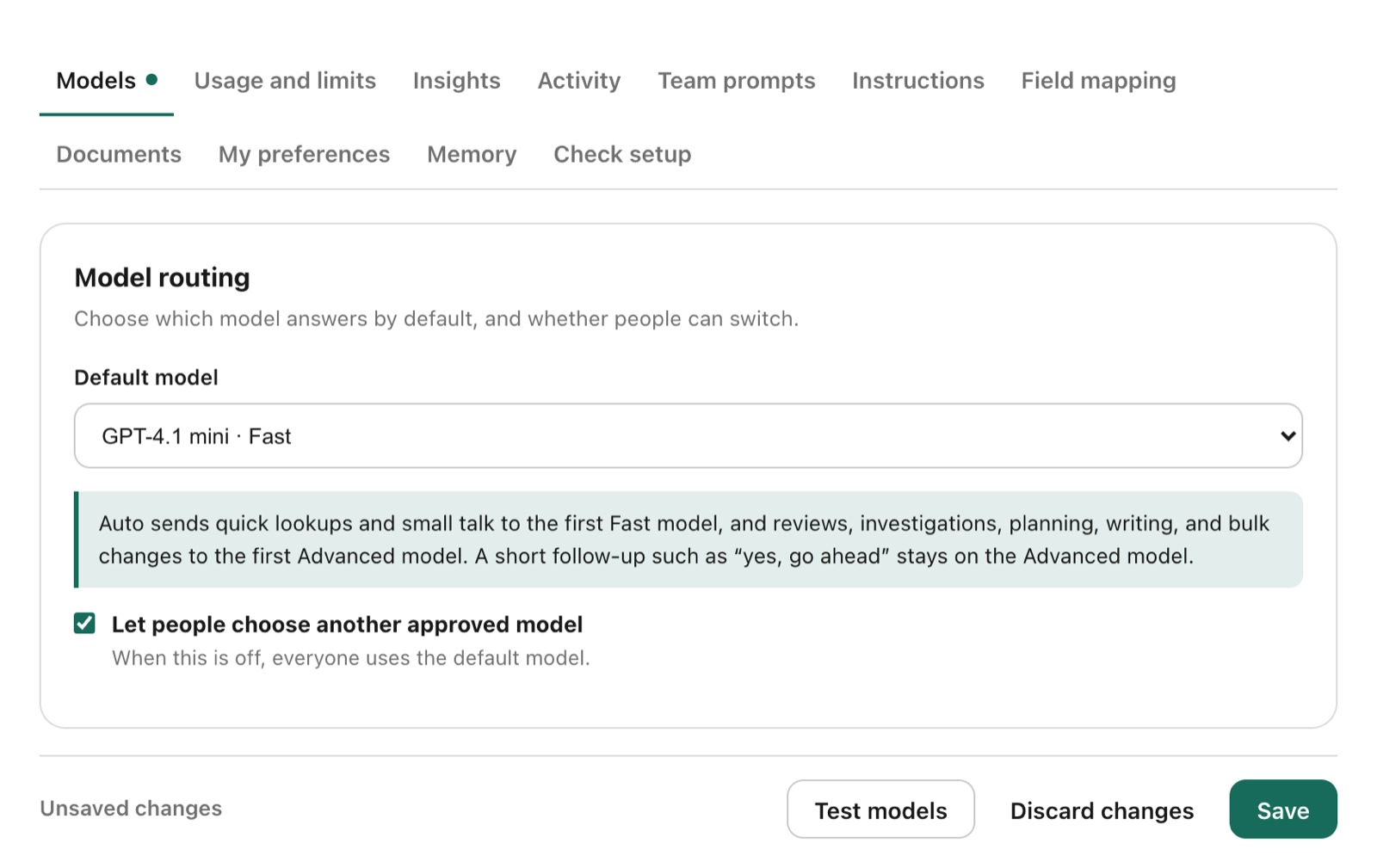
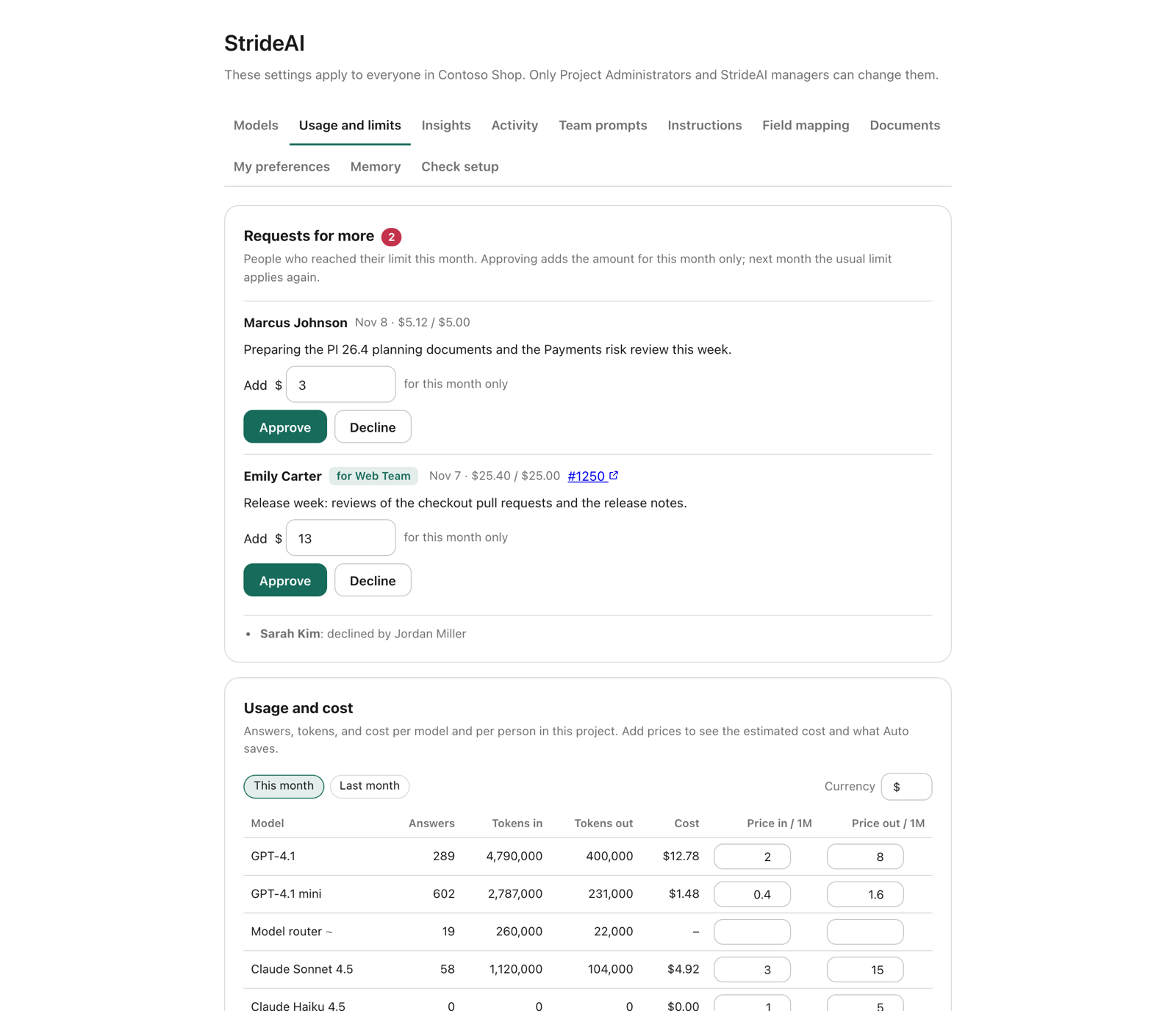
Settings are organized in tabs: Models, Usage and limits, Insights, Activity, Team prompts, Instructions, Field mapping, Documents, My preferences, Memory, and Check setup. Each tab saves on its own, so a change in one tab never overwrites another, even when two administrators edit at the same time. A dot shows which tabs have unsaved changes.
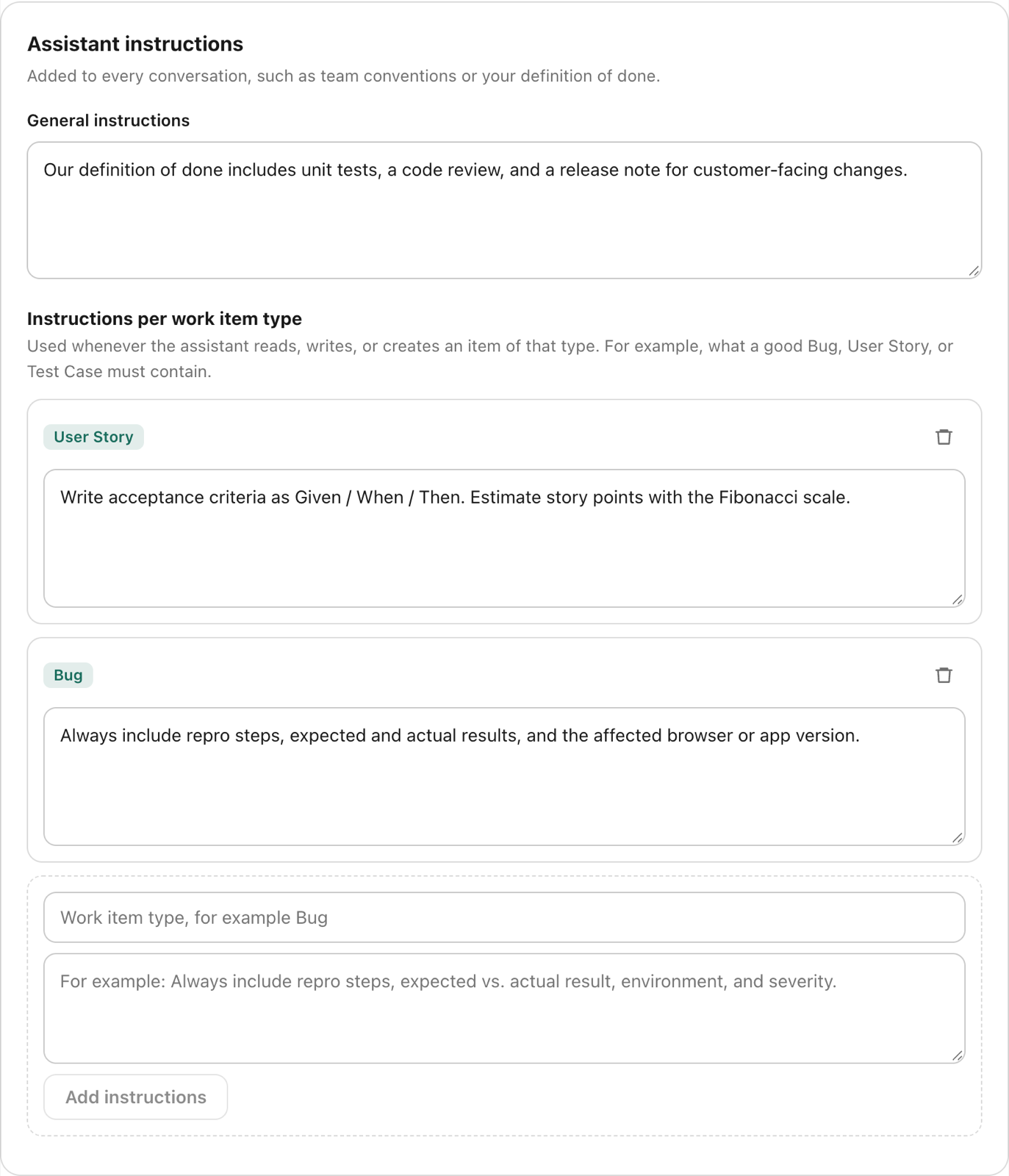
Teach it how your team works: add general instructions, such as your definition of done, and instructions for each work item type. They apply to every conversation.
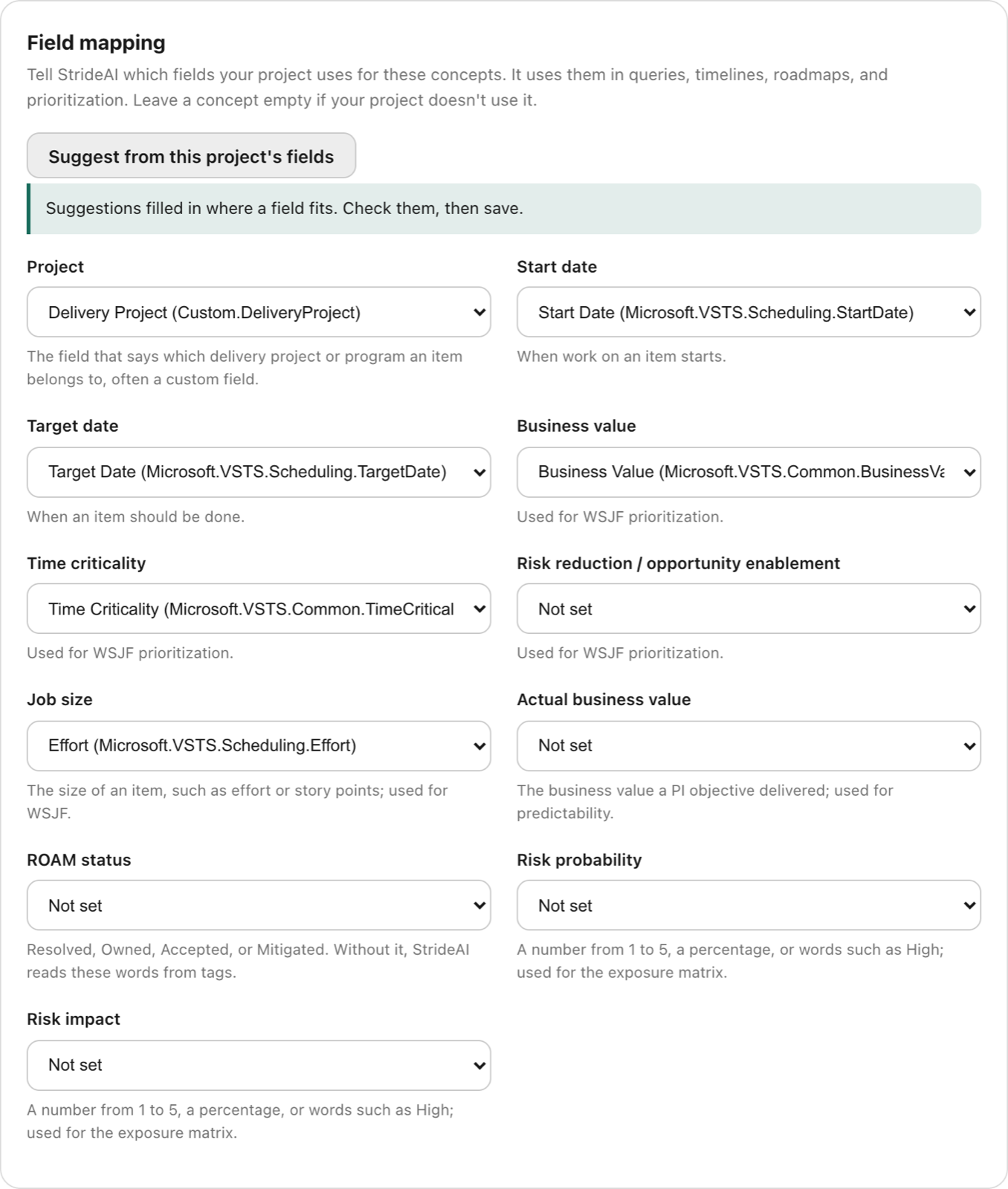
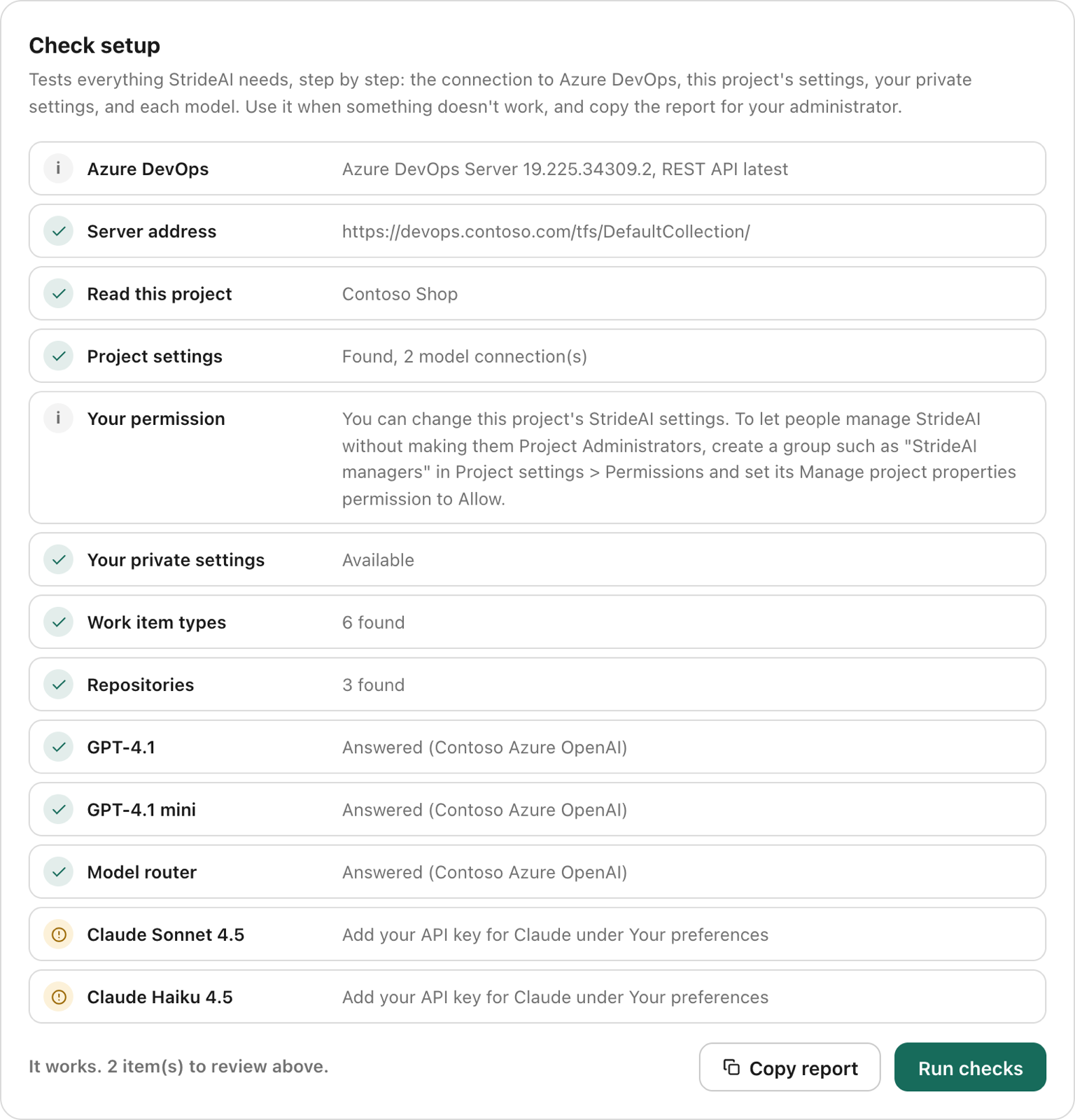
Add team prompts that everyone can start from, such as your definition of ready check or a weekly stakeholder update, in categories, and pin the important ones to the top. StrideAI managers run StrideAI without being Project Administrators. Anyone with the Manage project properties permission can change StrideAI's settings, and that permission covers only project properties. Create a group such as StrideAI managers in Project settings > Permissions, set its Manage project properties permission to Allow, and add the people who manage models, limits, requests, and prompts. Check setup shows whether you can change the settings and explains this too. Use Field mapping to tell StrideAI which fields your project uses for the delivery project, start and target dates, prioritization (business value, time criticality, risk reduction, job size), the actual business value of PI objectives, and the ROAM status, probability, and impact of risks, including your own custom fields. Suggest from this project's fields fills them in for you to check. StrideAI then uses your fields when it writes queries, creates or updates items, and draws timelines and roadmaps.
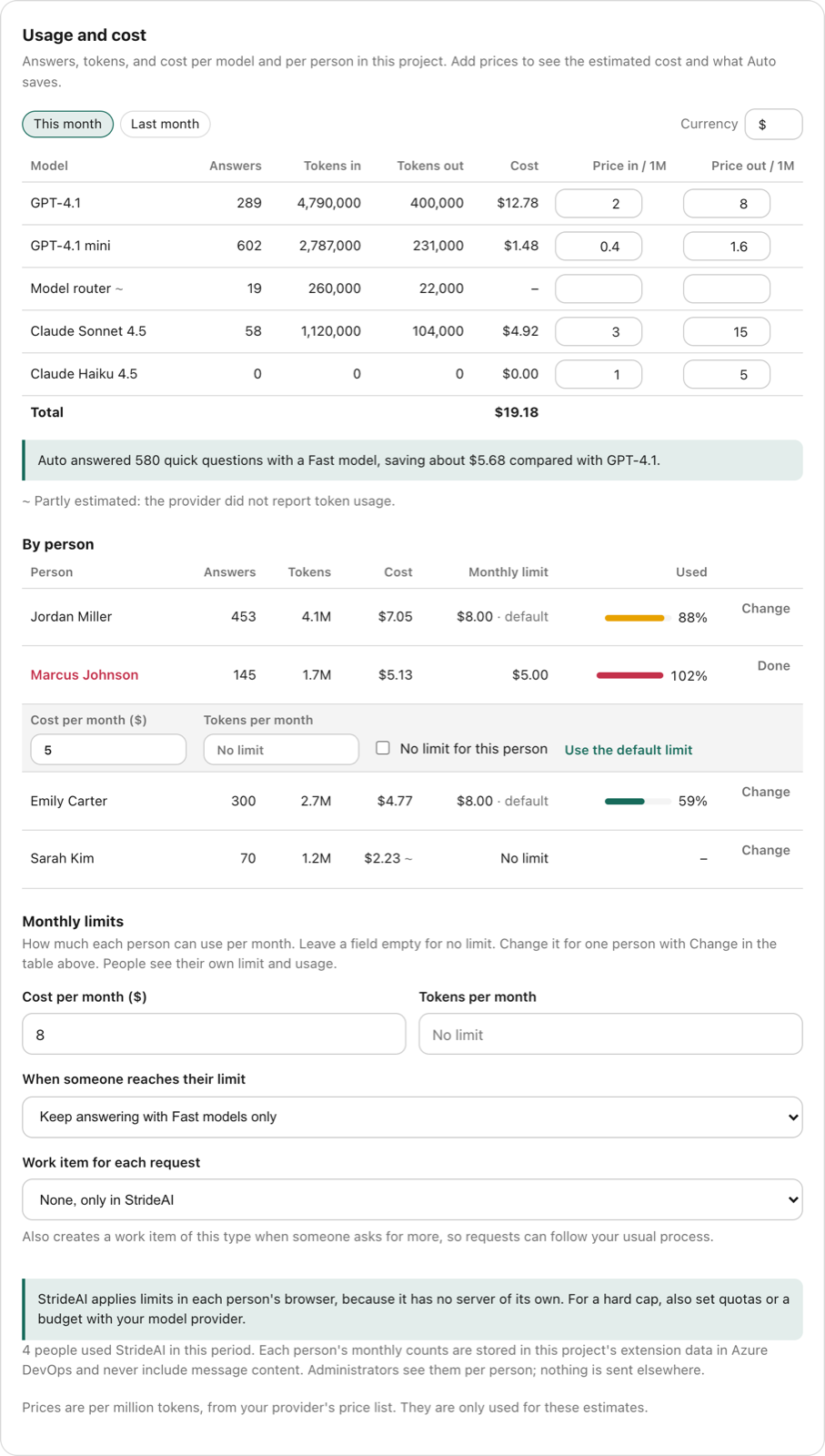
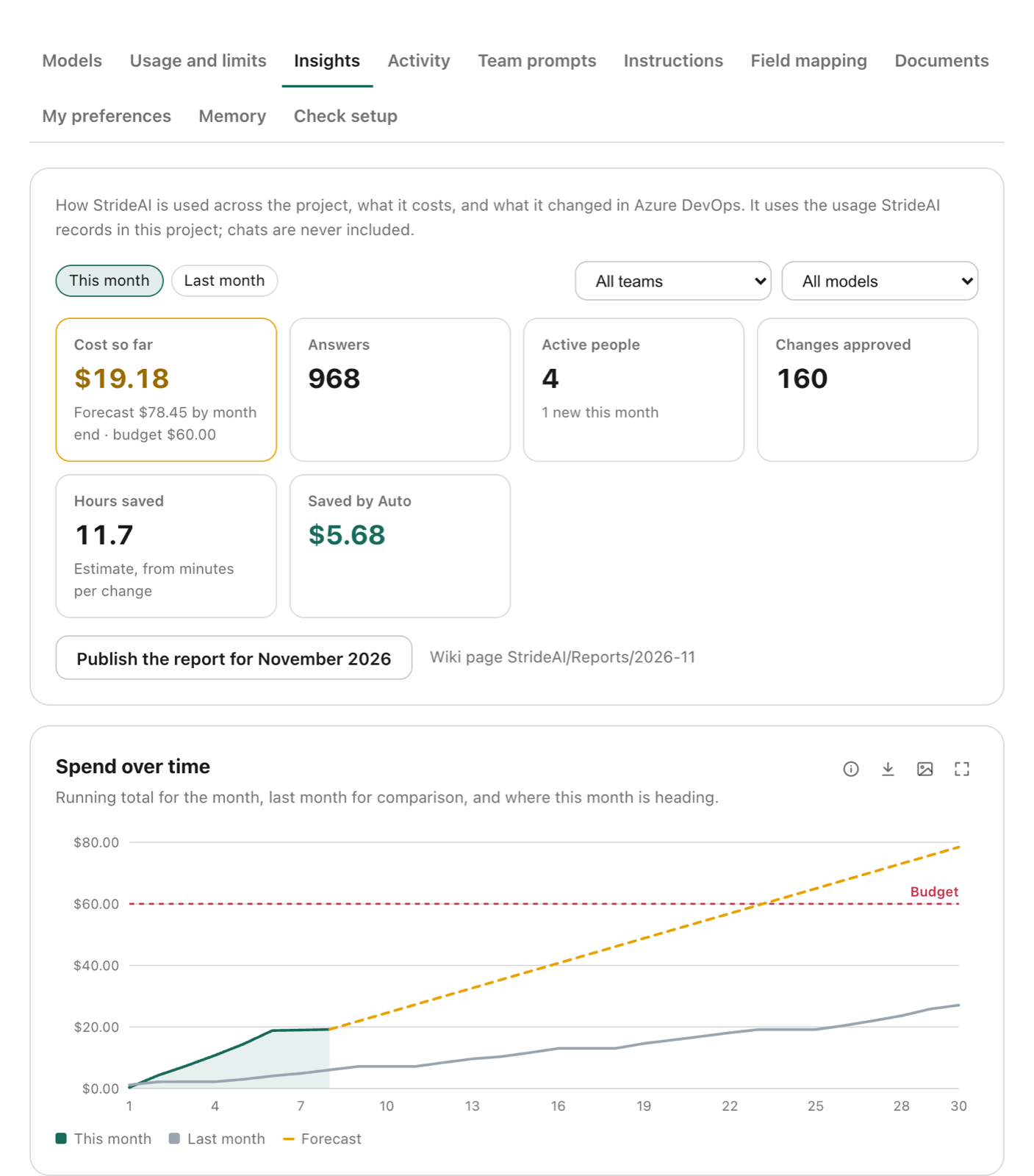
Track usage, cost, and limitsSee how many answers and tokens each approved model used, and what each person used and cost, this month and last month. Add the prices from your provider's price list to estimate the cost and see how much Auto saved by sending quick questions to a Fast model. Set a monthly limit in cost, tokens, or both: one default for everyone, a different limit for some people, or no limit for others. When someone reaches their limit, StrideAI either keeps answering with Fast models only or stops until next month, as you choose. Everyone sees their own usage and limit, and gets a notice at 80%.
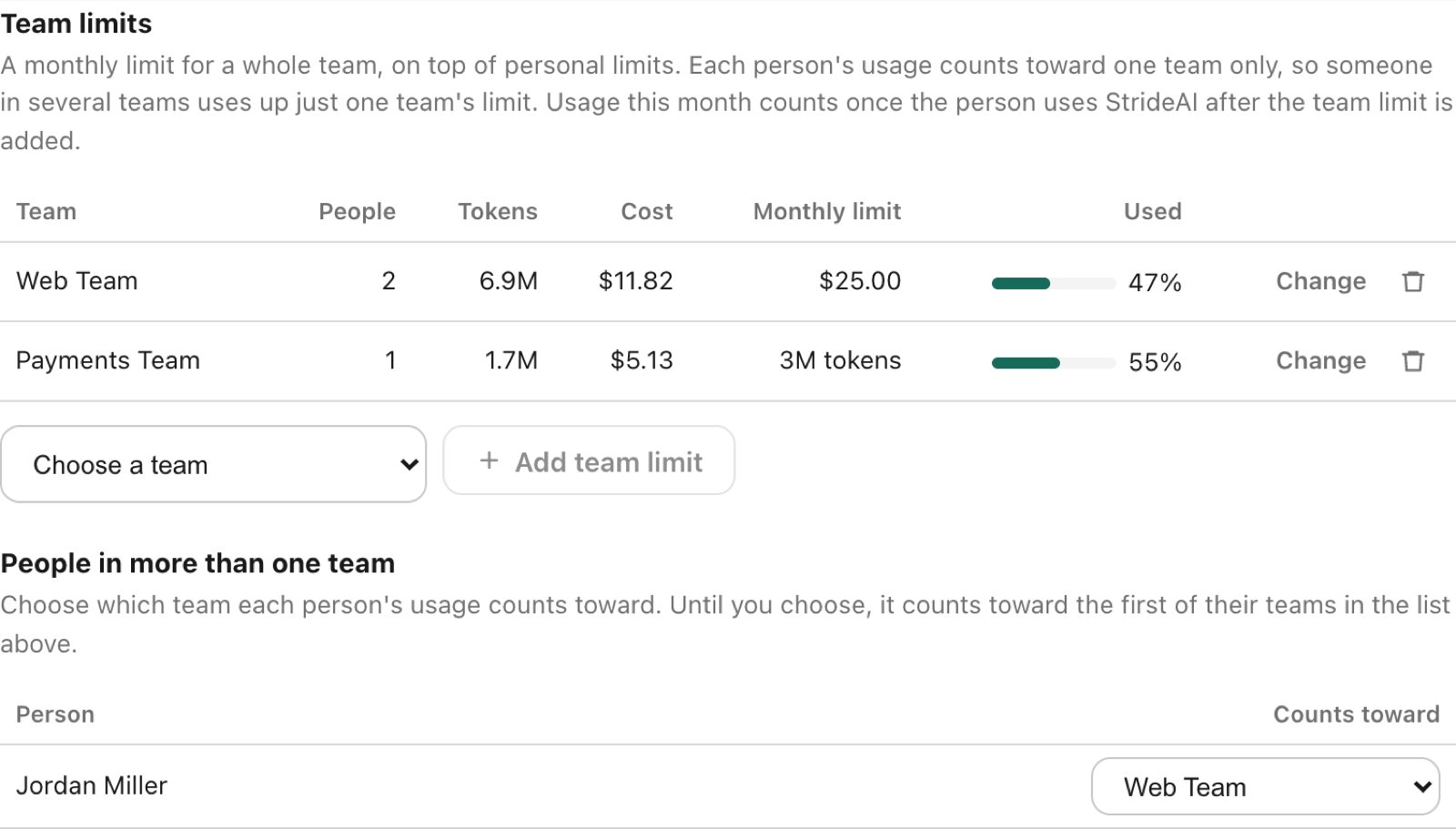
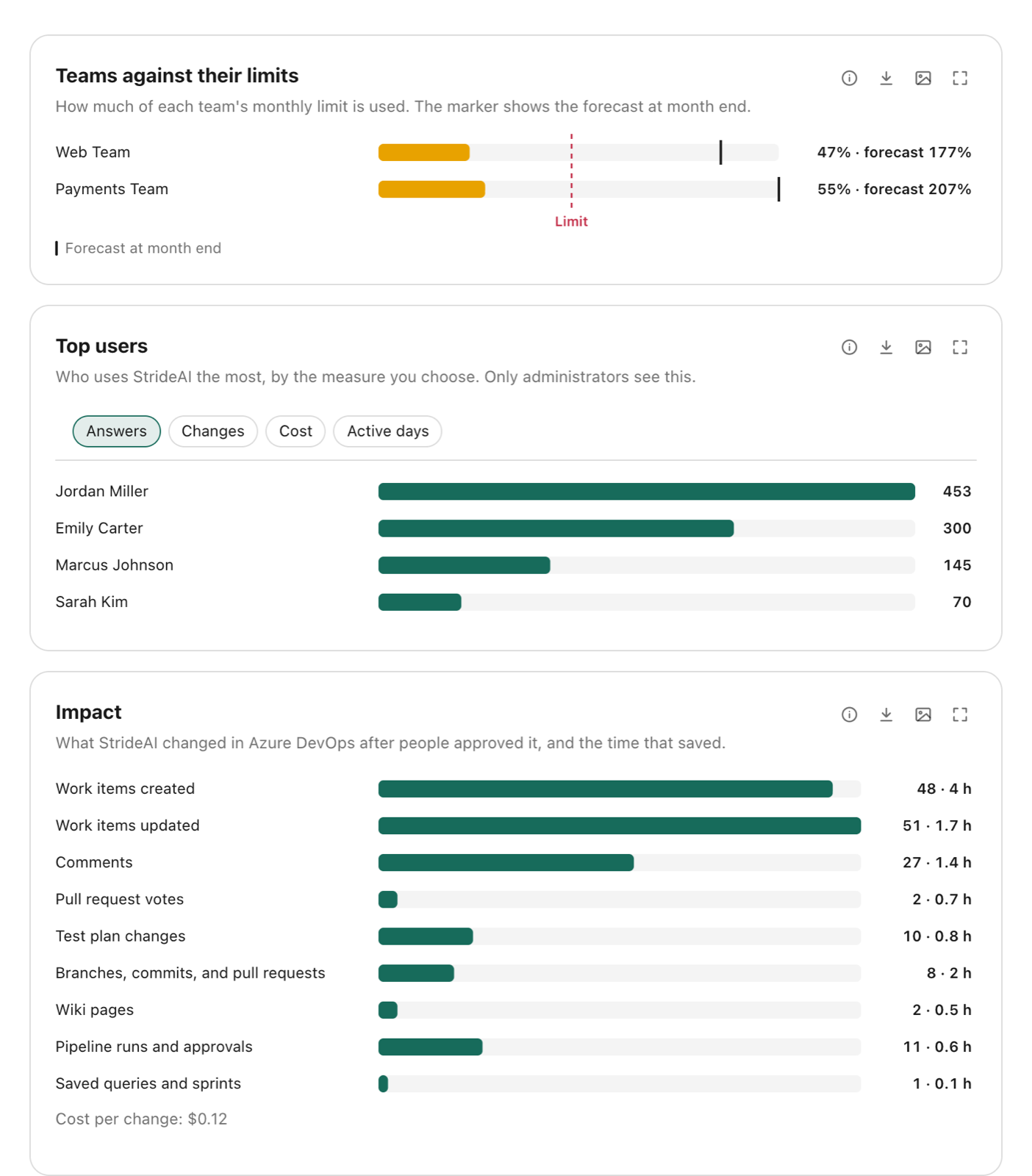
Add team limits for a monthly budget per Azure DevOps team, on top of personal limits. Each person's usage counts toward one team only, so someone in several teams never uses up more than one team's budget. You choose the team for people in more than one. When a team reaches its limit, everyone in it gets Fast models only or a pause until next month, the same as with a personal limit, and sees a notice from 80%.
StrideAI has no server of its own, so it applies limits in each person's browser. For a hard cap, also set quotas or a budget with your model provider. Ask for more: when someone reaches their limit, or their team's, they select Ask for more and say why. StrideAI managers see the waiting requests above the chat and in Usage and limits, and approve an amount for this month only or decline. The answer shows in the requester's chat, the higher limit applies right away, and next month the usual limit is back. If you like, each request also creates a work item of a type you choose, so it follows your usual process.
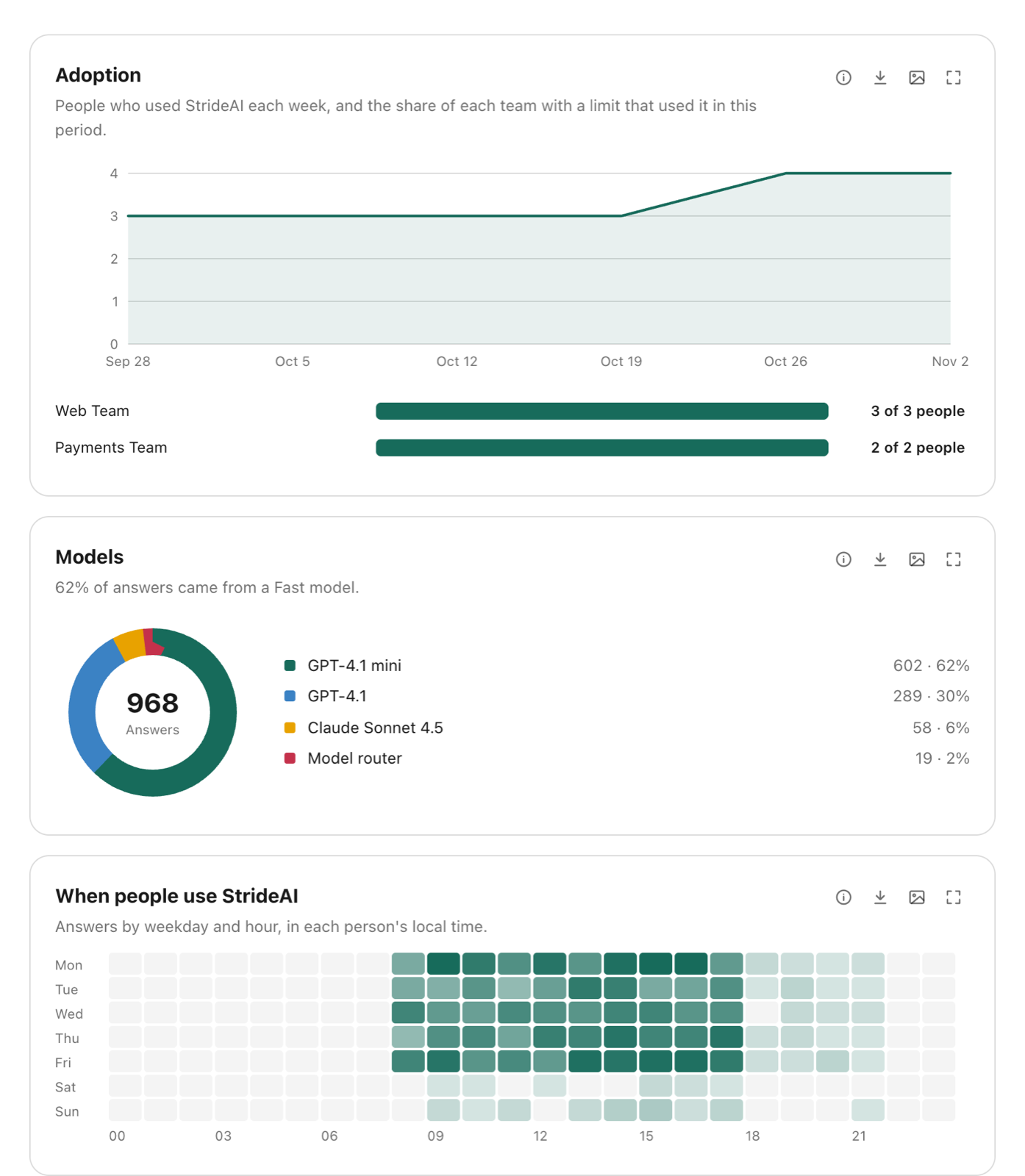
Budget alerts: from the 5th of the month, StrideAI continues the last seven days' pace to the end of the month. When the project's budget or a team's limit will run out before then, StrideAI managers see when it will happen above the chat and in Insights. See the value in InsightsThe Insights tab turns your usage into charts, for this month or last month, for all teams or one team, and for all models or one model:
Every chart explains how it's calculated, opens full screen, and downloads as CSV or an image for your reports. Only Project Administrators and StrideAI managers see Insights. Monthly report: publish a month's usage, cost, adoption, and impact to the project wiki, for example as StrideAI/Reports/2026-11, with the data as CSV. After a month ends, Insights offers last month's report to the first administrator who opens it. When Hide names is on, the report shows people as Person 1, Person 2, and so on.
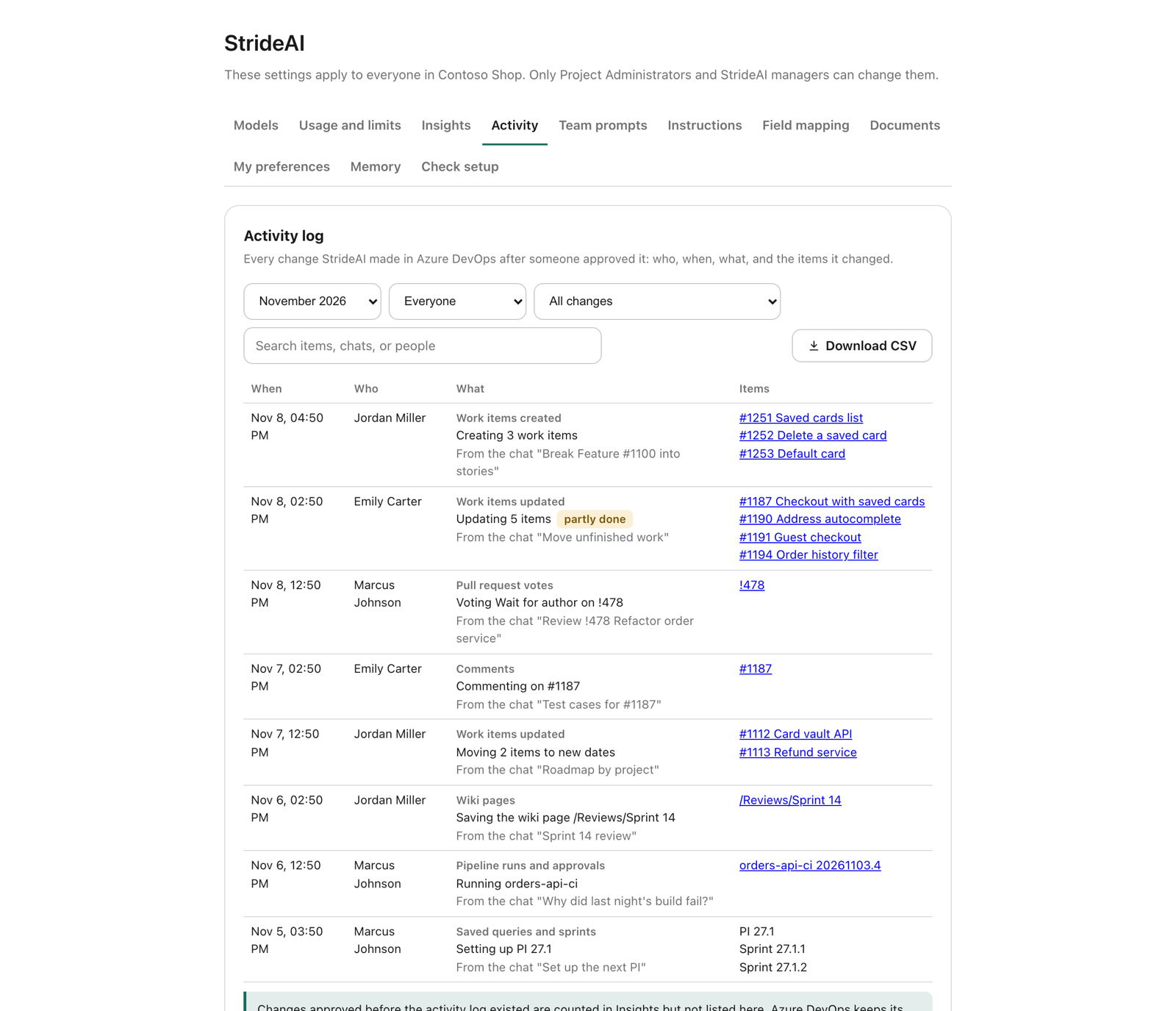
Activity log for auditorsSettings > Activity lists every change StrideAI made in Azure DevOps after someone approved it: when, who, what, the chat it came from, and links to the items it changed. Changes that only partly succeeded are marked. Filter by month, person, or kind of change, search, and download the list as CSV. StrideAI managers see everyone's changes; everyone else sees their own. The log is kept in the project's extension data; Azure DevOps also keeps its own history of every item, and each link opens it.
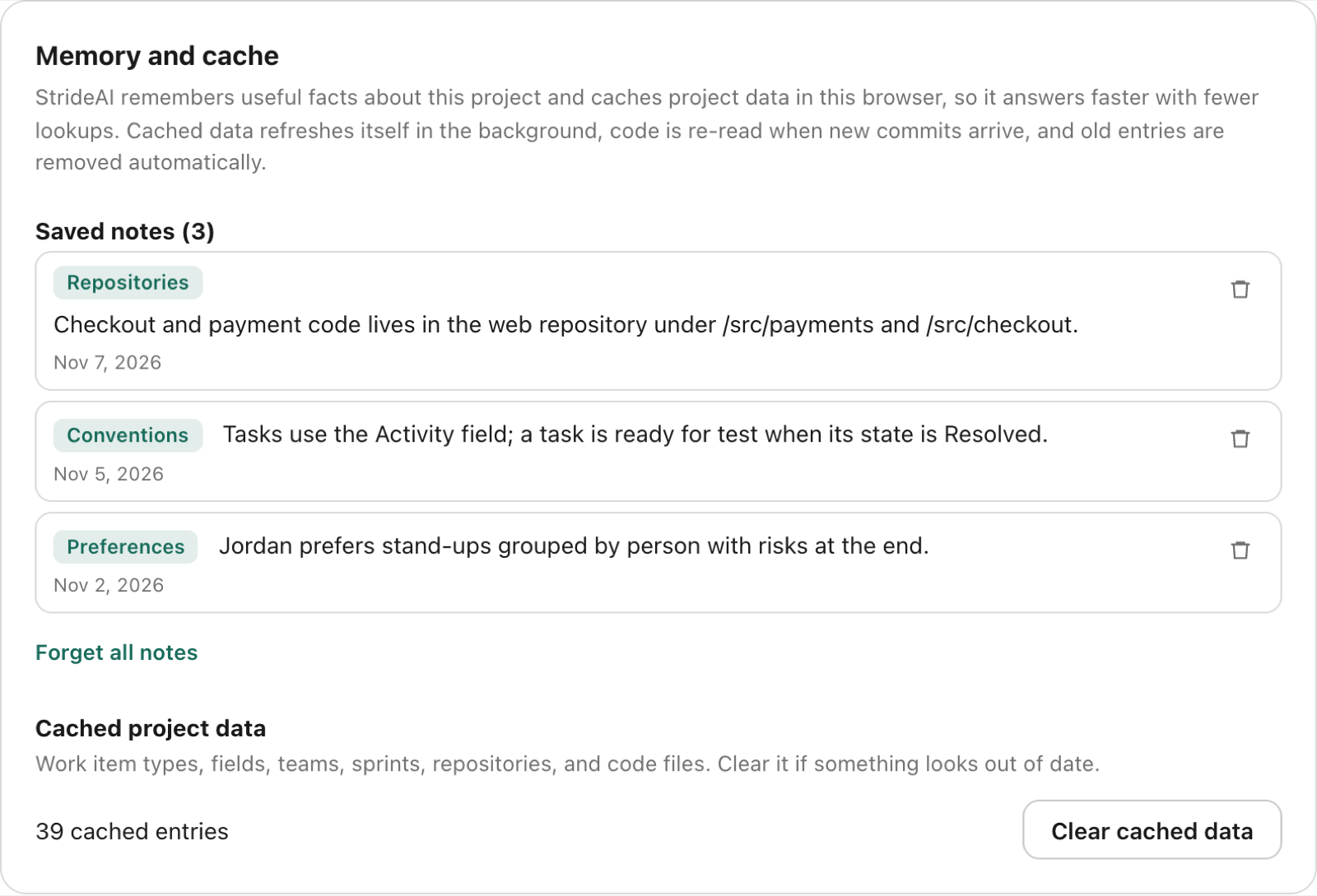
It learns your projectStrideAI keeps a small, self-refreshing cache of your process (types, states, fields), teams, sprints, and repositories in your browser, so answers are fast and need fewer lookups. It also saves short notes about how your team works, such as which repository holds which feature. You can see and delete every note.
Get started
Install on Azure DevOps Server (on-premises)StrideAI runs on Azure DevOps Server 2020, 2022, and later. The server hosts the extension itself, so nothing is downloaded from the internet when people use it.
To update, upload the newer For a fully on-premises setup, point StrideAI at a model your users' browsers can reach inside your network: Azure OpenAI or Microsoft Foundry through a private endpoint, or a self-hosted OpenAI-compatible model. Model endpoints must use HTTPS. If something doesn't workOpen Settings in StrideAI, go to the Check setup tab, and select Run checks. It tests each step and shows exactly where it stops. Select Copy report to send the result to your administrator.
Requirements
You stay in control
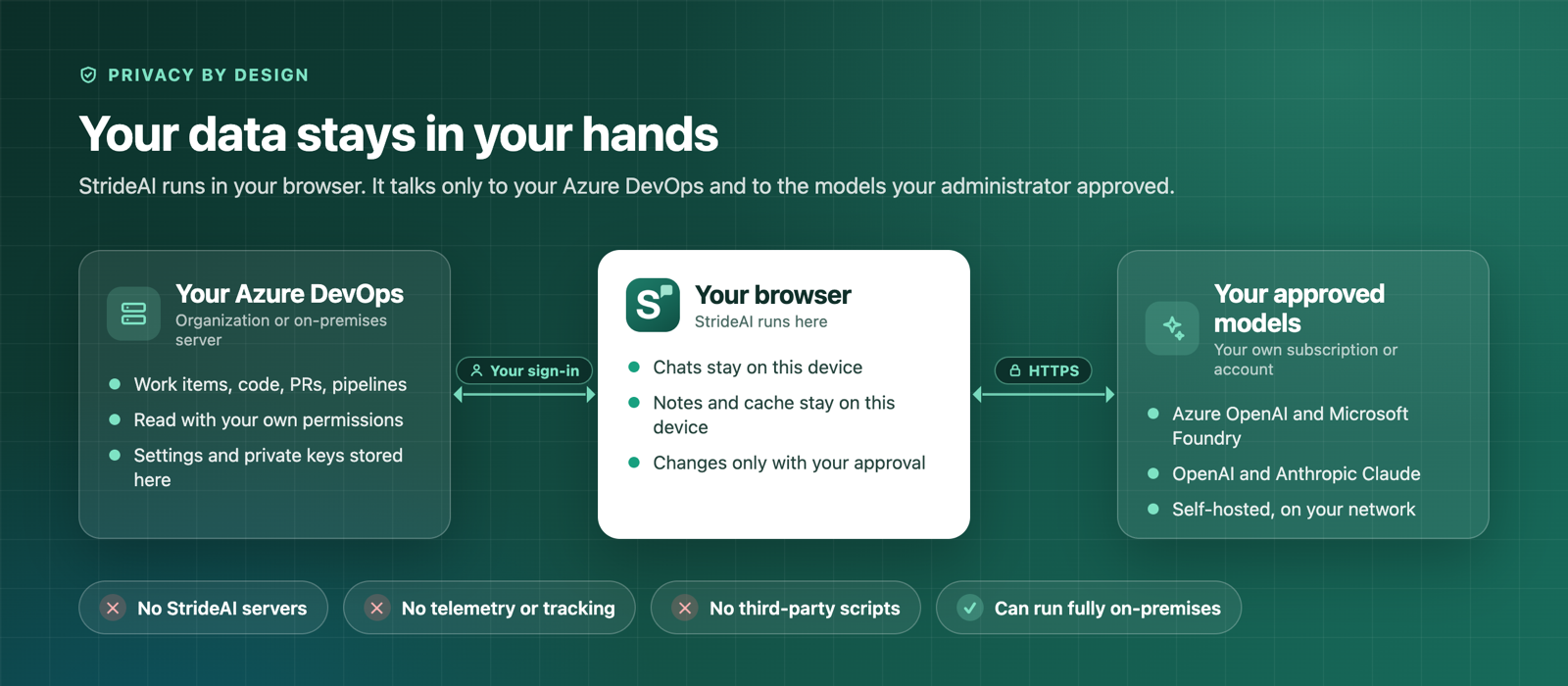
Privacy and dataWhere everything is stored
You can delete chats from the chat history, and clear notes and cached data any time in Settings > Memory. What is sent to the model, and only when you send a message
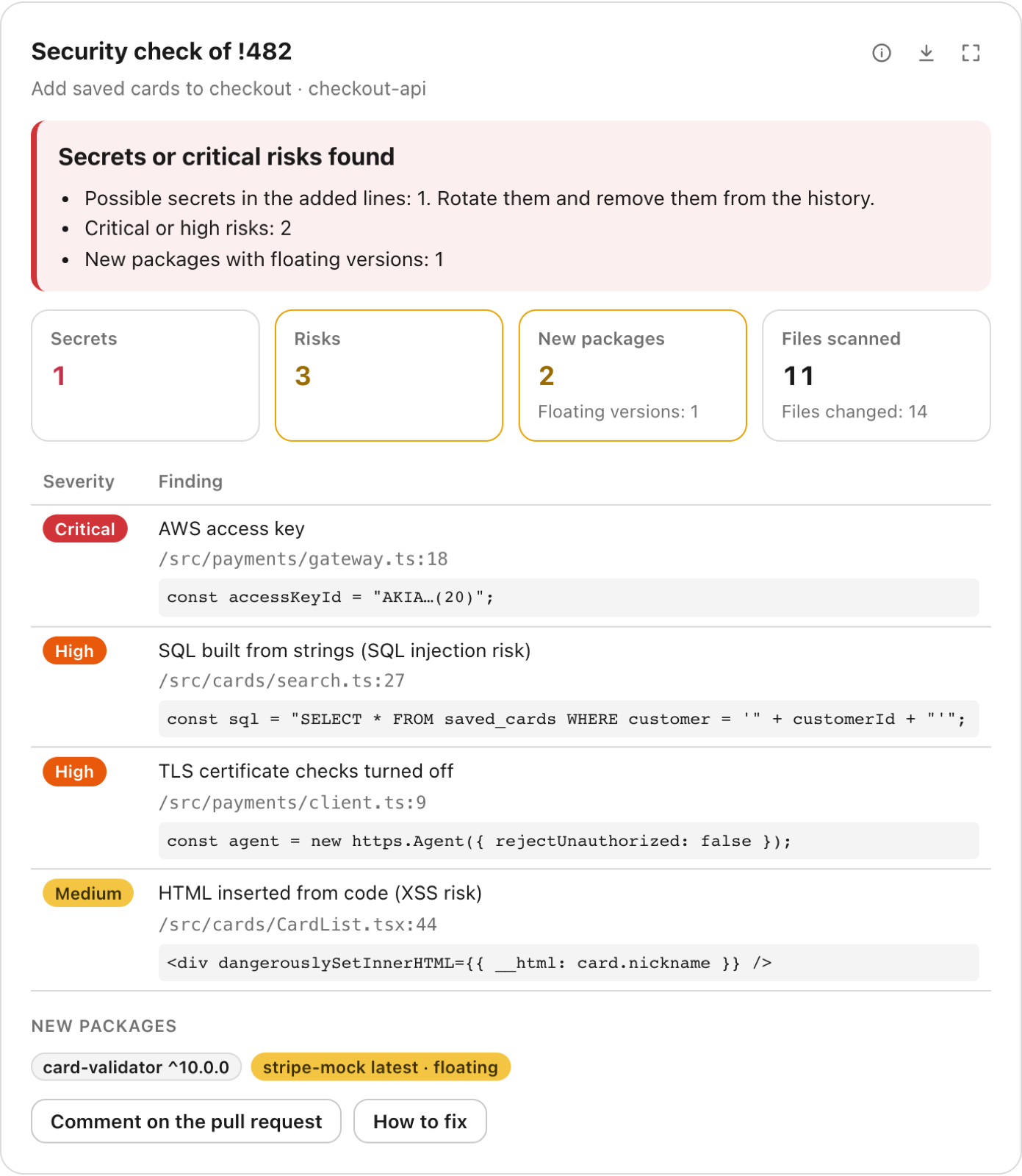
Secrets found by the security check of a pull request are masked before anything is shown or sent: only the first four characters and the length remain. The pipeline tasks run on your agents, not in a browser. They send the lines a pull request adds (secrets masked), work item and pull request titles, or the report to the model endpoint you configure in the task, and nothing to anyone else. It goes only to the approved model endpoints, and your provider's data terms apply. Azure OpenAI does not use prompts and completions to train models.
Permissions
StrideAI doesn't ask for the Advanced Security permission, so it installs and updates the same way on Azure DevOps Services and every supported Azure DevOps Server version. The pipeline tasks don't use these permissions: they run with the pipeline's own identity and its permissions in your project. Good to know
|