Raaghu Spec Kit
Raaghu Spec Kit brings specification-driven development into Azure DevOps. PMs, BAs, and QAs can generate, review, and manage structured specs, delivery plans, task breakdowns, and quality checklists — then create and refine Azure Boards work items — all from a guided AI workspace inside your project.
Works with Azure DevOps Services and Azure DevOps Server (on-premises).
Documentation
Full setup guides, tutorials, troubleshooting, and release notes:
Raaghu Spec Kit documentation
Secure Sign-In
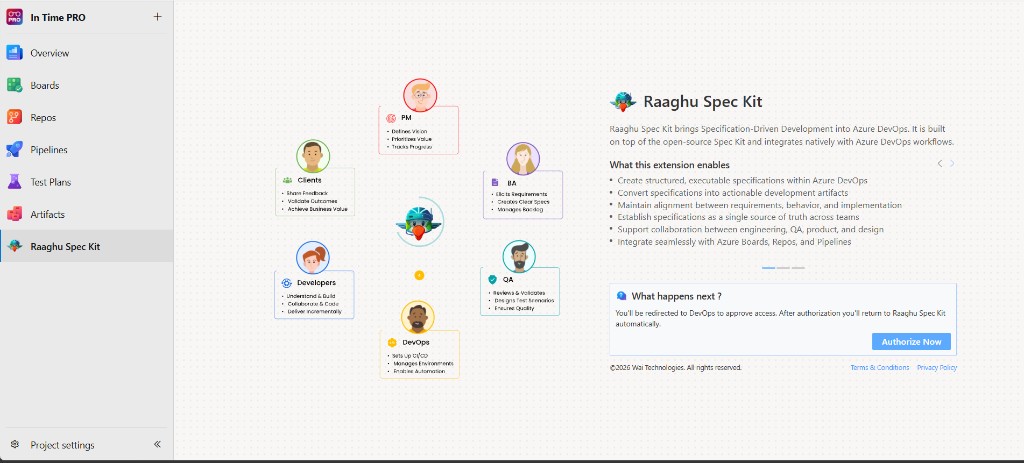
Sign in with your Microsoft account to get started. Raaghu Spec Kit uses Microsoft authentication to securely connect with your Azure DevOps organization or collection.
If your organization requires approval, you may see "Request submitted. Retry authorization after admin approval". An organization admin approves you under Organization Settings → Raaghu Spec Kit → Users → Pending requests, then you click Authorize Now again. Approval is separate from seat assignment.
Workspace — Five Tabs, One Flow
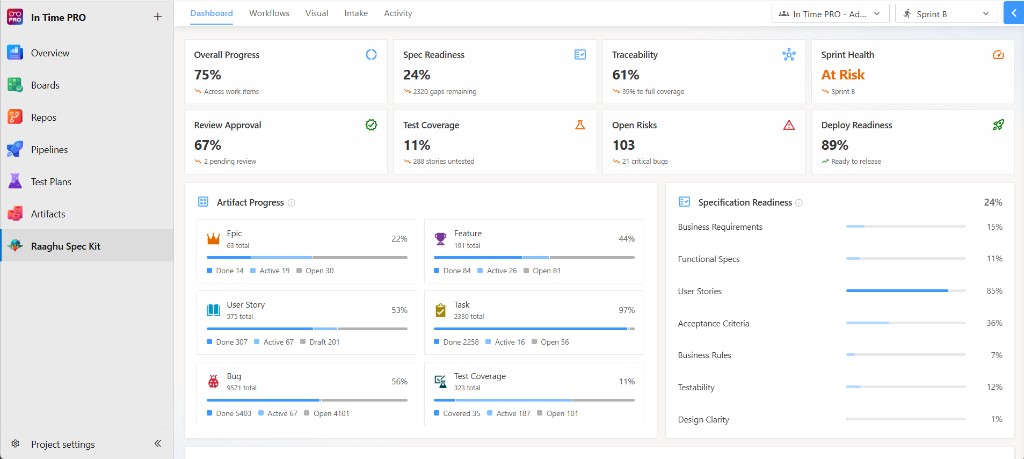
The left workspace is organized into five tabs so teams can move from intelligence → action → backlog → documents → audit:
| Tab |
Purpose |
| Dashboard |
Project intelligence — progress, spec readiness, traceability, sprint health, risks, and deploy readiness |
| Workflows |
Curated AI actions by delivery phase — pick a capability and start a guided chat |
| Visual |
Interactive Epic → Feature → User Story → Task hierarchy with Sync (find + auto-link), pan, and zoom |
| Intake |
Analyze BRD/PRD and project docs from the wiki; extract requirements and open questions |
| Activity |
Audit trail of Spec Kit work-item creates, updates, and deletes by day, week, or month |
Dashboard — Project Intelligence
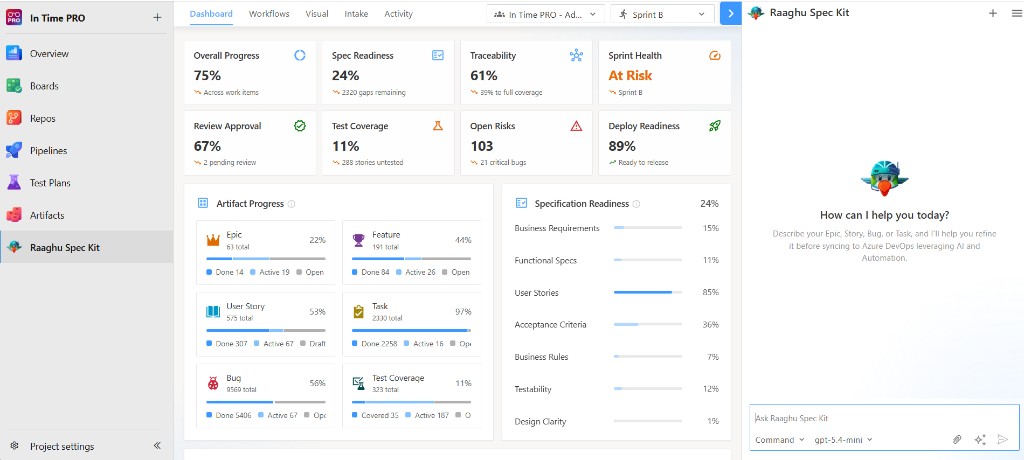
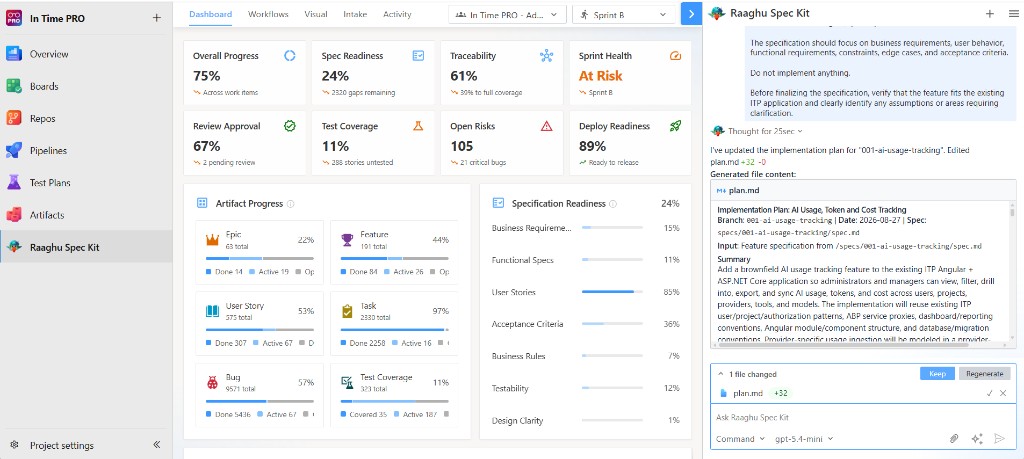
The Dashboard gives PMs a live view of delivery health grounded in Azure Boards and Spec Kit artifacts:
- Overall Progress — completion across stories and tasks
- Spec Readiness — gaps in acceptance criteria, testability, and related dimensions
- Traceability — how well work items stay linked through the hierarchy
- Sprint Health — Healthy / Watch / At Risk for the current iteration
- Review Approval, Test Coverage, Open Risks, and Deploy Readiness
- Artifact progress and specification readiness panels with drill-down into Boards items
- Lifecycle progress across the Spec Kit delivery pipeline
Use the Iteration filter and KPI drill-downs to jump from a metric to the work items that need attention. From a drill-down you can search, filter, sort, open an item in Boards, or Export as CSV. Artifact progress and Test Coverage drill-downs also offer Needs attention and All tabs.
Workflows — Guided AI Actions
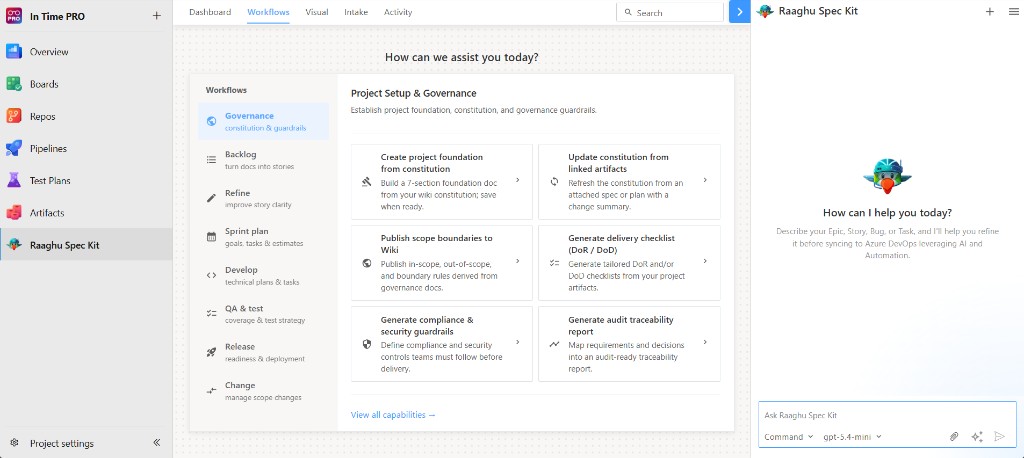
The Workflows tab is your command center — AI-powered actions organized by delivery phase. Select any action to start a guided conversation in the chat panel. Search workflows or browse by phase.
| Phase |
What You Can Do |
| Project Setup & Governance |
Create project foundation from constitution, update constitution from linked artifacts, publish scope boundaries to Wiki, generate delivery checklist (DoR / DoD), generate compliance & security guardrails, generate audit traceability report |
| Backlog Creation |
Generate epics from linked artifacts, split epics into features, generate stories from selected feature, generate stories from linked artifacts, generate intake summary from BRD/PRD, link artifacts to selected work item |
| Backlog Refinement |
Refine selected stories, standardize acceptance criteria, detect missing requirements, attach NFRs to stories, detect duplicates or overlaps, highlight unclear or risky stories |
| Sprint Planning & Breakdown |
Generate sprint goal from selected items, generate dev tasks from selected stories, estimate tasks from plan, identify cross-team dependencies, run readiness check (DoR validation) |
| Execution Support |
Generate technical plan for selected feature, refine tasks into implementation steps, generate test cases from selected stories, convert bug to linked dev task, track work items status from implementation progress |
| Quality & Validation |
Generate test strategy for selected epic, generate negative / edge test cases, generate test data matrix, validate acceptance criteria completeness, generate UAT checklist |
| Release & DevOps |
Generate CI pipeline checklist from constitution, generate release gates from compliance rules, generate runbooks (deploy / rollback), generate release notes from completed work items, publish release notes to Wiki |
| Change Management |
Detect scope drift from latest artifacts, highlight changes since last PRD version, draft change request with impact analysis, mark items requiring approval, generate stakeholder approval checklist |
Visual — Work Item Hierarchy
The Visual tab shows your Azure Boards hierarchy as an interactive chart — Epics, Features, User Stories, and Tasks — with drag-to-pan navigation, zoom, Sync, and one-click child generation from Spec Kit artifacts.
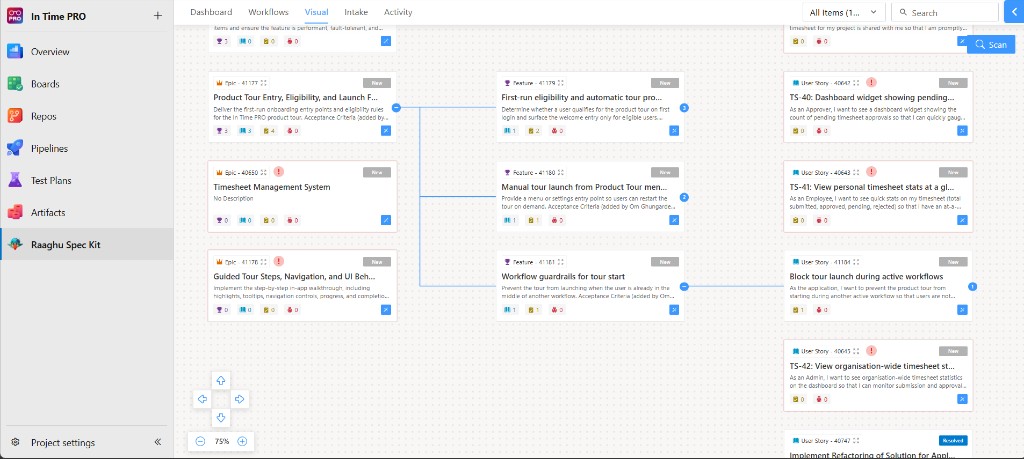
- Tree visualization — connected cards with Azure DevOps icons and status badges
- Sync (chart) — finds work items outside the Spec Kit tree, then auto-links matching Boards items into the hierarchy (requires Spec Kit initialized and an AI provider). Linked cards can show a connection check; Spec Kit stamps the
raaghuspeckit-autolinked tag
- Sync (card menu) — generate child items from wiki specs, one level at a time (e.g. Epic → Features)
- Spec gaps — amber warning when a linked item’s description is behind the wiki; use the wand → Refine to update from the constitution /
spec.md / tasks.md
- Refine — improve a work item with AI from the card menu
- Filter & search — filter by type and search by title
- Pan & zoom — navigate large backlogs comfortably
- Process templates — Agile, Scrum, CMMI, and Basic
Intake — Documents to Backlog
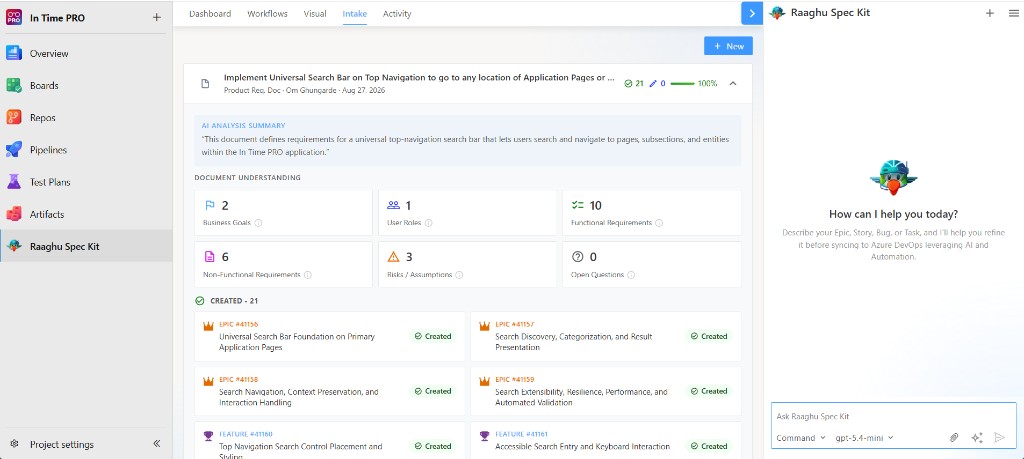
The Intake tab turns BRDs, PRDs, and related docs into structured understanding and Azure Boards work items:
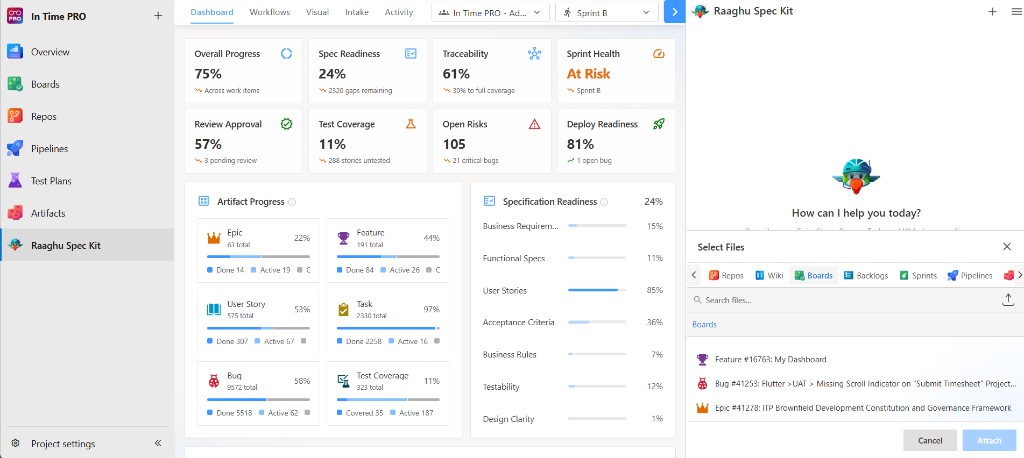
- Click New to add files from Repos, Wiki, Boards, Backlogs, or Upload from computer (up to 4 files at a time)
- Spec Kit saves a copy under
Raaghu Spec Kit/intake/ in the wiki (or Speckit/intake/ on older projects) and analyzes each document for scope, requirements, risks, assumptions, and open questions
- Large documents are analyzed in overlapping sections and merged; if analysis is only partial, the result notes that
- Use Stop generating to cancel an in-progress analysis, then Retry to run it again without re-selecting the same files
- Review the analysis, then create or skip suggested Boards items from chat. After Skip, use Show skipped and Undo skip to restore a suggestion for Create
- Track remaining open questions and risks until they are resolved
Ideal for onboarding existing product docs before /speckit.specify and backlog creation.
Activity Feed
The Activity tab is a real-time audit trail of what Raaghu Spec Kit has done in your project. Browse by Day, Week, Work Week, or Month, and search across all activity.
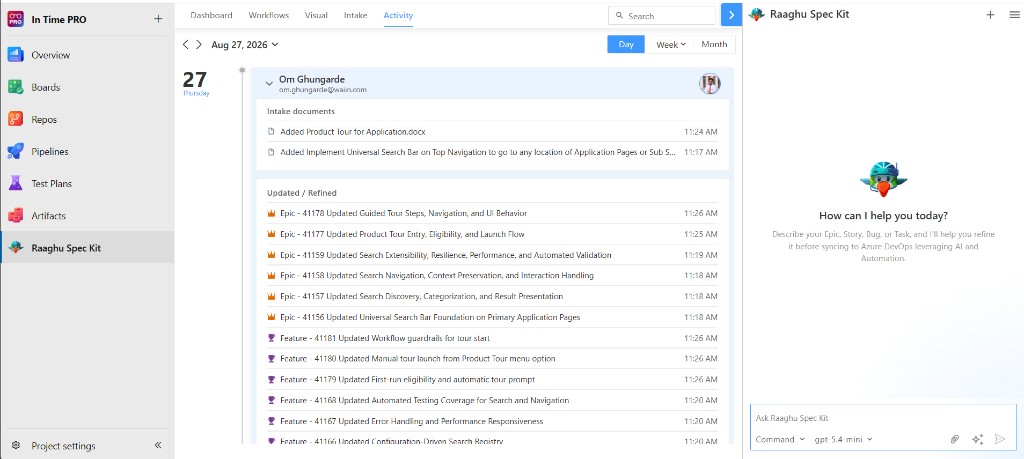
- Date navigation — step forward or backward by day, week, or month
- Per-user grouping — see who generated or updated what
- Work item audit trail — Epics, Features, User Stories, and Tasks with ID, title, and timestamp
- Change labels — Created, Updated / Refined, and Deleted (including soft-deletes from the Azure DevOps Recycle Bin)
- Search — filter by keyword
Key Features
Conversational AI Chat
Natural-language interface for context-aware specification engineering. Ask questions, run /speckit.* commands, and generate structured deliverables — all within Azure DevOps. Use Stop generating to cancel a reply in progress, then Retry to run the last prompt again.
Repository-Aware Context
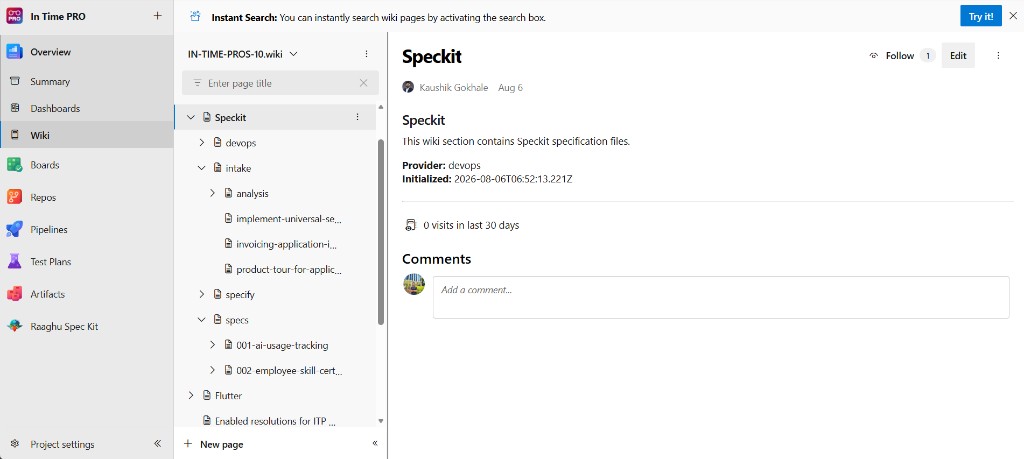
Automatically scans your wiki file tree and repository sources to give the AI project context — README, existing specs, constitution, and structure.
Wiki-Based Storage
Built on GitHub Spec Kit. Spec Kit artifacts (constitution, spec, plan, tasks, checklists, and related files) are saved to your Azure DevOps Wiki under Raaghu Spec Kit/ (projects initialized earlier may still use Speckit/) with full version history — no Git commits required for Spec Kit content.
Flexible AI — BYOK or Raaghu Hosted AI
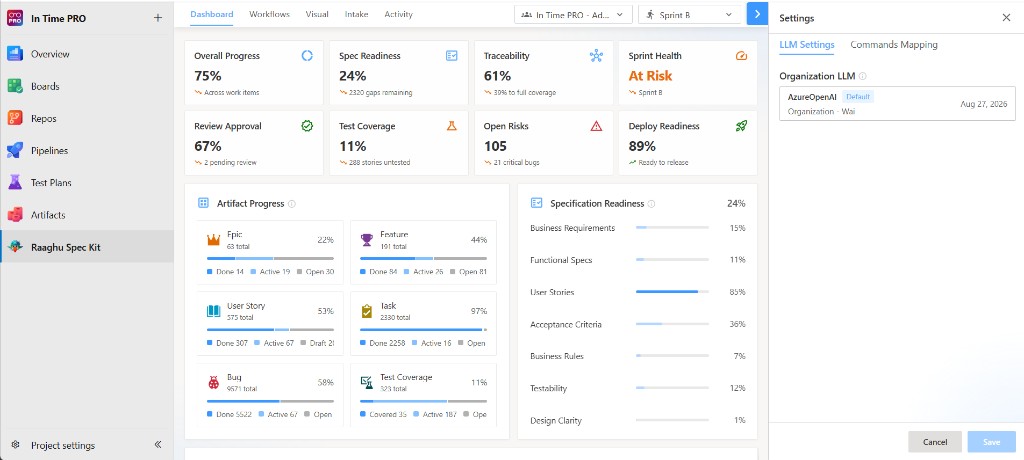
Use your own AI provider, Raaghu-hosted AI, or both when your organization admin allows it for the project.
| Option |
How it works |
| Bring Your Own Key (BYOK) |
Add Azure OpenAI, OpenAI, or Anthropic Claude under Settings → LLM Settings (Project LLM), or use organization connections assigned under Organization Settings → Configurations. Requests go from the browser to your provider. |
| Raaghu AI (hosted) |
Enable Raaghu AI on the LLM Settings tab (when allowed for the project). Spec Kit uses organization-hosted models and deducts from your credit balance. |
In-Extension Settings
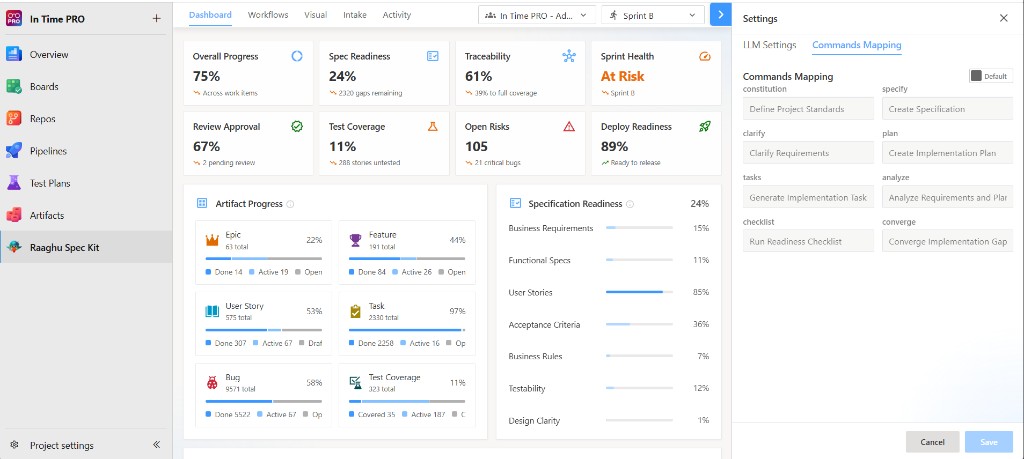
Open Settings from the Spec Kit project hub (hamburger menu). Organization admins and Project Administrators can open this dialog for the current project. Regular members do not see Settings.
| Tab |
What you configure |
| LLM Settings |
Project LLM On/Off and project BYOK configs (provider, API key, model, endpoint, expiration — 7 / 30 / 60 / 90 days, a custom date, or no expiration). Choose a catalog model or enter a custom model name. Raaghu AI toggle, hosted model, credit balance, and top up credits. |
| Commands Mapping |
Switch command labels between Spec Kit (speckit.* IDs) and Default (friendly names). Labels are read-only. |
Organization-wide LLM connections, billing, seats, and license keys stay in Organization Settings → Raaghu Spec Kit (organization-admin only).
My Usage
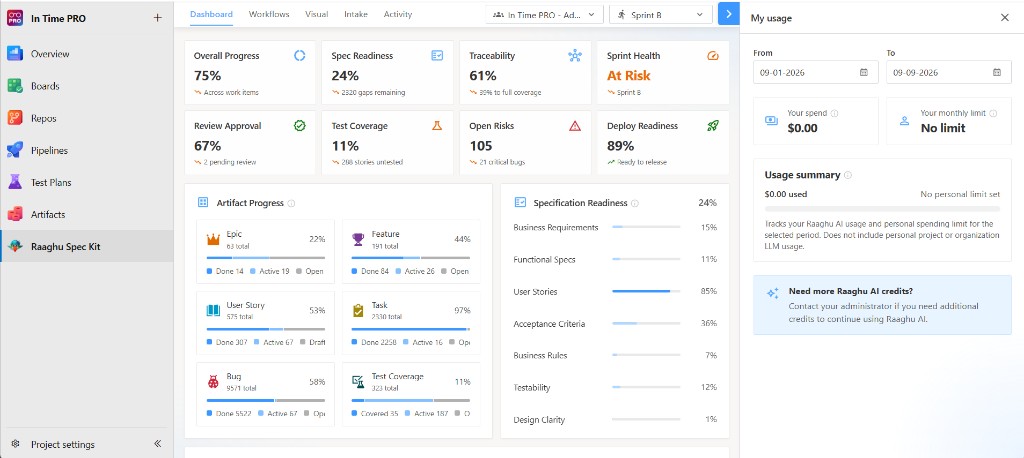
Track your personal AI spend from the extension header:
- Spend for a selected date range
- Your monthly limit (set by an organization admin, or no limit)
- Clear guidance when you need a higher limit
From Azure Boards or Queries, open a work item’s context menu → Raaghu to run AI actions without leaving the board.
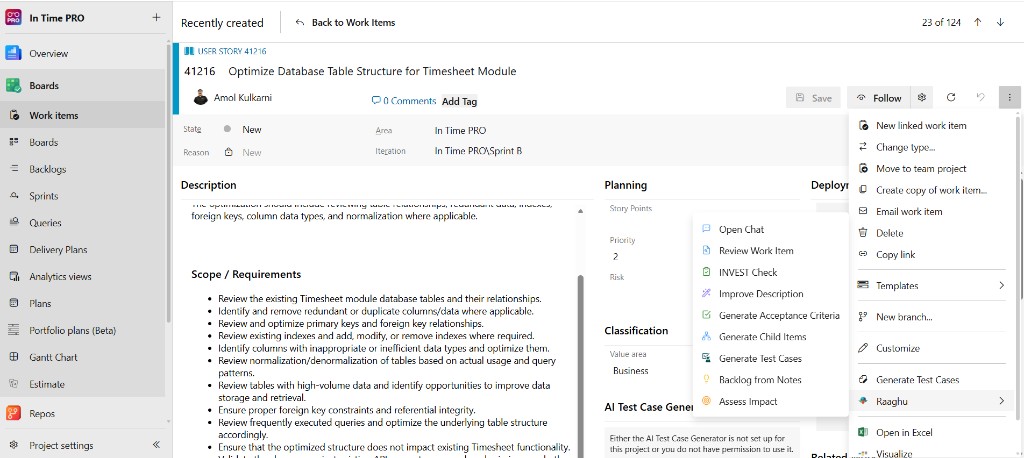
| Action |
What it does |
| Open Chat |
Ask questions about the work item |
| Review Work Item |
Readiness report with gaps, risks, and next steps |
| INVEST Check |
Type-aware INVEST scoring |
| Improve Description |
Reviewable rewrite that preserves meaning |
| Generate Acceptance Criteria |
Draft testable criteria, then Save changes to Azure DevOps |
| Generate Child Items |
Suggest next-level children for your process template |
| Generate Test Cases |
Suggest Gherkin or step-based test cases to create in Azure DevOps |
| Backlog from Notes |
Paste or upload notes (.txt / .md) and generate child work items to review and create |
| Assess Impact |
Describe a change and get an impact report across linked items (links are context only) |
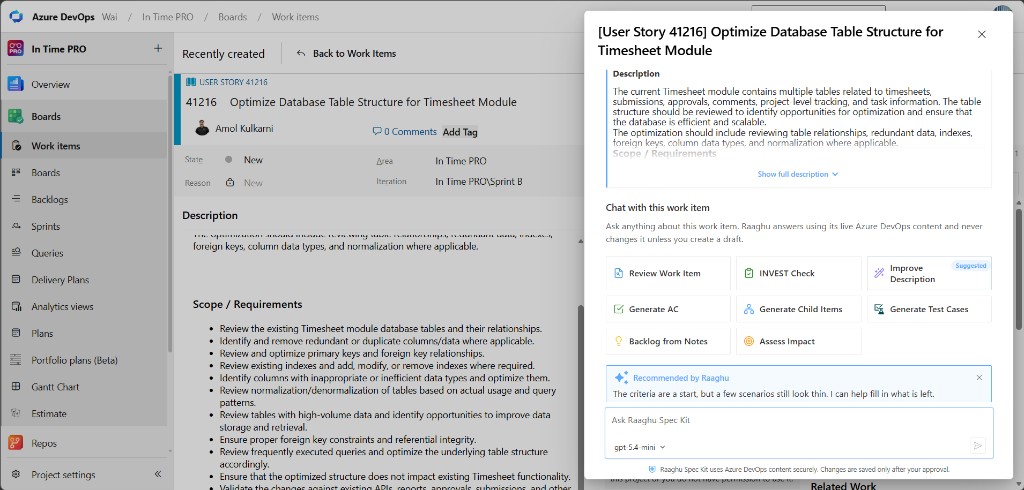
The side panel shows the work item context and quick actions. Recommended by Raaghu appears only when there are concrete gaps (for example a thin description or missing/thin acceptance criteria). When the work item looks ready, no recommendation cards are shown. Completed actions stay excluded until you start a New conversation. A quick-action chip can show a Suggested badge when gaps remain. Refine flows use Preview / Edit / Diff — nothing is written to Azure DevOps until you confirm. Multi-select supports Review Work Item, INVEST Check, and Generate Acceptance Criteria.
Organization Settings Hub
Organization admins manage seats, access requests, billing, AI credits, LLM connections, and usage from:
Azure DevOps → Organization Settings → Raaghu Spec Kit
(On Azure DevOps Server, open the same hub from Collection Settings.)
| Tab |
Purpose |
| Subscription |
Plan, seats, billing, and credit top-ups |
| Users |
Approve access requests, assign or revoke seats |
| Configurations |
Org-wide AI provider connections and per-project permissions |
| License Keys |
Activate a standalone license key |
| Raaghu AI Credits |
Credit balance, spending limits, and usage analytics |
Configurations
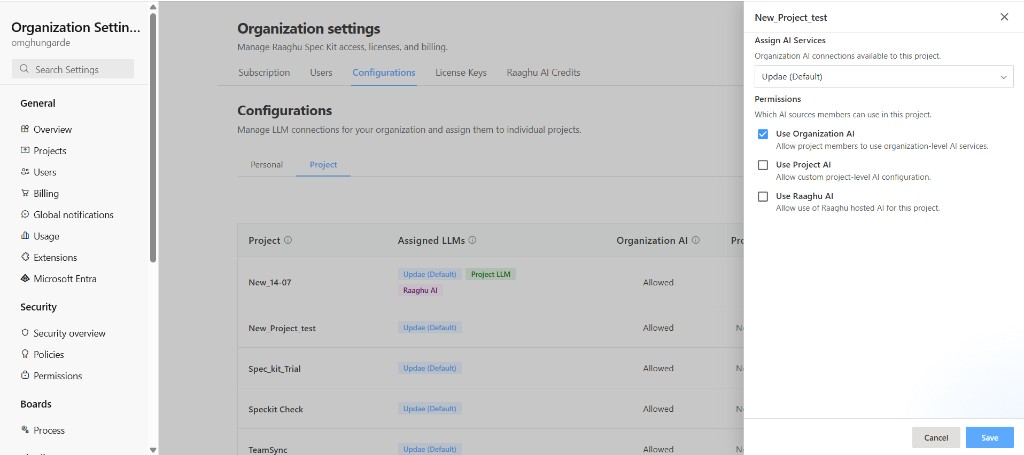
Manage organization-wide AI provider connections and assign them to projects.
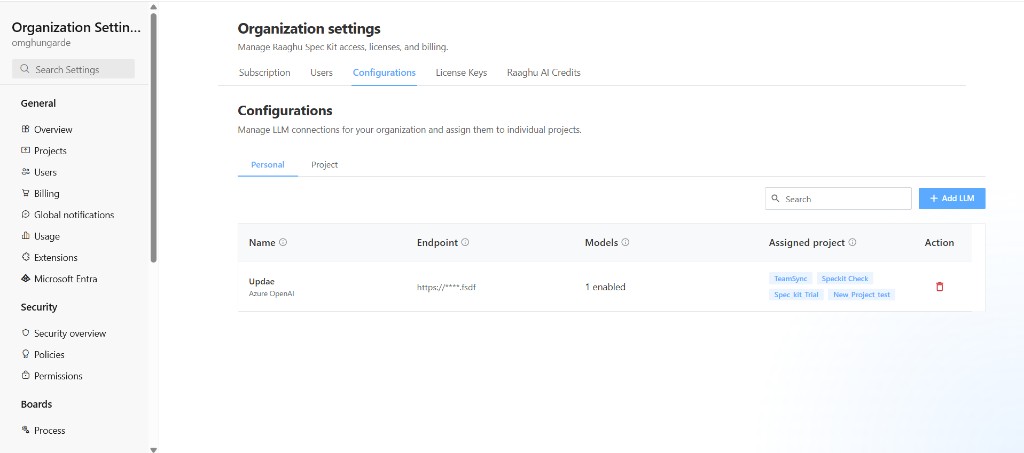
Organization sub-tab — create shared connections (+ Add LLM) and review Name, Endpoint, Models, and Assigned project.
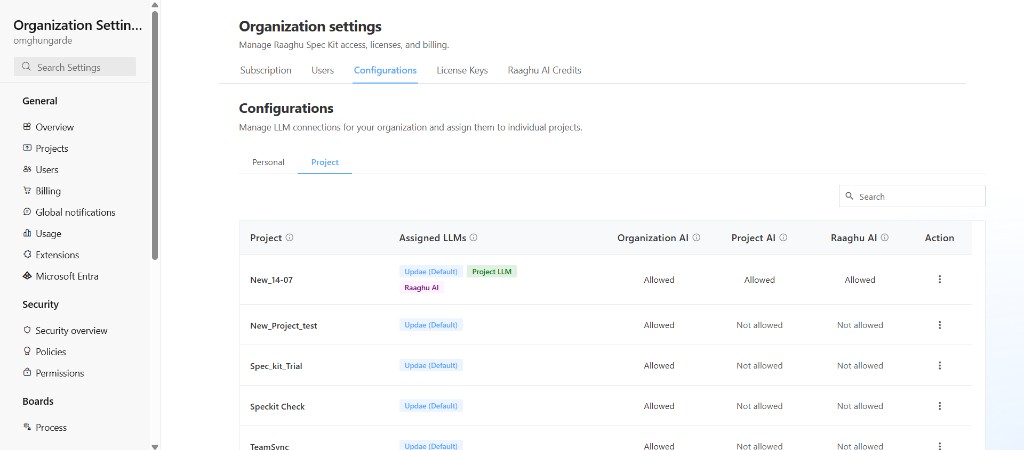
Project sub-tab — for each Azure DevOps project, review assigned LLMs and AI permission status. Open a project to assign organization connections and set permissions in the side panel.
| Column |
Description |
| Assigned LLMs |
Org connections assigned to the project, plus badges such as Project LLM or Raaghu AI when those sources are allowed |
| Organization Key |
Whether organization-level AI is Allowed / Not allowed |
| Project Key |
Whether project-level BYOK is allowed |
| Raaghu AI |
Whether Raaghu-hosted AI is allowed |
In the side panel, use Assign AI Services and toggle Use Organization Key, Use Project Key, and Use Raaghu AI, then Save.
Subscription
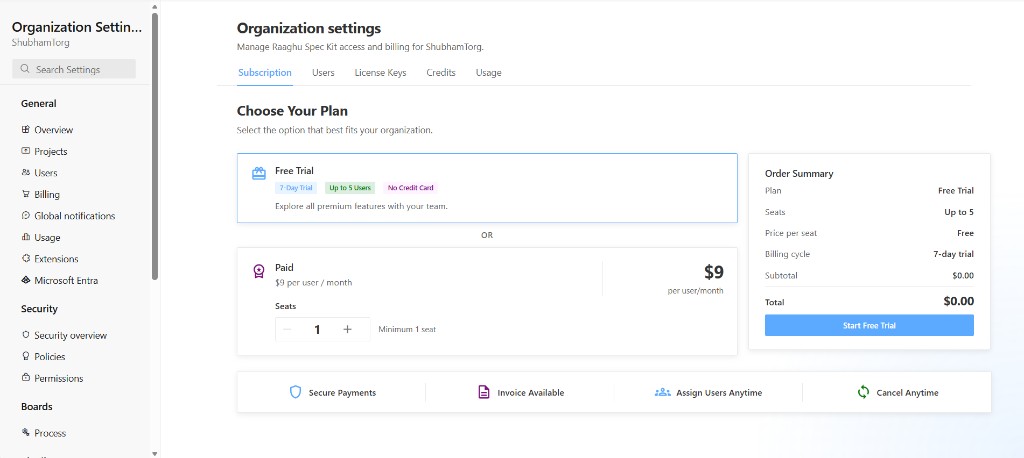
Subscribe to the Professional Plan at $9 USD / seat / month, then manage seats and billing in one place.
Getting started (eligible new organizations)
Tenant admins see Choose Your Plan when the organization is trial-eligible. The trial is started in Spec Kit (Raaghu entitlement). Microsoft Marketplace does not process payment for this BYOL extension.
- Select Free Trial or Paid
- For Free Trial — click Start Free Trial (up to 5 seats, no credit card required)
- For Paid — set seats with − / +, then click Subscribe Now and complete Stripe checkout. At Stripe checkout, you can enter a promotion code if one was issued to you.
- Assign seats to team members on the Users tab
If the organization is not trial-eligible, use the paid-only path (Subscribe for $…/month) or activate a key on License Keys.
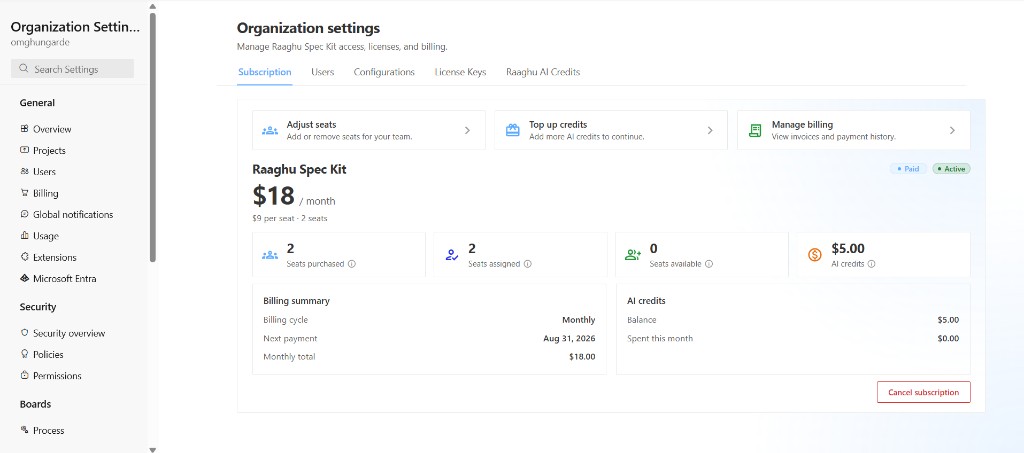
After you subscribe (paid, trial, or license key), you can:
| Action |
Description |
| Adjust Seats |
Add or remove seats on paid card billing. Seat reductions take effect at the end of the billing period and can be undone. During a free trial, seat count is fixed at 5 and cannot be changed here (contact support@raaghu.ai if needed). With a license key, seat count is fixed by the key. |
| Top up Raaghu AI credits |
Add Raaghu AI credits (preset or custom amount between $5 and $10,000). Credits do not expire. |
| Manage Billing |
Open the Stripe portal for invoices, payment methods, and payment history. During a free trial, use this when you are ready to upgrade to paid. |
| Cancel / Undo |
Cancel at period end, or undo cancellation before it takes effect. Cancel is hidden while the organization is on a free trial. |
You also see seats purchased / assigned / available and AI credit balance vs spend.
- Paid (card billing): Billing summary shows billing cycle, next payment date, and monthly total. Plan badge: Paid.
- Free trial: Plan badge shows Free trial. The summary panel is Trial summary (plan, Trial ends on, seats) instead of next payment / monthly total.
- License key: Plan badge shows License key instead of Paid, and Billing summary shows only Expires on.
Users
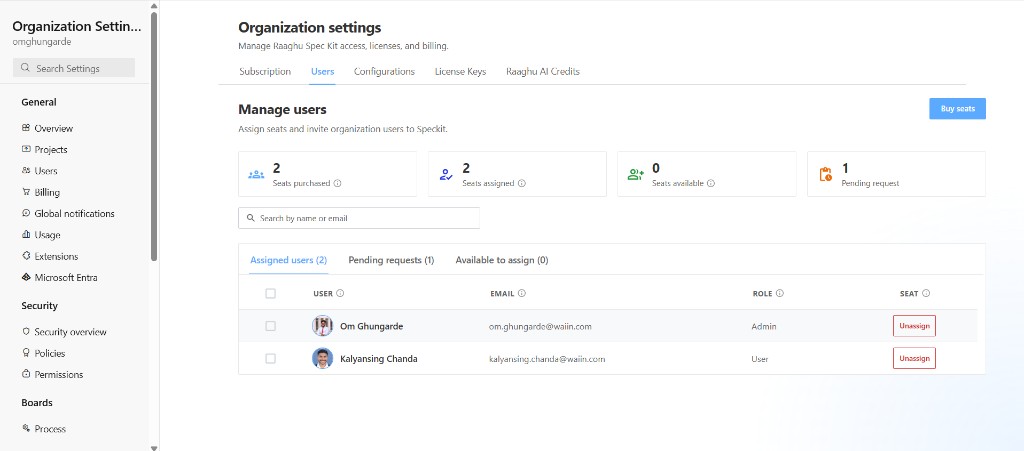
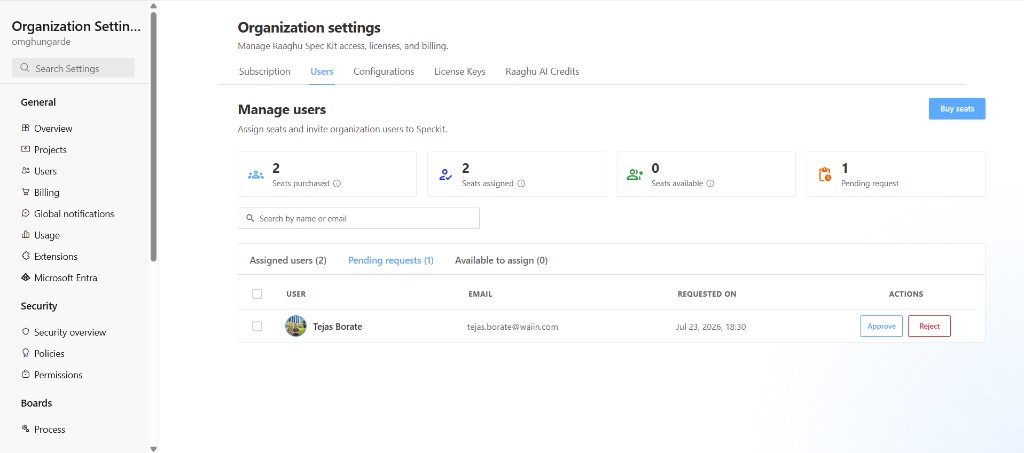
Approve first-time access requests and assign seats from Manage users.
| Capability |
Description |
| Seat summary |
Purchased, assigned, available, and pending-request counts at a glance |
| Search |
Find people by name or email across Users lists |
| Pending requests |
Review first-time users — Approve, Reject, or select multiple and Approve selected |
| Assign |
Assign seats one-by-one or in bulk from Available to assign |
| Unassign / Revoke |
Remove seats from Assigned users individually or with Unassign selected |
| Roles |
See whether each person is an Admin or Member |
Sub-tabs: Assigned users, Pending requests, and Available to assign. Use Buy seats when you need more capacity (disabled during a free trial).
Important: Approving an access request is not enough. Members also need an assigned seat to use Spec Kit — even when the organization is subscribed, on trial, or using a license key.
License Keys
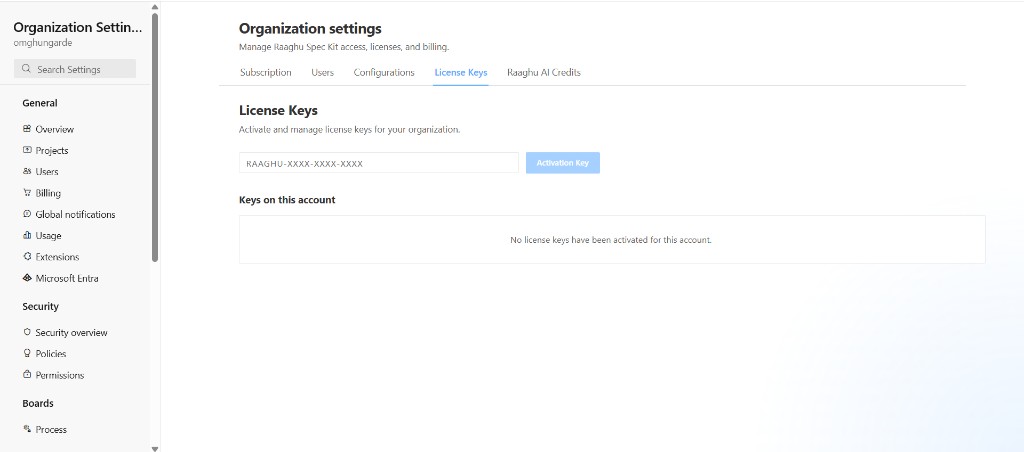
Activate and manage license keys for your organization — no Stripe checkout required.
Activate a key
- Open License Keys
- Enter the key (format
RAAGHU-XXXX-XXXX-XXXX)
- Click Activation Key — Spec Kit validates first and shows a preview (plan, type, validity)
- Click Confirm & activate to redeem, or Cancel to go back without activating
Keys on this account lists active entitlements with:
| Column |
Description |
| Plan |
Plan tier and seat count (e.g. SpecKit · 1 seats) |
| Status |
Active, Expiring (≤30 days left), or Expired |
| Expires |
Relative expiry (e.g. in 30 days) or the end date |
Empty state: "No license keys have been activated for this account."
After activation, billing method becomes License key. On Subscription, the plan badge shows License key, and Billing summary shows only Expires on.
Raaghu AI Credits
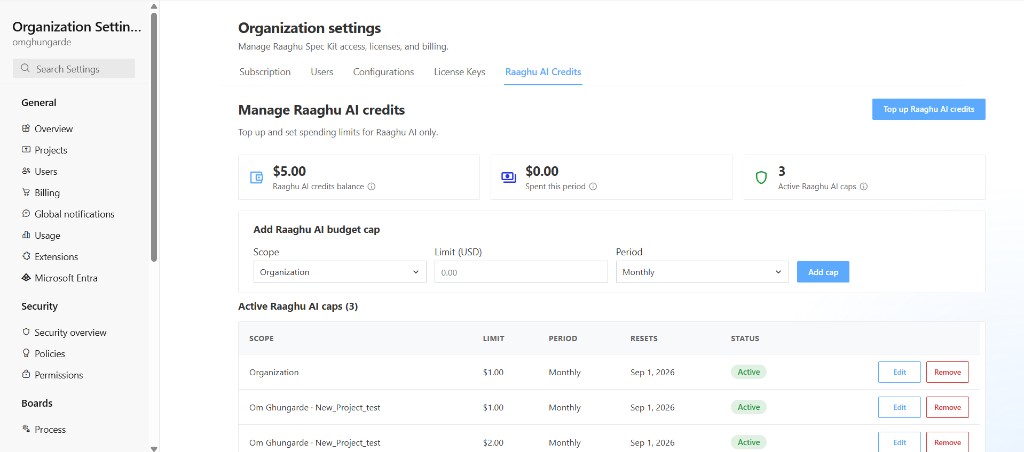
Use Manage Raaghu AI credits to top up and set spending limits for Raaghu AI only. Open Top up Raaghu AI credits from this tab (you can also top up from Subscription).
| Metric |
Meaning |
| Raaghu AI credits balance |
Credits available for Raaghu AI |
| Spent this period |
How much has been used |
| Active Raaghu AI caps |
How many spending limits are in place |
Add Raaghu AI budget cap
| Field |
Options |
| Scope |
Organization · Project · User in a project |
| Limit (USD) |
Spending ceiling in USD |
| Period |
Monthly or Lifetime |
Click Add cap. Review Active Raaghu AI caps (scope, limit, period, resets, status) and Edit or Remove anytime.
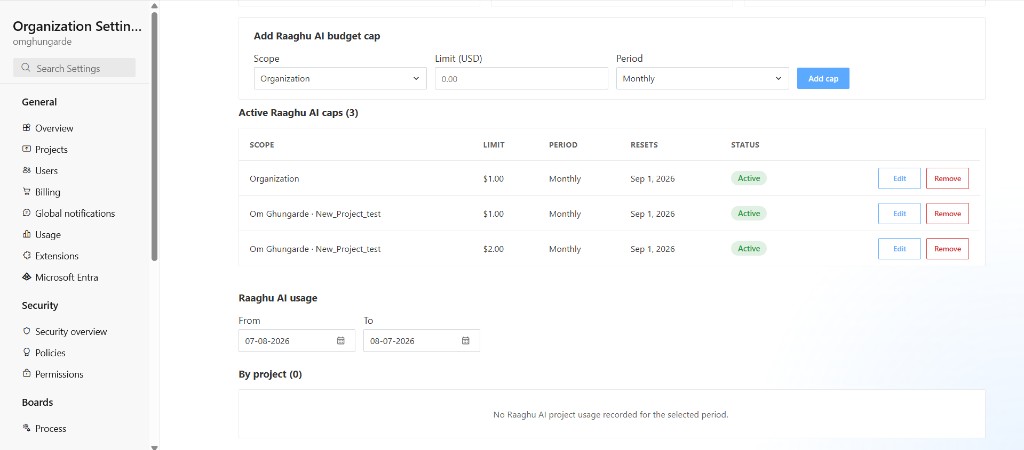
Raaghu AI usage (on the same tab) shows where credits are going:
| Feature |
Description |
| Date range |
Filter analytics with From / To dates |
| By project |
Expand a project to see each member’s spend and credit limit |
Admins see organization-wide project and member spend. Other members see Your spend by project for the selected period under My Usage in the extension.
Spec Kit Workflow
Raaghu Spec Kit follows a structured specification workflow using slash commands:
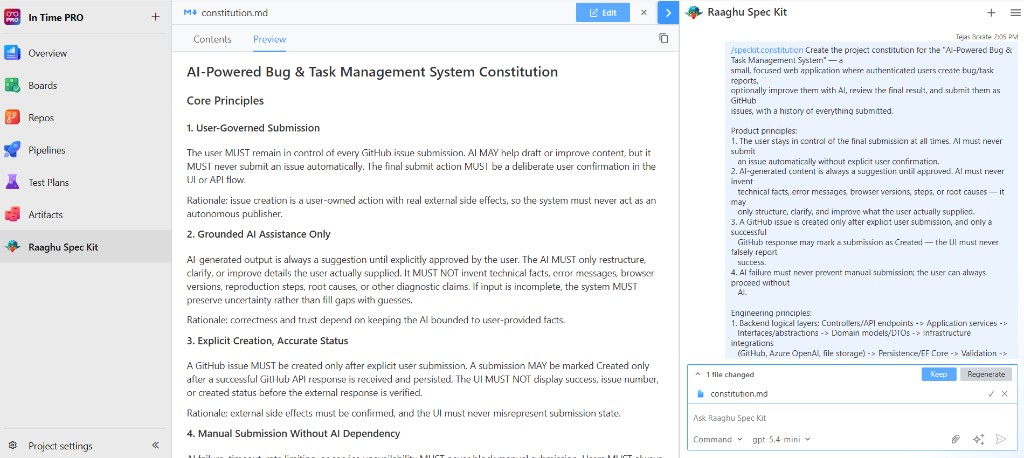
Define Project Standards (/speckit.constitution)
Establish constitutional principles. The AI generates a constitution that guides later specs and keeps the project consistent.
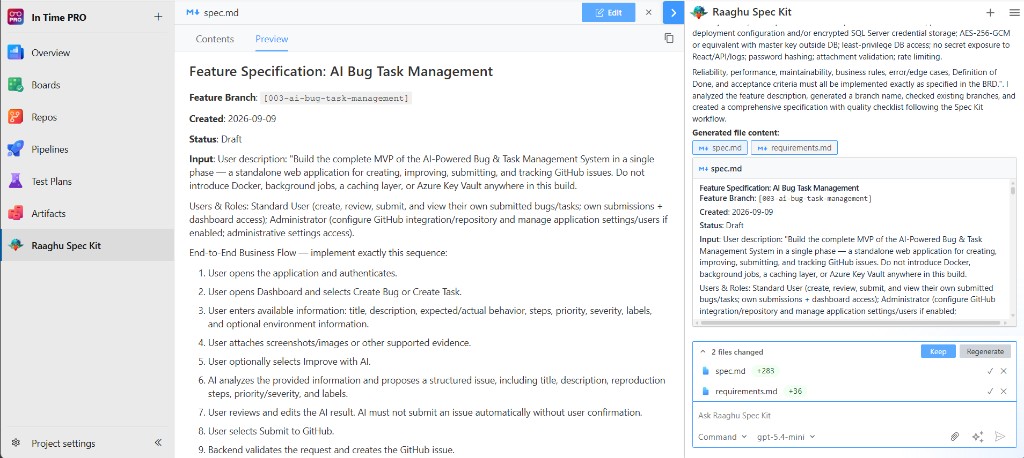
Create Specification (/speckit.specify)
Create the next numbered feature specification by default — structured sections, acceptance criteria, and a quality checklist. Updates an existing spec only when you explicitly ask. Later commands stay on that feature until you switch.
Clarify Requirements (/speckit.clarify)
Identify gaps and ambiguities, ask targeted clarification questions, and fold answers back into the specification.
Create Implementation Plan (/speckit.plan)
Generate delivery and technical plans — including research, data model, quickstart, and API contract artifacts where applicable.
Generate Implementation Tasks (/speckit.tasks)
Produce phase-based task breakdowns with task IDs, parallel markers, and user-story links — ready to sync with Azure Boards.
Analyze Requirements and Plan (/speckit.analyze)
Cross-check specs, plans, and tasks for duplication, ambiguity, underspecification, and coverage gaps. Findings are severity-rated (Critical, High, Medium, Low) with remediation guidance.
Run Readiness Checklist (/speckit.checklist)
Generate domain-specific quality checklists (UX, API, Security, and more) — “unit tests for requirements.”
Converge Implementation (/speckit.converge)
After developers push code, assess the selected repository branch against the feature’s wiki artifacts (spec, plan, tasks, constitution). Remaining work is appended to tasks.md. Converge does not generate or commit application code.
File Management
- Generate files — AI creates structured Spec Kit artifacts (
spec, plan, tasks, and related pages)
- Edit view — review AI-generated changes before saving
- Keep — save generated content to the wiki
- Attach context — attach wiki pages, repo files, or work items to the conversation (up to 4 files)
Chat History
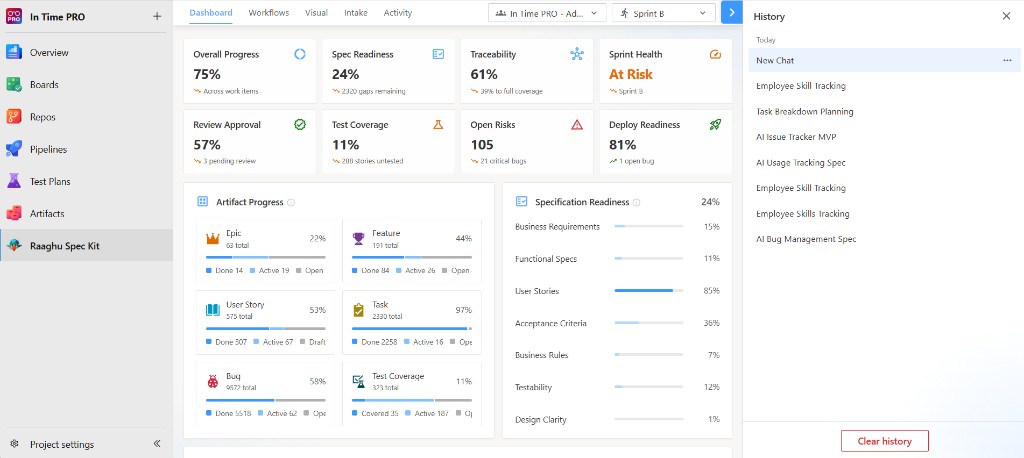
Persistent, project-scoped chat sessions let you resume any conversation:
- Browse sessions — all past conversations for the current project
- Resume anytime — reopen with full message context
- Rename sessions — descriptive names for easy navigation
- Delete sessions — remove one session or clear history
- New chat — start fresh without losing prior sessions
Pricing & Trial
| Item |
Details |
| Plan |
Professional — $9 USD per seat / month (BYOL — billed by Raaghu via Stripe or license key, not Microsoft) |
| Trial |
7 days free for eligible new orgs — start in-product: Choose Your Plan → Start Free Trial (up to 5 seats, no card required) |
| Manage |
Organization Settings → Raaghu Spec Kit |
After the trial: subscribe on Subscription, approve pending users and assign seats on Users, configure Configurations as needed, then manage credits and spend on Raaghu AI Credits. Organizations can also activate a key on License Keys instead of Stripe checkout.
See the Pricing tab on this Marketplace listing for full details.
Created using Raaghu Design System leveraging Spec Kit.
©2026 Wai Technologies. All rights reserved.

