An Azure DevOps extension that integrates with both Fortify Software Security Center (SSC) and Fortify on Demand (FoD) to display security scan results directly in your build pipelines.
Features
- ✅ Multi-Provider Support: Works with both Fortify SSC (on-premise) and Fortify on Demand (SaaS)
- ✅ Unified Reports: Consistent vulnerability reporting across both platforms
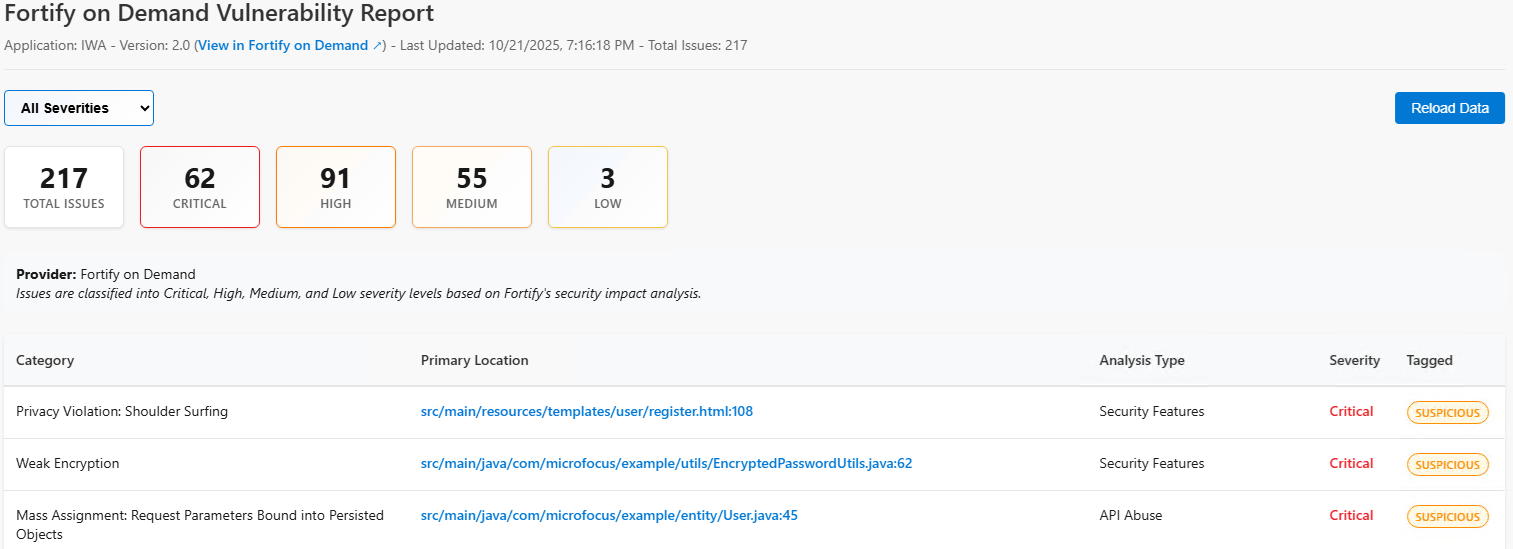
- ✅ External Links: Direct links to issues in your Fortify provider (with corrected URL format)
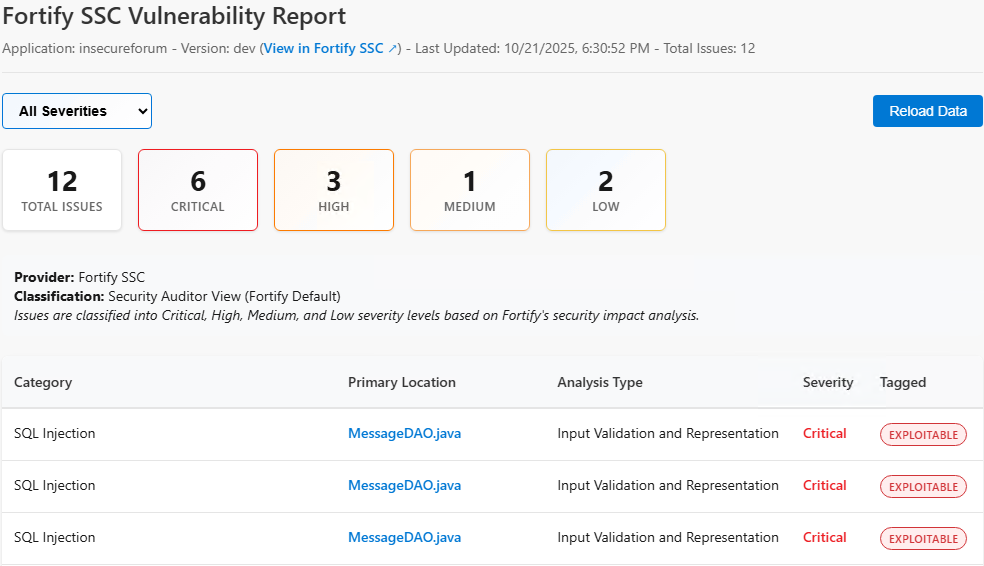
- ✅ Filtering & Sorting: Interactive report filtering by severity levels
- ✅ FoD Region Selection: Dropdown with 5 global FoD regions (AMS, EMEA, APAC, SGP, FedRAMP)
- ✅ Accurate File Paths: Correct file location display with proper line number formatting
- ✅ Backward Compatible: Existing SSC configurations work without changes
Supported Providers
Fortify Software Security Center (SSC)
- On-premise installations
- CI Token authentication
- Security Auditor View integration
Fortify on Demand (FoD)
- Cloud-based SaaS solution
- API Key/Secret authentication with OAuth2
- 5 Global Regions: AMS (America), EMEA (Europe), APAC (Asia-Pacific), SGP (Singapore), FedRAMP
- Native severity classifications
Quick Start
For Fortify SSC Users
- task: FortifyReport@17
  inputs:
    sscUrl: 'https://your-ssc-instance.com'
    ciToken: '$(FORTIFY_CI_TOKEN)'
    appName: 'MyApplication'
    appVersion: 'v1.0.0'
For Fortify on Demand Users
- task: FortifyReport@17
  inputs:
    providerType: 'fod'
    fodUrl: 'https://api.emea.fortify.com'  # Select from: ams, emea, apac, sgp, fed
    fodApiKey: '$(FORTIFY_API_KEY)'
    fodApiSecret: '$(FORTIFY_API_SECRET)'
    appName: 'MyApplication'
    appVersion: 'Release 1.0'
Report Examples
Fortify on Demand Report
Fortify SSC Report
Configuration Details
FoD Region Selection
When using Fortify on Demand, select from these predefined regions:
You can also enter a custom URL if needed.
Common Task Parameters
| Parameter |
Required |
Description |
appName |
✅ Yes |
Application name (must match exactly in provider) |
appVersion |
✅ Yes |
Version/Release name (must match exactly in provider) |
maxIssues |
No |
Maximum issues to fetch (default: 10,000) |
skipValidation |
No |
Skip connection validation (default: false) |
Security & Best Practices
- Store sensitive tokens in Azure DevOps secure variables
- Use Azure Key Vault integration for enhanced security
- Regular token rotation recommended
- SSL/TLS encryption for all API communications
- API credentials are never logged or exposed in build output
Support & Troubleshooting
For Fortify on Demand:
- Verify your API key and secret have
api-tenant scope
- Check that your tenant allows API access
- Ensure application name and release name match exactly (case-sensitive)
- Use the test-fod-integration.js script for diagnostics
For Fortify SSC:
- Ensure CI token has appropriate permissions in SSC
- Verify application and version names match exactly
- Check SSC instance URL is accessible from build agent
License & Disclaimer
⚠️ This is an open-source project licensed under MIT License and is NOT officially developed, maintained, or supported by OpenText. This is a community-driven extension created as an independent project.

